Anglo-Saxon (Northumbrian) Runestones In Ireland Showing Transition to Christianity
Irish Christian Cross With Druid Runic Text (750 CE)
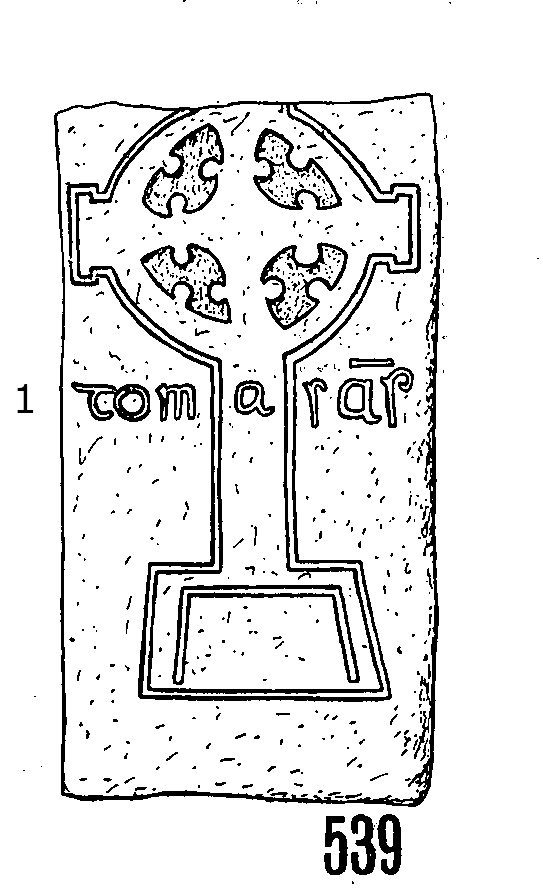
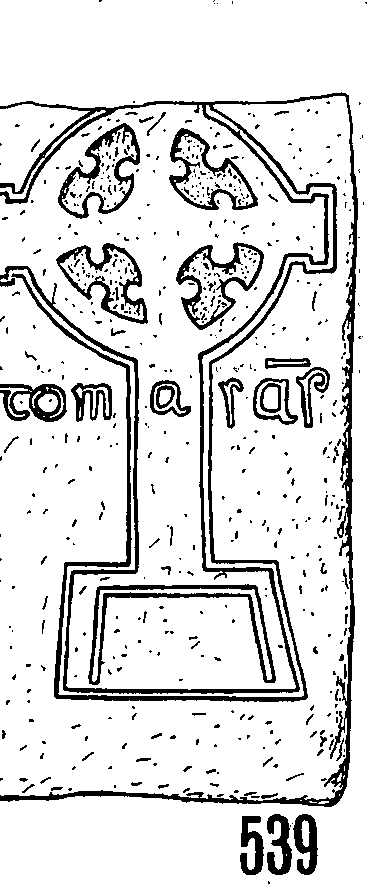
Kilbrecan (Onaght) Stone 539 - County of Galway, Ireland, Barony of Moycullen
Background
(March 25, 2026) Macalister reports that this stone was 1 of 8 stones found in the cemetery at the so-called "Seven Churches " near the W. end of the island.
The stone's dimensions are 2' 8" x 1' 3" 0' 4"
References
Macalister, R A Stewart. 1945. Corpus Inscriptionum Insularum Celticarum Volume 2, page 7 with plate in the appendix. Online at: https://www.google.com/books/edition/Corpus_Inscriptionum_Insularum_Celticaru/4jgaAAAAYAAJ?hl=en
Translation in Druid Akkadian (Northern Text 207)
(read left to right. Capital letters on object. Small letters are inferred Inner vowels. Vowels are italic bold, Dual use letters are E/H, I/Y, U/W, and '/A in which vowel appears at beginning of words except for Yahu which is keeping its traditional Hebrew transliteration)
Runic letter style is Saxon from letter chart: North European Runic Lineage
Dictionary used: Latest Runic Akkadian dictionary
Ta'u Mu A Gi AG
In English
The Pasture's fluids will affect this energy's anger
Comment: The Pasture was the starry night sky which defined fate so this text is saying that fate will anger the Christian god.
Previously Attempted Translation
TOMAS AP
The "AP" was assumed to be an abbreviation for "Apostle" so the text would translate as "Thomas the apostle" although why the letters were broken up as they are was never explained.
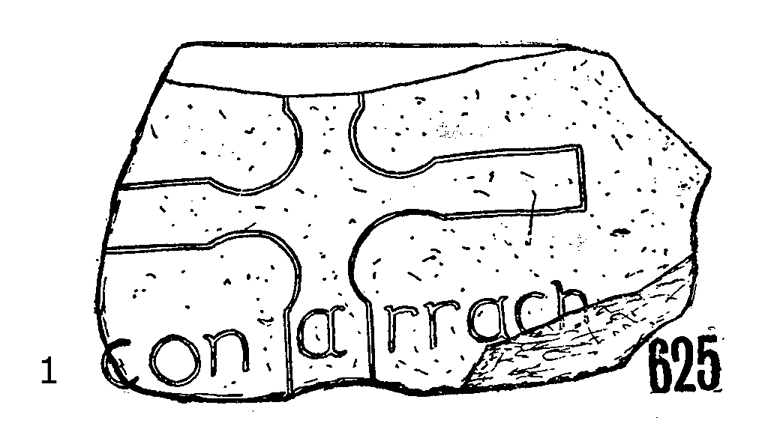
Clonmacnois Runestone 625 - Barony of Garrycastle, Ireland (700 CE)
Background
(March 29, 2026) Macalister reports that this stone was one of hundreds of fragments left behind after the 1552 destruction of this monastery by English soldiers garrisoned at Athlone during English King Henry VIII's war against Catholic monasteries after he split with Rome.
This site was originally established as a monastery by St. Ciarán on the banks of the River Shannon in the 700's. The monastery flourished and became a great seat of learning, a University of its time with students from all over Europe. Ireland's move from a monastic framework to a diocesan one in the 1100's during the imposition of Norman control greatly diminished it wealth but not before a small Cathedral had been built. Still it contained a large amount more ancient stone architecture including 2 round Towers, 3 high crosses, 9 Churches and over 700 Early Christian grave slabs.
It measures 28 x 18 x 3 inches
Ancient Christian parchments recorded that Irish monks traveled to Northumbria to convert the Pagans. Apparently this was in response to Northumbrian Druids coming over to Ireland. Northumbria was ruled by Anglo-Saxon kings between 654 and 1066 CE.
This stone was likely somewhat preserved because it was used in the construction of one of the many monastic buildings.
References
Macalister, R A Stewart. 1945. Corpus Inscriptionum Insularum Celticarum Volume 2, pages 43 and 45 with plate in the appendix. Online at: https://www.google.com/books/edition/Corpus_Inscriptionum_Insularum_Celticaru/4jgaAAAAYAAJ?hl=en
Translation in Druid Akkadian (Northern Text 209)
(read left to right. Capital letters on object. Small letters are inferred Inner vowels. Vowels are italic bold, Dual use letters are E/H, I/Y, U/W, and '/A in which vowel appears at beginning of words except for Yahu which is keeping its traditional Hebrew transliteration)
Runic letter style is Anglo-Saxon from letter chart: North European Runic Lineage
Dictionary used: Latest Runic Akkadian dictionary
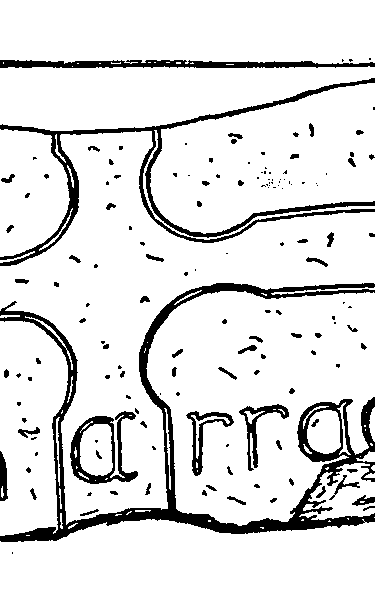
Ka'u Nu Su Gi. Gi SaKu Ḫu
In English
Prodding will reveal Su's energy. Energy will pound Hu.
Comment: Su is the Druid dark new moon god who is the power behind astrology-magic. This text is claiming his energy will make the life powers represented by the sun and storm god, Hu, conform to the natural order.
Previously Attempted Translation
CONASSACH
No English translation provided
The symbol is likely the archaic Druid letter "T" meaning "astrology-magic." It is an equilateral cross in contrast to the Christian cross which has a long lower arm.
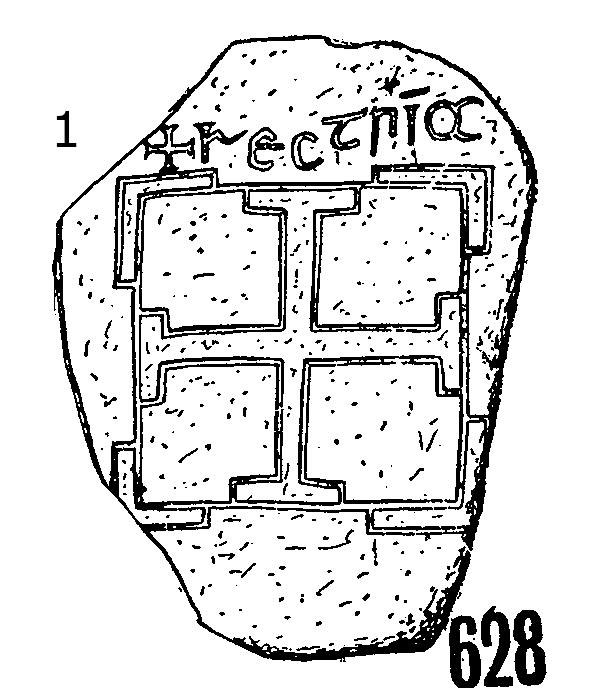
Clonmacnois Runestone 628 - Barony of Garrycastle, Ireland (700 CE)
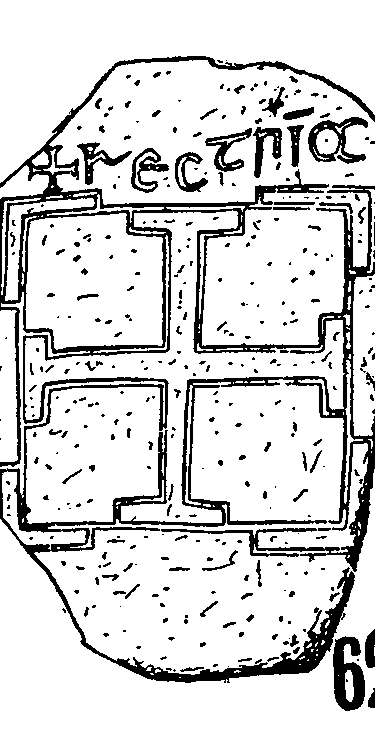
Background
(March 30, 2026) Macalister reports that this stone was one of hundreds of fragments left behind after the 1552 destruction of this monastery by English soldiers garrisoned at Athlone during English King Henry VIII's war against Catholic monasteries after he split with Rome.
This site was originally established as a monastery by St. Ciarán on the banks of the River Shannon in the 700's. The monastery flourished and became a great seat of learning, a University of its time with students from all over Europe. Ireland's move from a monastic framework to a diocesan one in the 1100's during the imposition of Norman control greatly diminished it wealth but not before a small Cathedral had been built. Still it contained a large amount more ancient stone architecture including 2 round Towers, 3 high crosses, 9 Churches and over 700 Early Christian grave slabs.
It measures 22 x 15 1/2 x 2 3/4 inches
Ancient Christian parchments recorded that Irish monks traveled to Northumbria to convert the Pagans. Apparently this was in response to Northumbrian Druids coming over to Ireland. Northumbria was ruled by Anglo-Saxon kings between 654 and 1066 CE.
This stone was likely somewhat preserved because it was used in the construction of one of the many monastic buildings.
References
Macalister, R A Stewart. 1945. Corpus Inscriptionum Insularum Celticarum Volume 2, pages 43 and 46 with plate in the appendix. Online at: https://www.google.com/books/edition/Corpus_Inscriptionum_Insularum_Celticaru/4jgaAAAAYAAJ?hl=en
Translation in Druid Akkadian (Northern Text 210)
(read left to right. Capital letters on object. Small letters are inferred Inner vowels. Vowels are italic bold, Dual use letters are E/H, I/Y, U/W, and '/A in which vowel appears at beginning of words except for Yahu which is keeping its traditional Hebrew transliteration)
Runic letter style is Anglo-Saxon from letter chart: North European Runic Lineage
Dictionary used: Latest Runic Akkadian dictionary
Tu Gu EKu. Tu Nu ISu
In English
Astrology-magic will energize starvation. Astrology-magic will reveal the Goddess
Comment: Notice this text begins with the old style letter "T". The 3 Druid goddesses represented by the "Goddess" are Ayu, Selu/Selene, and Kate/Hekate. Christians came to associate the Goddess with fate and with their dualist religion, this was something evil. Ayu was the crescent moon goddess who edited the connections of the life network which distributed life powers to earth. Selu was the celestial light goddess representing the heavenly bodies. Kate was the goddess of the underworld where souls where stored after death and before birth in the process of reincarnation.
Previously Attempted Translation
RECTNlA
No English translation provided
The symbol is the archaic Druid letter "T" meaning "astrology-magic." It is an equilateral cross in contrast to the Christian cross which has a long lower arm.
© 2022-2026. By David D. Olmsted. All pages licensed under a Creative Commons Attribution-NonCommercial-ShareAlike 4.0 International Copyright. https://creativecommons.org/licenses/by-nc-sa/4.0/