English Words From Druid-Akkadian
Ultimately, all Western European Words Derive From Druid Akkadian, Indo-European, or Greek


Language Groups Of Europe
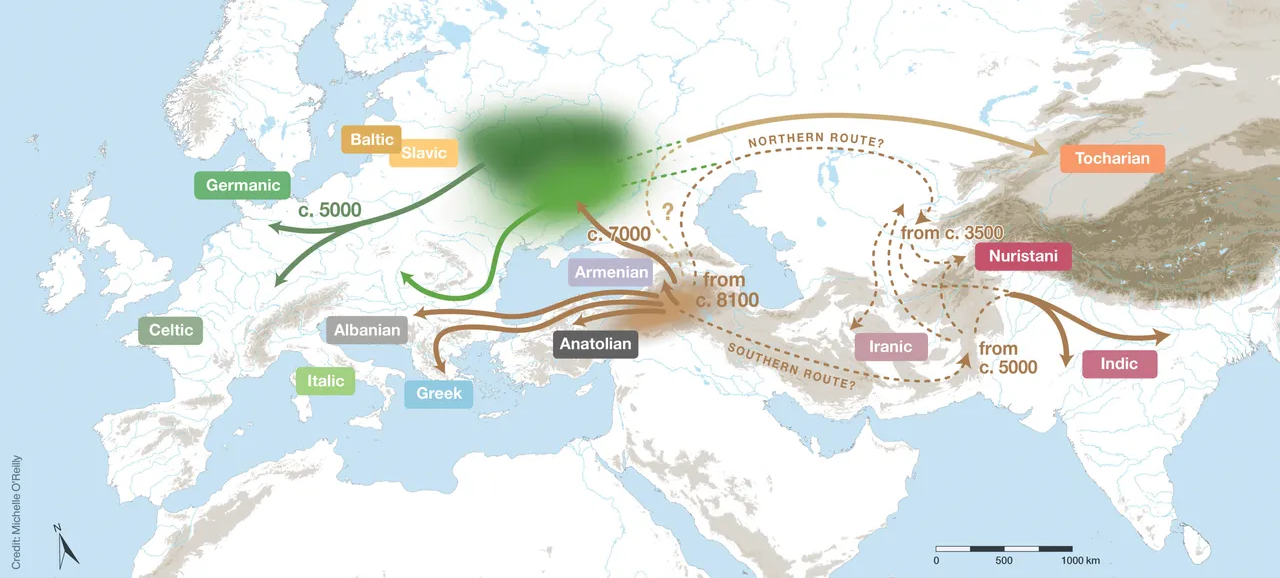
(January 28, 2026) This maps shows the modern language groups of central Europe. All of these have some words in common and in an amazing example of group-think, most existing academics assume all these common words derive from one source (Indo-European) despite evidence to the contrary.
Other ancient language centers besides Indo-European and Akkadian are:
Turkic: Step lands east of Indo-European homeland
Afro-Asian: Seems to have originated on the Green Sahara plains between 12,500 and 6,000 BCE. (found in Egyptian, Arabic)
Ob-Ugric : Forest lands north of the steppe. (Found in Hungarian, and Finnish)
Two Main Sources For European Words
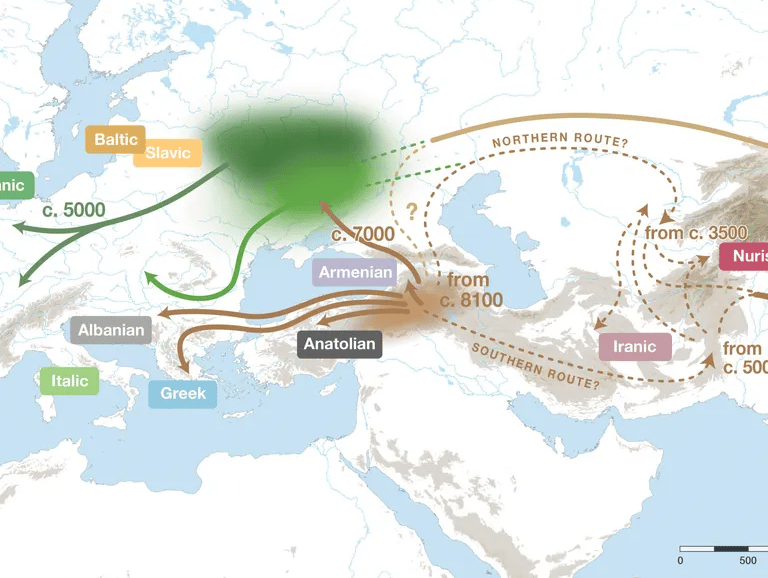
(January 24, 2026) Based on word similarity studies of modern languages, Europe has two word sources, one Akkadian from northern Mesopotamia and one Indo-European from the steppes. This map shows the dates of the Akkadian expansion but labels it incorrectly. Modern European languages are a mix and remix of Indo-European and Akkadian.
References
P. Heggarty, and all (Science, 28 July 2023) Language trees with sampled ancestors support a hybrid model for the origin of Indo-European languages. Online at:
https://dx.doi.org/10.1126/science.abg0818
Press Release from the the Max Plank Institute: New insights into the origin of the Indo-European languages. Online at:
https://www.mpg.de/20666229/0725-evan-origin-of-the-indo-european-languages-150495-x
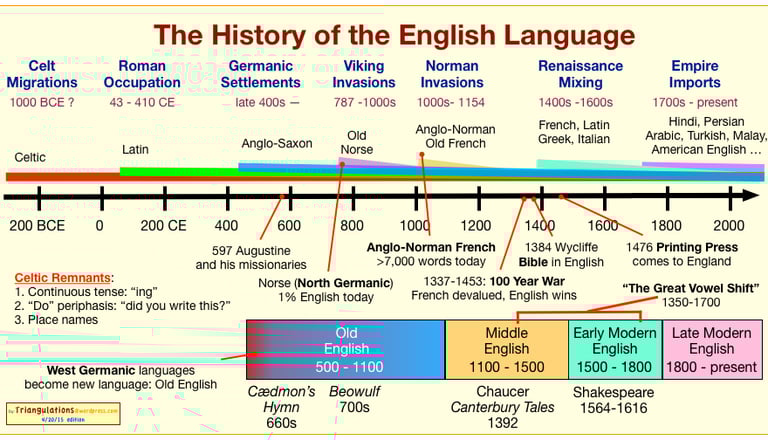


English Language History
(January 28, 2026) "Celtic Remnants" in the chart are either Druid Akkadian as found in the British runic texts or are the remnants of the early spoken language of Britain which would have been a mix of Indo-European and Druid Akkadian.
Linguistic Dad Jokes (Just to insure a complete education).
English is a weird language. The adjective for metal is metallic, but not so for iron, which is ironic.
Etymology is not Entomology, confusing the two bug me.
References
Traditional non-Akkadian etymologies from: Online Etymology Dictionary at https://www.etymonline.com/.
Celtic toponymy: https://en.wikipedia.org/wiki/Celtic_toponymy#cite_note-Lambert2-3
Image (2014) from Les Murry at: https://triangulations.wordpress.com/2014/09/30/the-history-of-the-english-language-a-diagram/
For a description of the problem of "Do support" see the section entitled "Supposed Celtic Syntax in English" at https://www.arrantpedantry.com/2014/12/01/celtic-and-the-history-of-the-english-language/
Alcohol Words
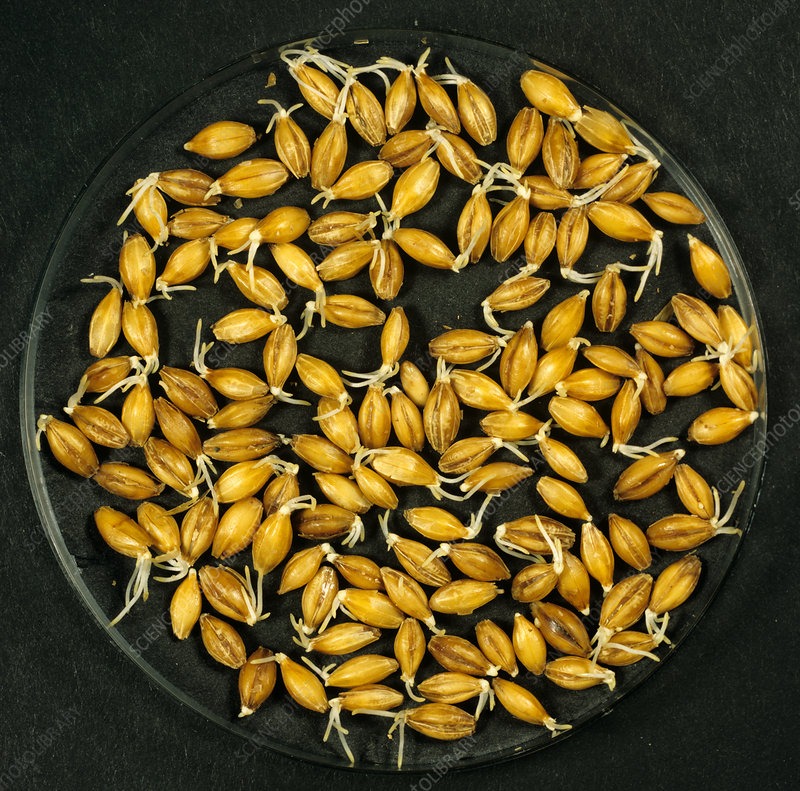
(January 24, 2026) Photo shows malting barley with its growing roots after soaking in water. These grains would then be dried for use in making beers. This growth starts breaking down the starch as a result of taking in oxygen and releasing carbon dioxide. Ancient people would have seen this soaking as a demonstration of magical power due to a ritual act.
"Beer" and other words relating to alcoholic drinks come from Druid Akkadian showing the agricultural legacy we derive from their culture.
Beer: Druid Akkadian phrase B.ER meaning the "Nourishment gathering-place or the "Nourishment harbor. via Middle English ber, from Old English beor "strong drink, beer, mead," cognate with Old Frisian biar, Middle Dutch and Dutch bier, Old High German bior, German Bier. This is a word having an ambiguous origin in traditional etymologies.
Wine: Druid Akkadian phrase W.IN meaning a "restriction from the Moon-eye." The Moon-eye is the dark new moon and eye pupil god Su who is the source of non-fate motion powers. He is associated with the shifting of fate from astrology-magic. So the behavioral changes from wine were seen as a temporary shift of one's fated personality. This is also seen in Old High German win, Old Norse vin, Dutch wijn, German wein, and an early borrowing from Latin vinum "wine," Arabic wain.
Ale: Druid Akkadian phrase A.L' meaning the "result of fate" via Old English ealu, Old Saxon alo, and Old Norse öl
Alcohol: Pure alcohol results from a distillation (reduction) of beer or wine which reduces the amount of liquid. This word is borrowed from Arabic as Al-cohol meaning "the Kohol" which is from the Druid Akkadian phrase K'.Ḫ'.L meaning "the prodding of an astrological-fate-owl's reduction." This word also tended to be spoken as "Kohl" which seems to have referred to any condensate but ultimately just meant the fine black powder used for eye-liner in ancient times. This later "kohl" was made from the soot from burning a pure oil which condensed on the side of a container. Purposely distilled alcohol made from condensing the boil-off was first used in medicines. Medieval doctor Paracelsus (1493-1541) used the word to refer to both the fine powder left after boiling-off a source liquid and any resultant condensed vapor.
Photo by Nigel Cattlin from https://www.sciencephoto.com/media/699250/view/malting-barley

Astrology Words
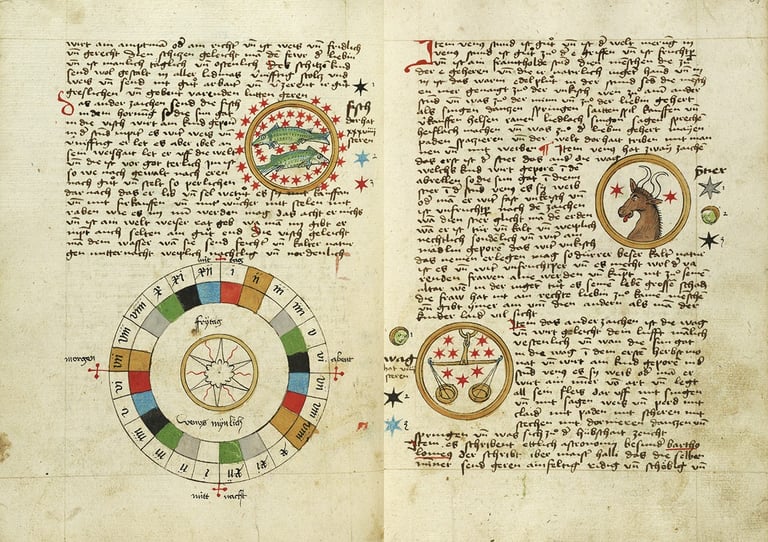
(January 30, 2026) Many English words associated with astrology and the shifting of fate come from Druid source words. Above are pages from a book on Astronomical Miscellany, written shortly after 1464 in Augsburg, Germany. The right page has illustrations for the constellation Pisces and Diagram for the hours on Friday (left). The left page has illustrations for the constellations of Libra and Taurus. Now at the J. Paul Getty Museum, Ms. Ludwig XII 8 (83.MO.137), fols. 56v-57. Image from: https://blogs.getty.edu/iris/written-in-the-stars-astronomy-and-astrology-in-medieval-manuscripts/
Bad: This is the Druid Akkadian word bādu meaning “evening.” In Akkadian this word is also an epithet for the night time astrological powers of fate which usually bring “bad” events. It has no apparent relatives in other languages outside of English and appears in English as soon as English started being written during the 1200s.
Cat: This is a phrase made from the Druid Akkadian phrase K.T meaning "involver of astrology-magic." Black cats would have especially fit this name.
Celestial: This is the Druid-Akkadian phrase K.EL.ES.T meaning "Involving the high-power's winds-of-fate with astrology-magic." Fate is determined by the movements of the heavenly bodies and astrology-magic seeks to shift that fate.
It is also found in Latin caelestis (heavenly, pertaining to the sky), and caelum (heaven, sky; abode of the gods) which is of uncertain origin. The Latin word is the source of what English calls a "ceiling" but what Romance languages call a sky such as French ciel, Spanish cielo, Italian cielo, and Portuguese céu.
Cinder, Sinter: This is the Druid Akkadian phrase Ṣ.IN.D.AR meaning "Activations from the Moon-eye's manifestations" where the Moon-Eye is the dark new moon god Su associated with astrology-magic. These are dark things left over from a change or transformation. It comes via Old English sinder meaning"dross of iron, slag," Old Norse sindr, Middle Low German and Middle Dutch sinder, Dutch sintel, Old High German sintar, German Sinter). This is also found in Latin as cinerem meaning "ashes," and Greek konis "dust." (Latin /c/ was initially pronounced like a /k/) and later French cendre meaning "ashes,"
Dipper, Big Dipper: This constellation comes from the Druid Akkadian words dappu and dippu meaning “dip” or “dipper” as a in ladle to get water. The constellation of the “Big Dipper” is not included in the Greek named constellations. The word comes into modern English via Old English dyppan "to plunge or immerse temporarily in water, to baptize by immersion," Old Norse deypa "to dip," Old Frisian depa, Dutch dopen, German taufen, and Gothic daupjan "to baptize")
Hollow, Hallow: This is from the Druid Akkadian phrase H'.L.L'.W meaning "astrological-owls reducing fate's curses." These owls were omens of change because they influenced the flow rate of life-powers through the life network. This owl connection is seen in the Middle English of the late 1300's in the word holowen meaning "to make hollow" as in "to hollow out the fate curses." The date of Oct. 31 is described as alle halwe eue or "all hallow's eve" by c. 1300 CE. Hence "Hallowing-out fate omens" became associated with "good omens" or "holy omens." Consequently the Christian church tried to coopt Halloween by associating it with the honoring holy persons or saints from 1590s onward.
Horoscope: This comes from the Druid Akkadian phrase ḪR.S.K'.P meaning "liver showing Su's prodding of the openings" where "openings" are paths through the life network allowing the flow of life-powers to earth. This prodding was done by the motion powers of the heavenly bodies which is represented by the dark new moon god Su. It is also found in the Latin words horoscopum/horoscopus as well as Greek hōroskopos
Juniper: This is the Druid Akkadian phrase IW.N.IP.ER.US via Latin iuniperus. In Akkadian it means "Redirecting fate-revelations by freeing-up the harbor's originator (Hu)" which means more loosely "Redirecting the fate powers using life powers." Hence juniper was used in magical rituals.
Muse: This is from the Druid Akkadian word mušu meaning "night powers." It is also found in Old French muser from the 1100's CE meaning "to ponder, dream, wonder; loiter, waste time."
Query, Quarry: This is the Druid Akkadian word qarȗ, qariu, qerȗ meaning "query, inquire, astrological inquiry." It is also found in Latin quaere “meaning to ask, to seek.” The word “inquire” is the Druid-Akkadian phrase IN.QR meaning “The Moon-eye's quiry” in which the Moon-Eye is the dark new moon and eye-pupil god Su who was the source of all non-fate motion powers. The words query and inquire were conflated around late Roman times.
Salt: From the Druid Akkadian words šalu, šelû, sala’u which are the names of the Druid goddess "Selu/Selene" (Selene means "powers of Selu") who represents the powers of fate. These powers were revealed by the motions of the heavenly bodies which were a cool white just like the mineral salt. The word is also found in Latin as sal. The northern Europeans added a /z/ to the end forming the meaning "Selu's emanations" which is seen in the Germanic word salz. From there it became Old English sealt, Old Saxon, Old Norse, Old Frisian, Gothic salt, and Dutch zout.
Emotions and Mental Activity Words
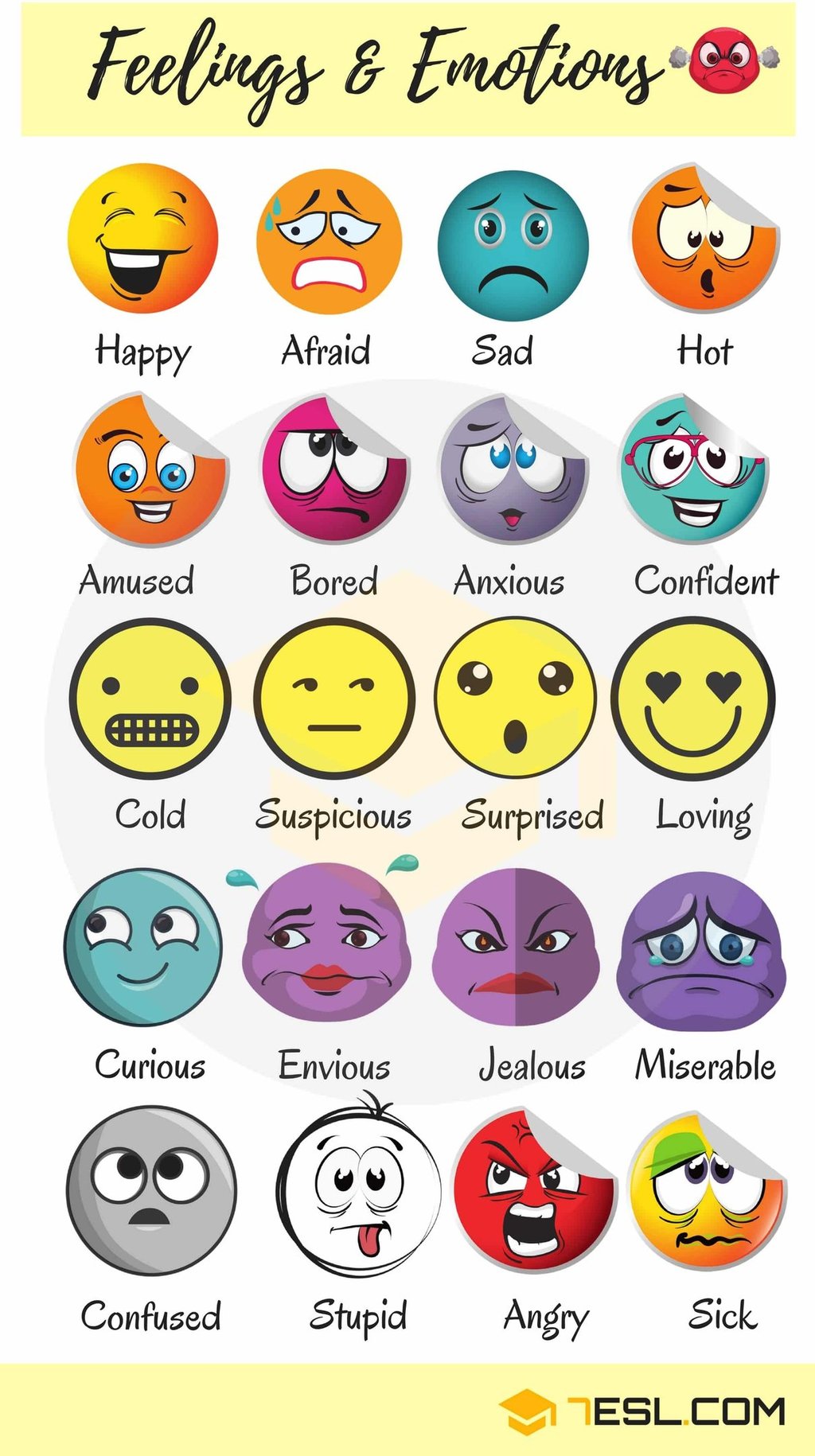
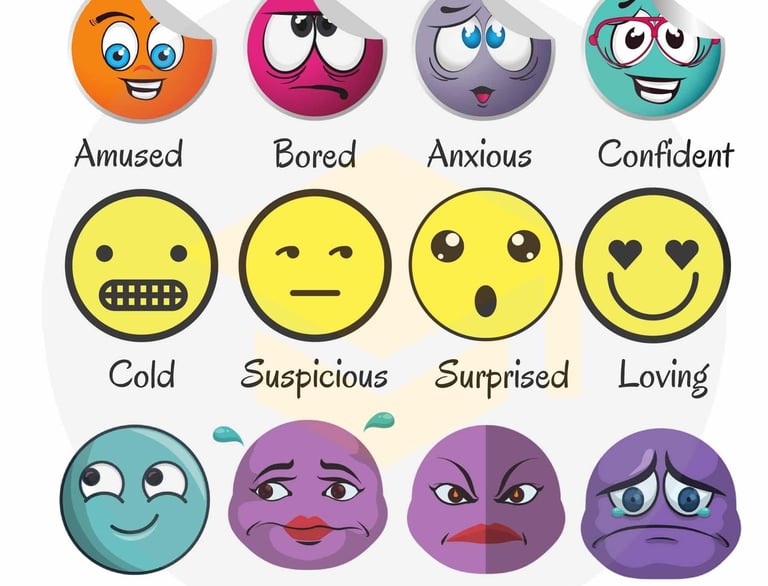
(January 30, 2026) Besides the motions of the heavenly bodies, emotions were believed to be another source of change powers on earth. Emotions were at the center of Druid emotion magic with the result that many emotional words derive from Druid Akkadian.
Ashes: Druid Akkadian words aṣu and ašu meaning “expelled thing.” It came to mean "ashes" as something expelled from burnt wood via Middle English asshe, Old English æsce, Old High German asca, German asche, Middle Dutch asche, Gothic azgo. The ash tree was the "expeller tree" due to its clumps of flying seeds. The creation of things were thought to be expulsions from the divine realm, hence, the ash tree was also the Yggdrasil creation tree of Norse myth. Christian Ash Wednesday is a time of expelling sinful behaviors prior to Easter.
Anger: Druid Akkadian word agȗ meaning "anger" via Old Norse angra and Old English enge.
Divine: Druid Akkadian word di’u meaning "divine" or "divine motion realm" as in all the spiritual powers behind all the change on earth. It is also seen in Latin divus "of a god”
Educate: This is from the Druid Akkadian phrase ED.K meaning "motivating involvement." It is also found in Latin educare.
Elevate: This is from the Druid Akkadian phrase EL.EW meaning "high-power attention-shift." It is also found in Latin as elevare. To elevate one's thoughts is to direct them towards the divine.
Emotion: This is from the Akkadian word imu meaning "emotions" or "emotional trigger." It is also found in Latin emovere.
Energy: The core of this word is the Druid Akkadian word gi meaning "emotional energy." It is also found in Greek as energeia and late Latin as energia. The English for of the word as “energy” comes from the Druid Akkadian phrase ENu.Gi meaning "reassigning energy.” Gi is linguistically the same as the eastern word "Chi" indicating this word goes back to the hunter-gatherers. Energy is manifested directly on earth as "breath" and "winds."
Gas: This is either the Druid Akkadian word gešû, gašû meaning "belch" or gisȗ, gasu meaning a "spiritual blessing." Traditionally, thought to have been first used by Flemish chemist J.B. van Helmont (1577-1644) who defined it as: Hunc spiritum, incognitum hactenus, novo nomine gas voco ("This vapor, hitherto unknown, I call by a new name, 'gas.'") [Helmont, Ortus Medicinae]. A similar sounding word, khaos, was used by Swiss physician Paracelsus (1493-1541), who used khaos in an occult sense of the "proper elements of spirits" or "ultra-rarified water."
Hazing: This is the Druid Akkadian word ḥazu meaning “sigh” or “to make sigh.” Traditional etymology has no information on this word.
Howl: This is the Druid Akkadian word ḫawȗ meaning “to howl” as an emotional response of angush. Earliest record related to English is 13th century Germanic houlen.
Lack, Lackey: This is the Druid Akkadian word lakȗ meaning “indifference.” Yet even this word seems to derive from the Druid Akkadian phrase L.K meaning “Lacking Involvement.” It is also found in Old Norse as lakr meaning “lacking.”
Magic: This is the Druid Akkadian word mugu, and magi meaning “magic” and "magic-power-user" respectively. It is also found in Latin as magus meaning “magical/emotional/spiritual healer.”
Mobilize: This is the Druid Akkadian word mūbû meaning “mobilize.” It is also found in Latin as mobilis
Pray: This is the Druid Akkadian phrase PR.AY meaning "To emotionally-coerce Ayu" in which Ayu is the goddess who directs the life powers to earth through the life network. A variant is found in 1400's English as preien, meaning "to ask earnestly, beg (someone). This is actually the longer Druid Akkadian phrase PR.AY.EN meaning "To emotionally-coerce Ayu's reassignments" as in reassigning the network connections. A variant is also found in Latin as precari meaning "to ask earnestly, beg, entreat." This is the Druid Akkadian phrase PR.EK.AR meaning "To emotionally-coerce by starving the controllers" where "controllers" is an epithet for the divine birds (eagle-vultures/griffons, owls) which edit the connections and flow rate of the life powers through the life network.
Remonstrate: This is the Druid Akkadian words ramû, remû meaning “emotional release.” It is also found in Latin as remonstrare meaning "to emotionally demonstrate."
Sad: This is the Druid Akkadian word sādu, sêdu meaning "to care about." If you have to care about someone then something is wrong with them. A different "sad" word comes from Akkadian ṣadû, ṣâdu meaning "to feast" producing the following lineage: Old English sæd "sated, full, having had one's fill (of food, drink, fighting, etc.), Old Norse saðr, Middle Dutch sat, Dutch zad, Old High German sat, German satt, Gothic saþs "satiated, sated, full."
Sin: This is the Druid Akkadian word ṣinu meaning “to sin.” It is first found in the Greek translation of the Bible (Septuagint) dating to the 300's BCE at the earliest.
Ugly: This is the Druid Akkadian word ugu meaning “ugly” and “frightful appearance,” enough to cause extreme fear as in "frightened to death." It is also found in Old Norse uggligr meaning "dreadful, fearful," and from uggr meaning "fear, apprehension, dread." Its meaning was softened to "very unpleasant to look at" during the late 1300’s.


English Tribal Names
(January 30, 2026) The tribal names of England prior to Roman invasion were Druid Akkadian phrases. The names of these Iron Age tribes in Britain were recorded by Roman and Greek historians and geographers, especially Ptolemy. Claudius Ptolemy (100 – 170 CE) was a mathematician, astronomer, and geographer from Alexandria in Egypt. The exact ranges of the tribal territories will always remain speculative. These names are what traders would have called them.
Atrebates: This is the Druid Akkadian phrase A.TR.EB.AT.ES meaning "Those who change the sky-shell-powers by monitoring the winds-of-fate"
Brigantes: This is the Druid Akkadian phrase BR.IG.AN.T.ES meaning those who "see the heavenly-bodies using considerations of astrology-magic's winds-of-fate." where "considerations" are focused emotion of emotion magic. The Greek geographer Ptolemy also named the Brigantes as a people in Ireland also, where they could be found around what is now counties Wexford, Kilkenny and Waterford.
Belgae: This is the Druid Akkadian phrase B.EL.G meaning those who "nourish the high-powers with emotional-energy."
Catuvellauni: This is the Druid Akkadian phrase K.AT.U.W.EL.L.AW.N meaning those who "involve the monitors (owls) by restricting the high-power's reduction of the motion-power's fate revelations."
Cantiaci: This is the Druid Akkadian phrase K.AN.T.Y.AK meaning those who "involve considerations of astrology-magic without the fate-owls." where considerations are focused emotions of emotion magic.
Corieltauvi: This is the Druid Akkadian phrase K'.R.Y.EL.T.AW.W meaning those who "prod the griffons without the high-power's emotion-power restrictions."
Cornovii: This is the Druid Akkadian phrase K'.R.N'.N.Y meaning those who "prod the griffons with emotional-effects not being revealed." Griffons and the eagle-vultures of earlier runic texts and they edit the connections of the life network under the control of magic or the crescent moon goddess Ayu.
Damnonii: This is the Druid Akkadian phrase D.AM.N'.Y meaning those who "manifest the Reed-boat (Ayu) not using emotional-effects." Ayu is the crescent moon goddess who controls the editing of connections in the spiritual irrigation network by the griffons.
Demetae: This is the Druid Akkadian phrase D.EM.ET. meaning those who "manifest the Supervisor's (Hu) boundary." Hu is the storm and sun god who represents the sky-shell (life network) powers directly.
Durotriges: This is the Druid Akkadian phrase D.W.R'.TR.IG.E meaning those who "manifest restrictions by shepherding the changes from the heavenly-bodies."
Iceni: This is the Druid Akkadian phrase IK.EN meaning those who "irrigate the reassignments" where reassignments are the shifting of life power flows in the spiritual irrigation network which then manifess life on earth.
Novantae: This is the Druid Akkadian phrase N'.W.AN.T meaning those who "emotionally-affect restrictions with considerations from astrology-magic" where considerations are focused emotions used in emotion magic.
Ordovice: This is the Druid Akkadian phrase AR.D'.W.IK meaning those who "control the divine-motion-powers restricting the irrigation-network."
Parisi: This is the Druid Akkadian phrase P.AR.IS meaning those who "open the controllers of the Woman (Ayu). The controlers are the griffons/eagle-vultures of the crescent moon goddess Ayu who edit the connection of the spiritual irrigation network.
Regni: This is the Druid Akkadian phrase R.EG.N meaning those with "griffons which neglect fate-revelations."
Trinovantes: This is the Druid Akkadian phrase TR.Y.N'.W.AN.T. meaning those who "don't change the emotional-effect's restrictions with considerations of astrology-magic."
Selgovae: This is the Druid Akkadian phrase S.EL.G'.W meaning those who use "Su's high powers to break-through the restrictions." Su is the dark new moon god who is the source of all non-fate motion powers. He is associated with astrology magic.
Place Names
(February 2, 2026) The names European geographical locations tend to derive from Druid Akkadian phrases describing the religion of the tribe residing in certain places. While all tribes of the Druid culture had a common overarching religion each tribe had their own slight variations much like Christian denominations today.
Asia: This word is the Druid Akkadian phrase or A.SY meaning "Those who block" because Asia blocks direct trade routes to India. Europe was always seeking ways to get to India and the east.
Avalon: This is the Druid Akkadian phrase AW.A.L'.N meaning those whose "emotional-powers result in fate's revelations." Emotion powers are the magical powers of emotion-magic. Avalon was the island to which Britain’s legendary king Arthur was conveyed for the healing of his wounds after his final battle. It is first mentioned in Geoffrey of Monmouth’s Historia regum Britanniae (c. 1136). The same author’s Vita Merlini ("Life of Merlin" c. 1150) described it as “the island of apples called fortunate [‘Insula pomorum’]" The magic was provided by its ruler, the enchantress Morgan le Fay and her eight sisters. Morgan le Fay was described as being skilled in the arts of healing and of changing shape.
Belgium: This word is from the Latin Belgæ which is the Druid Akkadian phrase B.EL.G meaning those who "nourish the high-power's energy."
Britain: This word is from the Latin Britannia which is the Druid Akkadian phrase BR.IT.A.IN meaning those who "see omens resulting from the Moon-eye (Su)" where Su is the dark new moon god who is the source of all non-fate motion powers. He is associated with astrology magic.
Bryn: This is the Druid Akkadian phrase BR.IN meaning "seeing the Moon-eye" where the Moon-eye was the dark moon and eye-pupil god Su who was the source of non-fate motion/emotion powers. Bryn in Welsh now just means "hill" but originally these hills were a type of high place involved with the astrological powers. A "bryn" became the city of Manchester.
Brill: This is a Druid Akkadian phrase BR.IL meaning "seeing the high-powers" so a general purpose high place. A "brill" became the city of Buckinghamshire.
Briga: Druid Akkadian phrase BR.IG.A meaning "seeing the eyes-of-fate's results" where the "Eyes of fate" are the heavenly bodies. Another ritual high place dealing with the astrological powers. Traditional Celtic language scholarship also concluded independently that this meant hill or high place. (compare to Brigit and Brigand)
Celt: This word originated from the Greek Keltoi first used by Herodotus. It is from the Druid Akkadian phrase K.EL.T meaning those who "involve the high-life-powers with astrology-magic."
Dan, Don, Den: This is the Druid Akkadian word DN meaning "judgement." Yet this in turn may derive from the phrase D.AN meaning "life-manifestations from considerations" where "considerations" are focused thoughts/emotions which would latter be associated almost exclusively with emotion magic.
Druid: This word is the Latin word Druidum which is the Druid-Akkadian phrase DR.W.ID meaning those who "break-through the restrictions of the life-channels" where the life channels are the spiritual paths which bring the life powers down to earth from the divine realm (high powers).
Dun: This is the Druid Akkadian phrase D.UN or D.WN meaning "life-manifestations from resisting." Celtic tradition has the word Dun meaning "fortress."
Europe: This word is the Druid Akkadian phrase EW.R'.P meaning "Those who attend to the shepherd-priest's nourishments." Shepherd-priests are the Druid priestly class which uses astrology-magic used to shift fate.
Germany: This word is from the Latin Germania. It is the Druid Akkadian phrase G.ER.M.AN. meaning those who "energize the harbor's fertility-fluids with considerations" where "considerations" are the focused emotions of emotion magic and fertility-fluids are the life powers which flow down to earth through the life network (sky-shell or harbor) to trigger life manifestations.
Land, Lond: This is the Druid Akkadian phrase L'.N.D meaning "Layout for revealing life-manifestations. So land or a landing is an area designed to bring forth life. "London" derives from the Latin word Londinium. As Lond.IN It means the "The landing of the moon-eyed-ones" where Moon-eye" is an epithet for the dark new moon god Su who must have been popular in the area.
Lay, Ley: This is the Druid Akkadian word L', LY meaning “layout, plan, and fate" as in the “lay of the land” and the plan of fate. It comes via Old English leah meaning an "area of open fields." It is found in earlier place names as læch, Old High German loh "clearing," and probably also Flemish -loo, which forms the second element in the word "Waterloo."
Libyu or Libya: This word is the Druid Akkadian phrase LY.B.Y meaning "Those whom fate does not nourish" which can apply to those who live in the desert or any group barely surviving. This is another river trade blockage.
Rome: This is the Latin word Romana which is the Druid Akkadian phrase R'.M.AN meaning those who "shepherd the fertility-fluids with considerations" where "considerations" are the focused emotions of emotion magic and fertility-fluids are the life powers which flow down to earth through the life network (sky-shell or harbor) to trigger life manifestations. So Romans shepherded while the Germans energized the life powers.
Shire: This is the Druid Akkadian word ṣēru, and ṣiru meaning "life realm." via Middle English shire, from Old English scir, scyr meaning "administrative office, jurisdiction, stewardship, authority."
Spain: This is the Latin word Hispania which is the Druid Akkadian phrase ḪY.S.P.AN which means those who "respect Su's nourishing of considerations" "considerations" are the focused emotions of emotion magic and Su is the dark new moon god associated with astrology-magic.


Biology Words
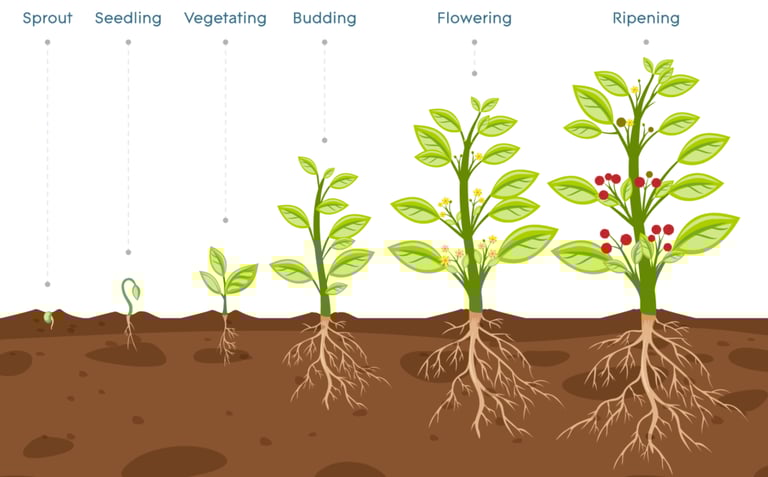
(January 30, 2026) Besides words involved with motion/emotion powers many Druid Akkadian words involving the life powers made their way into English.
Game, Gamete: This is from the Akkadian phrase G.A.M meaning energizing the fertility-fluids. This phrase always had something to do with fun and sex. From Greek gamos "marriage," gamete "a wife," gametes "a husband, gamein "to take to wife, to marry. Also the seventh month of the ancient Attic calendar (corresponding to late January and early February) was Gamelion, "Month of Marriages." By 1200 CE Old English gamen "joy, fun; game, amusement," Old Norse gaman "game, sport; pleasure, amusement," Old Saxon gaman, Old High German gaman "sport, merriment," Danish gamen, Swedish gamman "merriment"), Gothic gaman "participation, communion."
Heal: This is the Druid Akkadian word ḪeLu meaning "to physically heal." It is also seen in Old Norse heila and Old Frisian hela. It is also an epithet for the sun god Hu which became “Helios” in Greek.
Lipid: This is the Druid Akkadian word lēpu, līpu meaning “fat-of-the land." It is also found in Greek as lipos meaning "fat"
Ma: This is the Druid Akkadian word ma meaning “fertility fluid provider” in a reference to milk. This is similar to the Indo-European "Mother" via Latin māter, Greek mētēr, Sanskrit matar, Old Norse moðir.
Naked: This is the Druid Akkadian word neku meaning "naked" via Old English nacod, Old Frisian nakad, Middle Dutch naket, German nackt, Old Norse nökkviðr, Old Irish nocht, Welsh noeth. Not to be confused with "Nude" having a /d/ or /g/ which is Indo-European as evidenced by Old Church Slavonic nagu and Russian nagoi
Nut: this is the Druid Akkadian word nutu meaning "nature manifests" via Old English hnutu, and Latin natus meaning "birth."
Inherent Nature: This is the Druid Akkadian word naṭû. It also found in Latin as natura meaning a non-divine inherent character, constitution, and quality.
Pit: This is the Druid Akkadian word pitu meaning "pit." This is an epithet for both "grave" and "wellspring." The comes via Old English pytt meaning "natural or man-made depression in the ground, water hole, well; grave," Old Frisian pet, Old Saxon putti, Old Norse pyttr, Middle Dutch putte, Dutch put, Old High German pfuzza, German Pfütze meaning "pool, puddle."It is also found in Latin as puteus meaning "well, pit, shaft."
Summer: This is the Druid Akkadian word ṣummu meaning “dehydration” and "dehydration time" via Old English sumor, Old Saxon, Old Norse, Old High German sumar, Old Frisian sumur, Old Irish sam.
Tit: This is the Druid Akkadian word tittu meaning "fruit" and "tit" via Old English titt.
Turn, Trans: This is the Druid Akkadian phrase TR.N meaning "to change revelations." It is also found in Latin as tornare meaning “turn on a lathe,” Greek tornus meaning “lathe,” and Latin trans meaning “change state” as in the words transform and transport.
English River Names
(January 31, 2026) The names of rivers tend to derive from Druid Akkadian phrases. Each river was thought to have a specific magical power.
Aire: This is the Druid Akkadian phrase AY.R.E meaning river where "Ayu's griffons are disabled." Ayu is the crescent moon goddess who controls the editing of the spiritual irrigation network which distributes life powers (fertility-fluids) to earth. She does this using griffons/eagle-vultures who actually do the channel cutting.
Atlantis, Atlantic: This is the Druid Akkadian phrase A.TL.NT meaning "Those of the Mounds Manifested-from-Nature." This word is also seen in Latin atlanticus and Greek atlantikos which gave the name to the ocean. In Plato's Timaeus (360 BCE) it is spelled as Ἀτλαντὶς νῆσος or "Atlantis Nesos" or "Atlantis the distant" where "nesu" is an Akkadian word meaning "distant."
Arun: This is the Druid Akkadian phrase AR.UN meaning river where "control is resisted."
Avon: This is the Druid Akkadian phrase A.W'.N meaning river where “her restrictions are revealed" where "her" is the Druid underworld goddess Kate/Hekate. The dark underworld was were dead souls rested until reincarnated. Deep pools and springs were thought to be connected to the underworld so she would have been the Lady of the Lake in Arthurian legends. She was responsible for fate involving life and health.
Derwent: This is the Druid Akkadian phrase D.ER.W.EN.T meaning river where "life-manifestations will harbor the restrictions reassigning astrology-magic.
Exe: This is the Druid Akkadian phrase EŠ.E meaning river where "confusion is disabled."
Lea: This is the Druid Akkadian phrase L.E.A meaning river where "reductions in disablements results"
Lune: This is the Druid Akkadian phrase L.UN.E meaning river where "reducing resistances is made ineffective."
Medway: This is the Druid Akkadian phrase M.ED.W.AY meaning river where "Fertility-fluids motivate restrictions on Ayu." Ayu is the crescent moon goddess who control the editing of the spiritual irrigation network which distributes life powers (fertility-fluids) to earth.
Mersey: This is the Druid Akkadian phrase M.ER.S.UY meaning river where "fertility-fluids will harbor Su's fate-curses" in which Su is the dark new moon god associated with the astrology-magic which shifts fate.
Nene: This is the Druid Akkadian phrase N.EN.E meaning river where "Fate-revelation's reassignments are disabled." (In other words, astrology-magic is disabled)
Ouse: This is the Druid Akkadian phrase AW.S.E meaning river where "Motion-powers of Su are disabled."
Parrett: This is the Druid Akkadian phrase P.AR.R.ET.T meaning river where "openings controlling the griffons set boundaries for astrology-magic"
Severn: This is the Druid Akkadian phrase S.EW.ER.N meaning river where "Su's attention is controlled by fate-revelations."
Stour: This is the Druid Akkadian phrase S.T'.UR meaning river where "Su pastures the dawn (witching hour)." Su is the dark new moon god associated with the astrology-magic which shifts fate.
Tamar: This is the Druid Akkadian phrase T.AM.AR meaning river where "Astrology-magic for the Reed-boat is controlled" where the Reed-boat is the crescent moon goddess Ayu who edits the connections of the spiritual irrigation network.
Taw: This is the Druid Akkadian phrase T.AW meaning river where "astrology-magic is emotionally-empowered."
Tees: This is the Druid Akkadian phrase T.E.ES meaning river where "astrology-magic disables the winds-of-fate."
Thames: This is the Druid Akkadian phrase Ṭ.A.M.EṢ meaning river where "Thu results in fertility-fluids for shedding (raining)." Thu is the genderless deity associated with emotion magic.
Trent: This is the Druid Akkadian phrase TR.EN.T meaning river where "emotion-changes can reassign astrology-magic."
Tyne: This is the Druid Akkadian phrase T.IN.E meaning river where "astrology-magic of the Moon-Eye (Su) is made ineffective." Su is the dark new moon god associated with the astrology-magic which shifts fate. He is also associated with the dark pupil of the eye as the window into emotions.
Ure: This is the Druid Akkadian phrase UR.E meaning river where the "dawn is made ineffective." Dawn was when the night powers of fate became fixed so this was the time when rituals were done to shift fate with emotional magic. Hence, Dawn also became known as the witching hour.
Wharfe: This is the Druid Akkadian phrase W.Ḫ.AR.P.E meaning river where "restrictions on Hu will control the ineffective openings" in which Hu as the sun and storm god represents the life powers which flow through the spiritual irrigation network to earth.
Witham: This is the Druid Akkadian phrase W.IṬ.AM meaning river where "restrictions make-sticky the Reed-boat" in which the "Reed-boat" is the crescent moon goddess Ayu who controls the editing of the spiritual irrigation network which directs the life powers to earth.
Wye: This is the Druid Akkadian phrase UY.E meaning river where "fate-curses are disabled."
Yare: This is the Druid Akkadian phrase Y.AR.E meaning river where "Nothing controls disabilities."
Animal Words
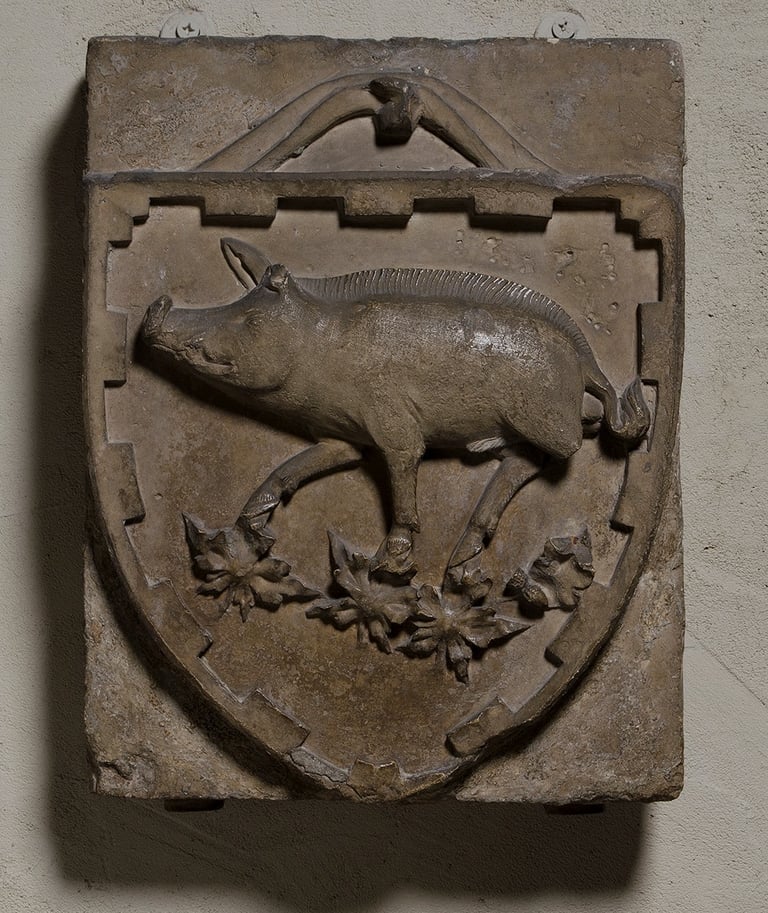
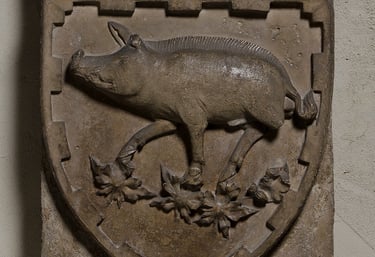
(February 1, 2026) Animal and people classifications tend to be Druid Akkadian words. The word for Pigs, Pagans, and Pages derive from the same Druid Akkadian word PG. Pigs were generally seen as dirty, ravenous animals from the countryside yet here is a pig on some French family's coat of arms carved in stone. It is dated to around 1300 CE. From the Metropolitan Museum of Art, The Cloisters Collection, 1925. Online at: https://www.laphamsquarterly.org/roundtable/ubiquitous-medieval-pigs
Cat: This is probably the Druid Akkadian phrase K.A.T meaning "involved with those astrology-magic-powers" via Old English catt (c. 700), Old Frisian katte, Old Norse köttr, Dutch kat, Old High German kazza, German katze), from Late Latin cattus. Alternately, it may be the Druid Akkadian word Kate who was the Life source goddess Kate (Hekate in Greek) which means "depleter." She is the life-power source goddess representing the powers of the dark underworld where souls reside until reincarnated. The word appeared in Europe as Latin catta (Martial, c. 75 C.E.), Byzantine Greek katta (c. 350) and was in general use on the continent by c. 700, replacing Latin feles.
Cow: This is the Druid Akkadian word K' (ka'u) meaning "prodded one" via Middle English cu, qu, kowh, from Old English cu Old Frisian ku, Middle Dutch coe, Dutch koe, Old High German kuo, German kuh, Old Norse kyr, Danish, Swedish ko,
Dog: This is the Druid Akkadian phrase D'.G meaning "Divine energy" probably due to a dog's ability to run for long distances.
Goat: This is the Druid Akkadian word GT (gutu) via Old English gat "she-goat," Old Saxon get, Old Norse geit, Danish gjed, Middle Dutch gheet, Dutch geit, Old High German geiz, Gothic gaits.
Hound, Hunt: This is the Druid Akkadian phrase ḪW.N.D meaning "Howler who reveals life" via Old Saxon and Old Frisian hund, Old High German hunt, Old Norse hund.
Liberty: This is the Druid Akkadian word LB meaning "liberty" and "liberated-one (lord)" because lords have liberty over themselves and are not controlled by others. Also seen in Old French liberte "freedom, liberty, free will" and Latin libertatem (nominative libertas) "civil or political freedom, condition of a free man; absence of restraint; permission," from liber meaning "free."
Man: This is the Druid Akkadian word MN meaning "supporter" via Old English man and Old Frisian mon. Traditionally, this word was thought to derive from proto-Indo-European but that is incorrect because that word has an MZ root as evidenced from Old Church Slavonic mozi and Russian muzh.
Page, Pig: This is the Druid Akkadian word PG meaning "something incomplete. It is also found in Latin pagos meaning incomplete. A medieval "page" is an incomplete knight. A paper "page" in a book is an incomplete book which derives either Latin pagella meaning "small page." A pig is an incomplete animal because it is not a proper hunter or grazer but is instead a scavenger. This mixing of power roles made it impure in Jewish culture. It derives from Middle English pigge (which was also used as a surname around 1300 CE). Its use as an incomplete territory is found in Julius Ceaser's Gallic Wars 1.12.4 as nam omnis civitas Helvetia in quattuor pagos divisa est ("for the Helvetian nation incomplete was divided into four cantons").
Pagan: This is the Druid Akkadain phrase PG.N meaning "The pig revealed" or "The mongral revealed" which was an insult. The Roman army used paganus to refer to a "civilian" or "incompetent soldier." Roman city dwellers used paganus to refer to country dwellers. By 1841 "pagan" is found in Christian English texts refering to non-Christians of all types, but especially for those from the pre-Christian classical era.
Work Words
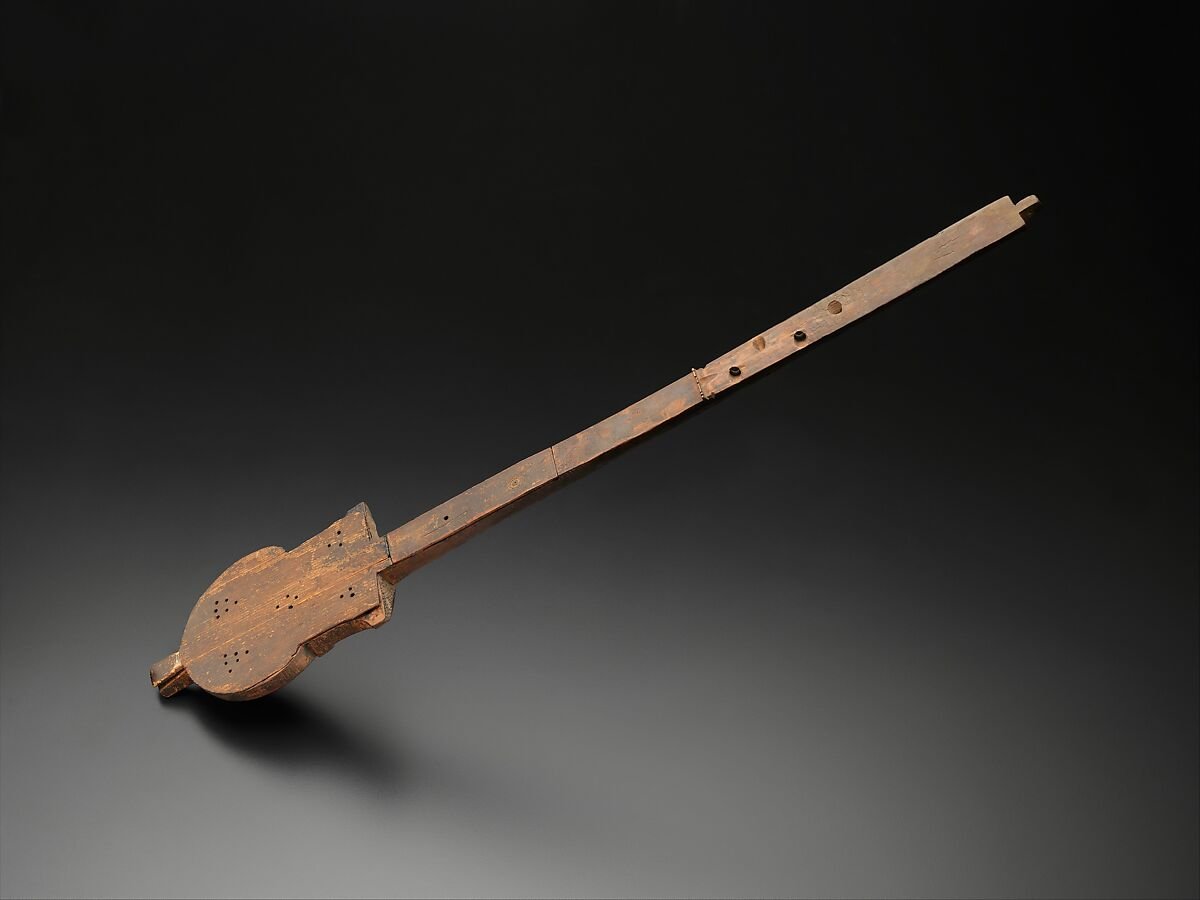
(February 1, 2026) The photo above is a Roman Lute dated to between 200 and 500 CE which is now at the Metropolitan Museum of Art. Online at: https://www.metmuseum.org/art/collection/search/473395
Bonus: This is the Druid Akkadian word BN meaning "good" and "bonus." It is also found in Latin as bonus which is source of Romance language’s bueno and bien meaning "good."
Equal: This is the Druid Akkadian word EQ meaning "functional replacement." Also seen in Latin aequalis (uniform, identical, equal), Old French egal.
Hit, Hat: This is the Druid Akkadian word ḪT meaning "hit" and "attack" via Old English hyttan, hittan and Old Norse hitta. An epithet which gave the Hittites their name. Also an epithet for the lintel of a doorway which is a "head hitter." Also the source for another head hitter known as a "hat" via Frisian hat, Old Norse hattr, and höttr meaning a "hood" or "cowl"
Lid: This is the Druid Akkadian word LṬ and Mesopotamian Akkadian lâṭu, līṭu, lētu) meaning “lid” via Old English hlid meaning "covering, opening, gate," Old Norse hlið meaning "gate, gap," Swedish lid meaning "gate," Old French hlid, Middle Dutch lit, Dutch lid, Old High German hlit .
Lute: This is the Druid Akkadian word LṬ and Mesopotamian Akkadian luṭu also meaning "harmony" and "harmony-maker." Traditional etymology only goes back to 1200’s as Old French lut, leut.
Mold, Made (Make): This is the Druid Akaddian word MD meaning “molder” and "maker" via Old French modle which in turn derives from Latin modulum meaning ”model” as in “the reference against which things are measured." In contrast the word “Make” with a /k/ instead of a /d/ derives from the northern Druid Akkadian word lineage via Old English macod, and macian, Old Saxon makon, Old Frisian makia meaning "to build, to make," Middle Dutch and Dutch maken, and German machen.
Quit: This is the Druid Akkadian word QT meaning "to quit or to end" via Latin quietus meaning to end or be free of debt.
Sack: This is the Druid Akkadian word SK meaning “cloth pounder” or “cloth sacker” which was a process to fluff and fill out cloth. Also seen in Latin saccus and Old Norse sekkr.
Same, Equal: This is the Druid Akkadian word Š. It is also seen in Old Norse samr
Size: This is the Druid Akkadian word ŠZ via Old English around 1300. It is also found in Old French as sise.
Origin Of This Weird Term
(February 1, 2026) "Quid pro quo" has an interesting history deriving from the Druid Akkadian word qu meaning "connected" in its most general sense and "channeled" and threaded" in its more specific sense. When used as a question it means "how is something connected?" The inventors of Latin used it as a root for more precise meanings when they added vowels to their written words. Both Greek and Latin were languages invented by wealthy elites and derived from local mixings of Druid Akkadian and Indo-European (with Greek having some 3rd source as well). The use of vowels for grammar and more precise word meanings were the new invented parts of their written language.
Latin Derivatives of Druid Akkadian Qu
Qua - means how is something connected spatially like "what side?"
Qui - means how is something connected internally like "how does it work? or what is its function?"
Quo - means how far does the connection go like "to what extent, how far?" It is also used as a prepositional phrase "to the extent of, because, whereby."
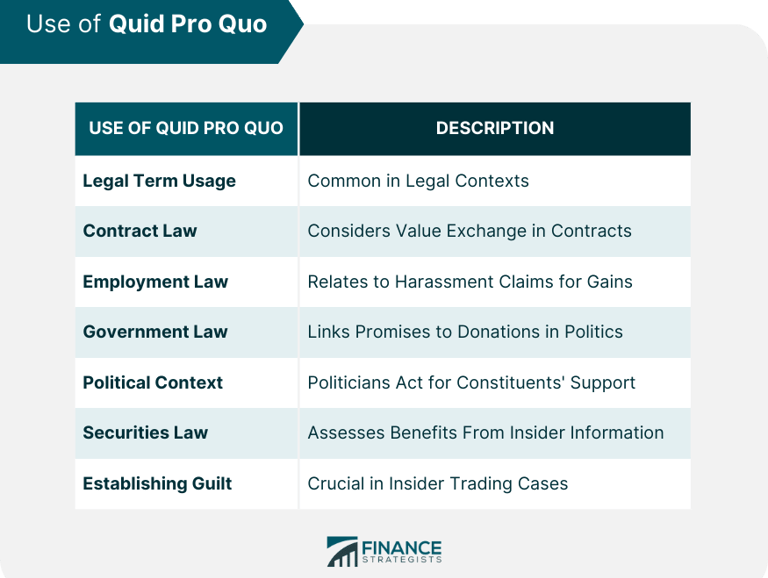
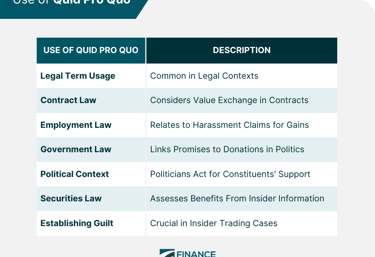
This invented written Latin started to coalesce during the era of Roman statesman and lawyer Cicero (born 106 BCE in Italy, died 43 BCE). At that time Qui was further extended to Quis/Cuis meaning a generic "who" (as in who is working something) with Quid keeping its traditional use as "what" (as in how does it work). This led to the Latin phrase quid pro quo having the literal Latin meaning of "What is similar to what-extent" for referencing when two things are essentially equivalent at their core. It continues to be used in legal contexts as shown in the above illustration.
Latin Reference
Cassell's Latin Dictionary Latin-English, English-Latin (1977) by D.P. Simpson Harper-Collins (This continually updated dictionary has been a standard English language reference since 1854 for the Latin of the classical period (200 BCE to 100 CE).
© 2022-2026. By David D. Olmsted. All pages licensed under a Creative Commons Attribution-NonCommercial-ShareAlike 4.0 International Copyright. https://creativecommons.org/licenses/by-nc-sa/4.0/