Ogham Letter Chart And Letter Assignments
ᚐ ᚑ ᚒ ᚓ ᚔ ᚁ ᚂ ᚃ ᚄ ᚅ ᚋ ᚌ ᚍ ᚎ ᚏ ᚆ ᚇ ᚈ ᚉ ᚊ
A ' U/W E Y/I R P Ṣ Š N M Ṭ Z B G Ḫ D T K S
X = (letter divider) > = (end of sentence)
New Ogham Letter Assignments Based On Druid Akkadian Runes
Previous Ogham Letter Assignments Based On Extrapolating From Latin
(January 19, 2026) Wales has several stones containing both ogham and runic texts on the same stone. The ogham text was assumed to be the same as the runic text. From this assumption the above and similar letter assignments were made. This assumption turns out to be false. Additionally, the letter assignments for the runes were also false. All that those assignments ever produced were names and that only about half the time. Names are not a translation because names are just clusters of letters not meaning anything.
Reference
Macalister, R A Stewart (1945) Corpus Inscriptionum Insularum Celticarum Volume 1. Online at: https://www.google.com/books/edition/Corpus_Inscriptionum_Insularum_Celticaru/4jgaAAAAYAAJ?hl=en
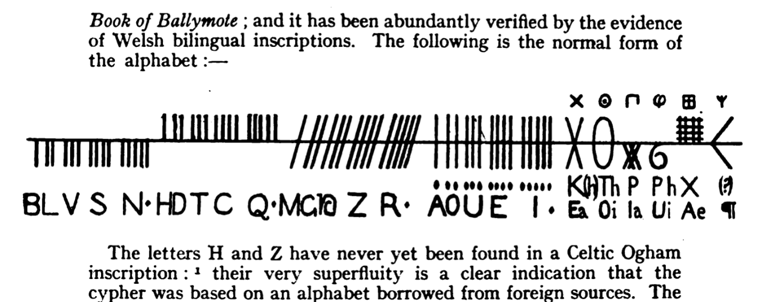
All Ogham Letter Assignments Begin With the Following Chart In The Book Of Ballymote
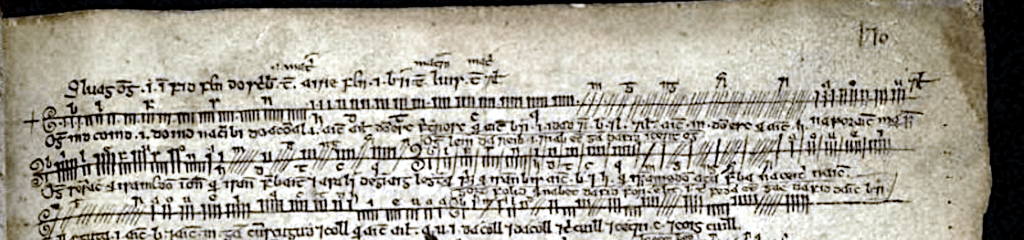
(January 19, 2026) All ogham letter assignments come from this chart on page 360 in the book of Ballymote (below). The problem has been what letters correspond to the letters associated here with the ogham letters. The decipherment of the Celtic runestones has finally provided the answer.
Ogham developed in Wales as a set of hand signals shortly after the Roman conquest. Only in Wales do we see the transition from normal runic writing to ogham with many stones having both. It also has some of the earliest datable stones based upon letter styles. Welsh runic letting derives from Etruscan, a fact which was first noticed by R.A.S. Macalister but which was ignored by later nationalist scholars.
Ogham crossed over into Ireland during the first wave of Christian oppression, that is, when the first chiefs of Ireland began to adopt the style of Christianity as it then existed in England. According to legend, this form of Christianity was brought over by Saint Patrick during the late 400's CE. The Druidry revealed by the ogham texts uneasily coexisted with Irish Christianity until the Viking raids began around 800 CE. This raiding hardened attitudes towards anything Druid and Pagan resulting in Druid culture and Ogham writing being extinguished shortly afterwards.
The Full Ballymote Page 360
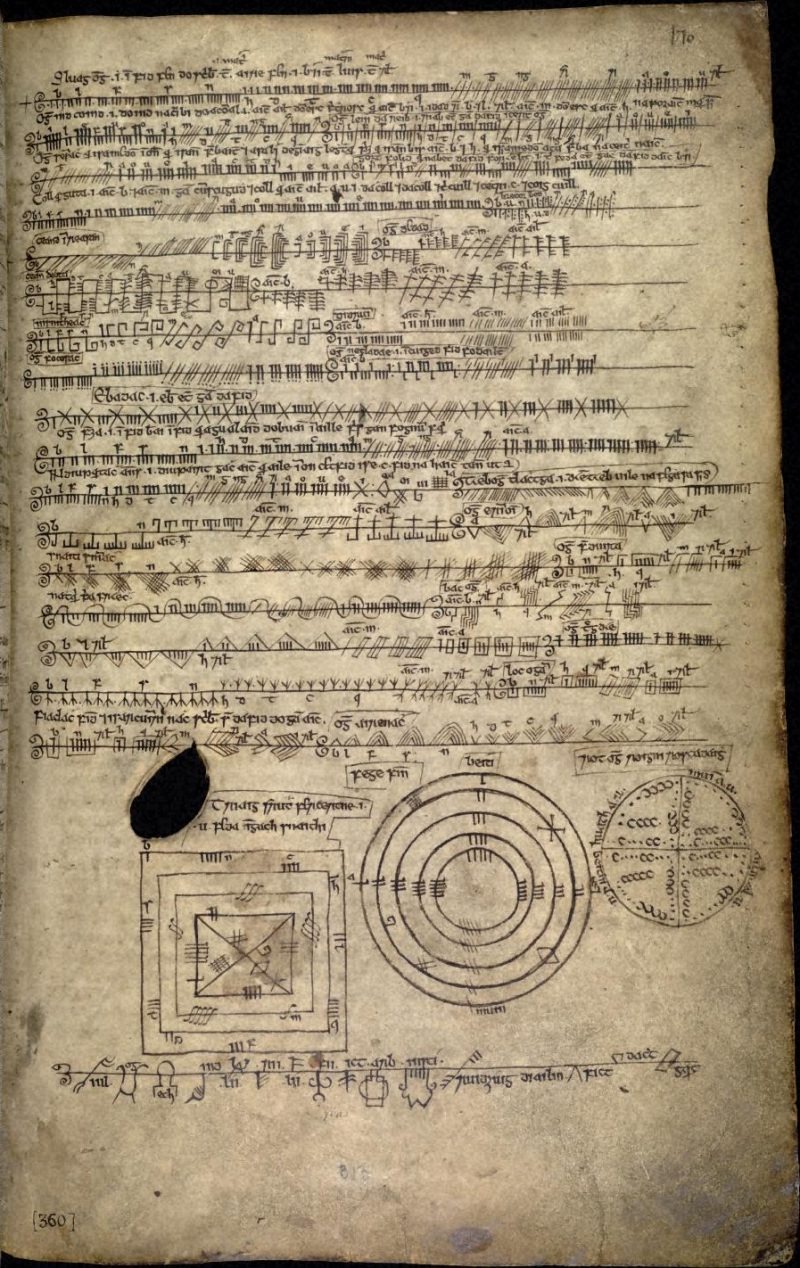
This is page 360 from the book Book of Ballymote. It was compiled towards the end of the 1300's at the castle of Ballymote for Tonnaltagh McDonagh of Ireland. The chief compiler was Manus O'Duignan, one of a family of scribes to the McDonagh and the McDermots. Other scribes of the book were Solomon O'Droma, a member of a famous County Fermanagh family, and a Robert McSheedy. The book is a compilation of older works, mostly loose manuscripts and valuable documents handed down from antiquity that came into possession of McDonagh.
References
https://en.wikipedia.org/wiki/Book_of_Ballymote
Photo from Wikimedia commons at: https://commons.wikimedia.org/wiki/File:Book_of_Ballymote_170r.jpgr text here...
Nordic Ogham


While most ogham is found in the Celtic lands, some of a different style are found in Scandinavia. Here is a sample from page 360 of the bool of Ballymote. Interestingly, the author was not familiar with all the letter assignments.
© 2022-2026. By David D. Olmsted. All pages licensed under a Creative Commons Attribution-NonCommercial-ShareAlike 4.0 International Copyright. https://creativecommons.org/licenses/by-nc-sa/4.0/