
Early National Differentiation Revealed by Pottery Styles


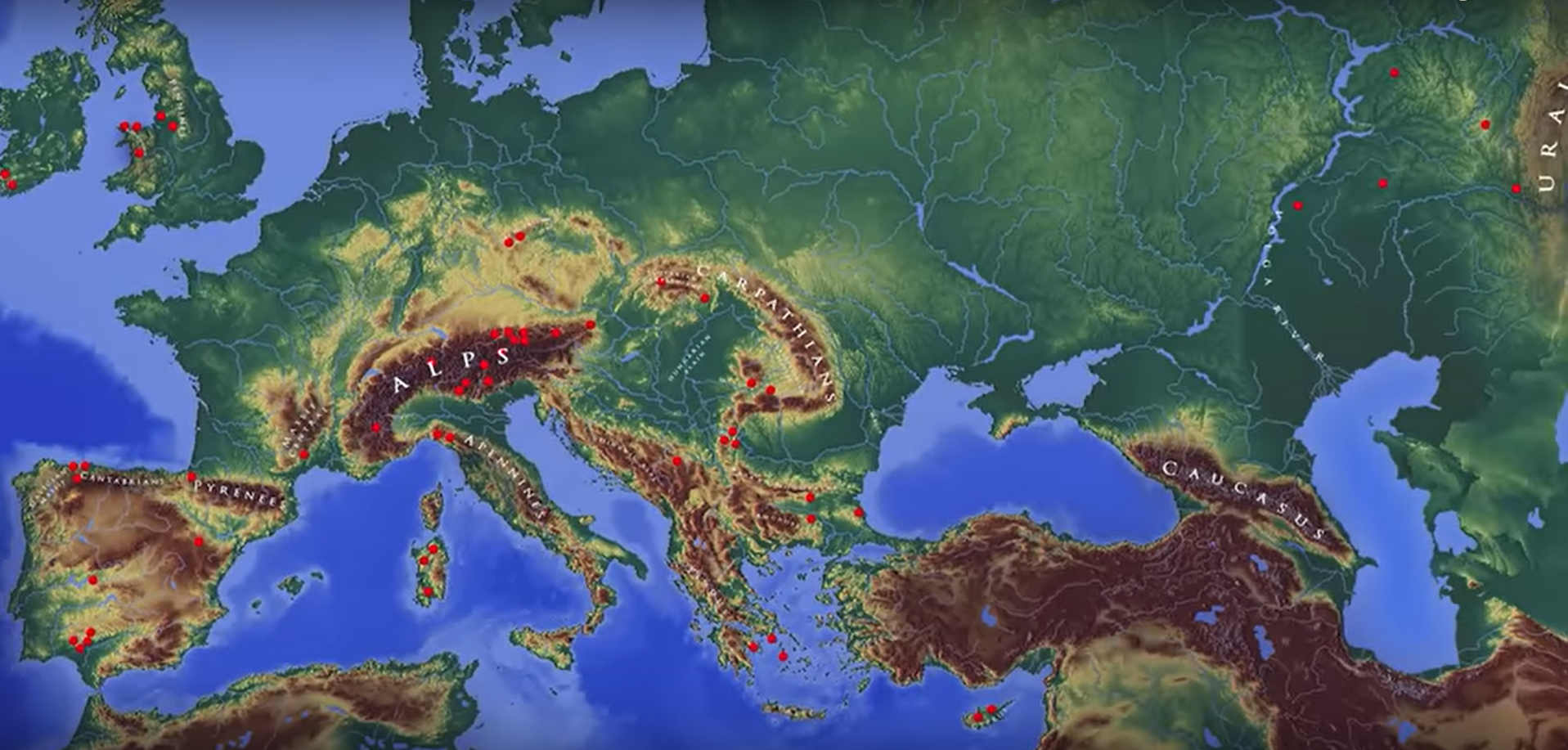
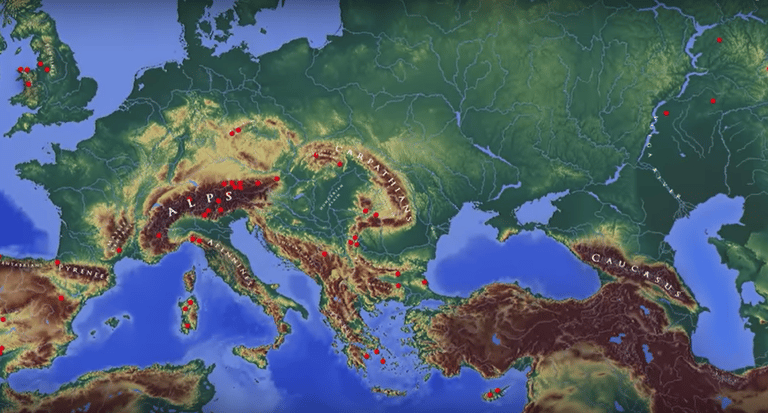
(January 25, 2026) A map showing the main riverine trade routes during the Neolithic. These and mining guided the formation of nationalist material traditions.
Map made by David Olmsted.
(January 26, 2026) Map showing the location of copper mines during the Neolithic. These mine along with the riverine trade routes tended to define the national boundaries revealed by various material traditions.


(January 25, 2026) An overview of all pottery styles from the Middle Neolithic (5000 BCE) indicates that national groups were forming. Such artistic styles are generally reflections of nationalist feelings based upon recent common history and trade connections. Notice that some researchers see a differentiation starting in the Linear Pottery Culture.
The earliest material traditions were the Starčevo–Kőrös–Criș material tradition (c. 6200-4500 BCE), the Dimini material tradtions, and the unnamed material tradition of the Aegean islands.
Image from Wikimedia Commons at
https://commons.wikimedia.org/wiki/File:European-middle-neolithic-en.svg

(January 26, 2026) The Starčevo–Kőrös–Criș material tradition (c. 6200-4500 BCE) represents the advance of early Neolithic farmers from Anatolia to south-east Europe.
Not many graves have been found from the Starčevo culture, and those were generally single graves. Most burials found so far belonged to women or children. They were inhumed under the floors of personal residences as they were in Anatolia, a practice that continued until 4000 BCE. Graves rarely contained goods. When they did, it was pottery, grinding stones, flint tools or jewelry.
DNA tests show these people had fair skin, brown eyes and dark hair, while Mesolithic Europeans had darker skin, dark hair, but blue eyes.
Starting around 5300 BCE the Starcevo tradition transitioned into the wealthier Vinca tradition with its distinctive blackish and redish fired pot patterns. On Vinča tells and in later Vinča flat sites, the houses were rectangular or squarish, with walls variously defined by post-framing. These were shorter buildings than those of the Linear Pottery tradition, lacked longpits flanking their long sides, had more visible internal furnishings, and were more clearly divided into rooms than was the case in Linear Pottery tradition. The Vinca map shows it extending northward into a copper mining area.
More information at: https://www.eupedia.com/genetics/haplogroups_of_neolithic_farmers.shtml


(January 25, 2026) Some Dimini pottery from Peloponnese and Crete (6700 BCE). This early pottery along the coast is mostly undecorated and reddish except for the bowl holder. The pots with narrow bases were used for trade as they could be fitted to the backs of animals (on either side) or into the holds of ships. Also notice the many small grinding stones for producing small amounts of flour.
The reddish color is from firing the pots in the open air with clay having some iron oxide. The black is likely from ash or smoke. This indicates special firing ovens were not yet in use. Neither are these pots glazed. If they held liquids they would have been oiled.
Photo taken in National Museum of Archaeology, Athens, Greece and from Wikimedia at: https://commons.wikimedia.org/wiki/File:Ancient_Greece_Neolithic_Pottery_%26_Stone_Artifacts.jpg

(January 27, 2026) Pottery from one border settlement showing early Vinča-style (1–7, 10–15) and early Linear Pottery-style (8–9) pottery. On both we start to see pottery decorations consisting of lines. These pots were also some of the fist Vinca style pots made and date to around 5300 BCE.
Reference
Jakucs, J., Bánffy, E., Oross, K. et al. (2016) Between the Vinča and Linearbandkeramik Worlds: The Diversity of Practices and Identities in the 54th–53rd Centuries cal BC in Southwest Hungary and Beyond. J World Prehist 29, 267–336. Online at:


(January 26, 2026) The Linear Pottery material tradition existed between 5500 and 4200 BCE. It is abbreviated as LBK (from German: Linearbandkeramik), is also known as the Linear Band Ware, Linear Ware, Linear Ceramics or Incised Ware culture, and falls within the Danubian I culture of V. Gordon Childe.
Two variants of the early Linear Pottery culture are recognized. The Early or Western Linear Pottery Culture developed on the middle Danube, including western Hungary, and was carried down the Rhine, Elbe, Oder and Vistula. The Eastern Linear Pottery Culture flourished in eastern Hungary.
Photo from: https://en-academic.com/dic.nsf/enwiki/2150725
(January 26, 2026) The Linear Pottery (LBK) Material Tradition (c. 5600-4200 BCE) representsed the northwestern advance of Early Neolithic farmers from the Starčevo-Körös culture across central Europe.
Their Neolithic agricultural economy was based primarily on the cultivation of crops from the Fertile Crescent, such as Emmer wheat, Einkorn wheat, peas and lentils, and to a lower extent barley, millet, rye, and broad beans. The LBK people settled on fluvial terraces and in the proximities of rivers, especially in regions rich in fertile loess. They raised cattle in particular, but also of goats and pigs. The LBK farmers supplemented their diets by hunting deer and wild boar in the open forests.
People lived in trapezoidal or rectangular wooden longhouses built with massive timber posts. They had thatched roofs and were chinked with wattle and daub mortar. The longhouses measured from 7 to 45 meters in length and 5 to 7 meters in width. Villages were composed of five to eight longhouses, about 20 meters apart. Some villages were fortified for some time with a palisade and outer ditch.
Flint and obsidian were the main materials used for points and cutting edges. LBK farmers harvested with sickles manufactured by inserting flint blades into the inside of curved pieces of wood. Trees were felled and carved using shoe-last celt, which consists of a ground stone chisel blade tied to a handle.
Like other early Neolithic cultures in Europe, the Linear Pottery featured burials of women and children under the floors of personal residences - a practice that continued until 4000 BCE. Cemeteries containing from 20 to 200 graves make their appearance from 5000 BCE and included both male and female skeletons, apparently arranged in groups based on kinship. Both cremation and inhumation were practiced. The inhumed were placed in a flexed position in pits lined with stones, plaster, or clay. Graves typically contained goods like flint implements or jewelry of Spondylus shells, but pottery was found almost exclusively in female graves.
The fast expansion of the LBK culture did not leave much time for Near Eastern farmers to intermingle with Mesolithic European hunter-gatherers - a fact now confirmed by the analysis of several LBK genomes that show only about 5 to 10% of indigenous European admixture. However, Mesolithic Europeans continued to live side by side with LBK farmers and progressively interbred with them during the later Rössen (4600-4300 BCE) and Schöningen (4200-3950 BCE) periods. The only exception is northern France, where the LBK-derived RRBP (French acronym standing for Recent Linear Pottery of the Parisian Basin) immediately shows high levels of indigenous European admixture.
LBK people had an average body height of 166.6 cm for men (6 feet 6 inches) and 158 cm (6 feet 2 inches) for women, considerably shorter than Mesolithic Europeans of the same period. Ancient DNA tests have shown that LBK people had fair skin, brown eyes and dark hair, while Mesolithic Europeans had darker skin, dark hair, but blue eyes. Both groups were lactose intolerant.
More information at: https://www.eupedia.com/genetics/haplogroups_of_neolithic_farmers.shtml
The Northern Branch


(January 25, 2026) Some pottery from the Funnelbeaker tradition (4200-2650 BCE). The style of pot with its narrow neck gave its name to the tradition.
Photo from the Drents Museum in Assen, Netherlands.
(January 25, 2026) The Funnelbeaker material tradition is a merger between the Neolithic agricultural society derived form the Linear Pottery tradition and the Mesolithic (hunter-gatherer) culture. This tradition owes its name to the distinctive collared flask ceramic, perhaps a precursor of the Bell-beaker ceramic that would spread across the western half of Europe from 2800 BCE.
Neolithic agricultural economy was dominated by animal husbandry of sheep, cattle, pigs and goats. Cow's milk was consumed and oxen were used for heavy work. Funnelbeaker complemented their diet through hunting and fishing. Primitive wheat and barley were grown on small patches that were quickly depleted. Flintstone was mined, notably in southern Sweden, to make flint axes. Copper daggers and axes were imported from Central Europe.
People lived in wooden longhouses with clay walls and thatched roofs. They were centered around a monumental grave, which acted as a symbol of social cohesion. Villages were located close to those of the preceding Mesolithic Ertebølle culture, near the coastline.
Funnel-beaker people reached an average height of 165 cm (5 feet, 4 inches) for men and 153 cm (5 feet) for women. They rarely lived over 35 or 40 years old. More information at:


(January 25, 2026) Pottery from Malta's Zebbug Period (4100-3800 BCE)
From: Gregory, I.V. (2017) Tradition, Time and Narrative: Rethinking the Late Neolithic of the Maltese Islands. Online at: https://www.researchgate.net/publication/309415830_Tradition_Time_and_Narrative_Rethinking_the_Late_Neolithic_of_the_Maltese_Islands
(January 25, 2026) These examples of pottery from Sardinia show the transition from the earliest Neolithic Pottery (top) to the Ozieri Culture Pottery of the lower image (3800 BCE) which shows beaker tradition influence. This shows trade routes were becoming extensive by 3800 BCE. (Delfino 2000)
The Southern Coastal Branch


(January 25, 2026) Cardium pottery from Capo Alfiere, Calabria, Italy (From Morter, 2002:732 via Spiteri (2012)
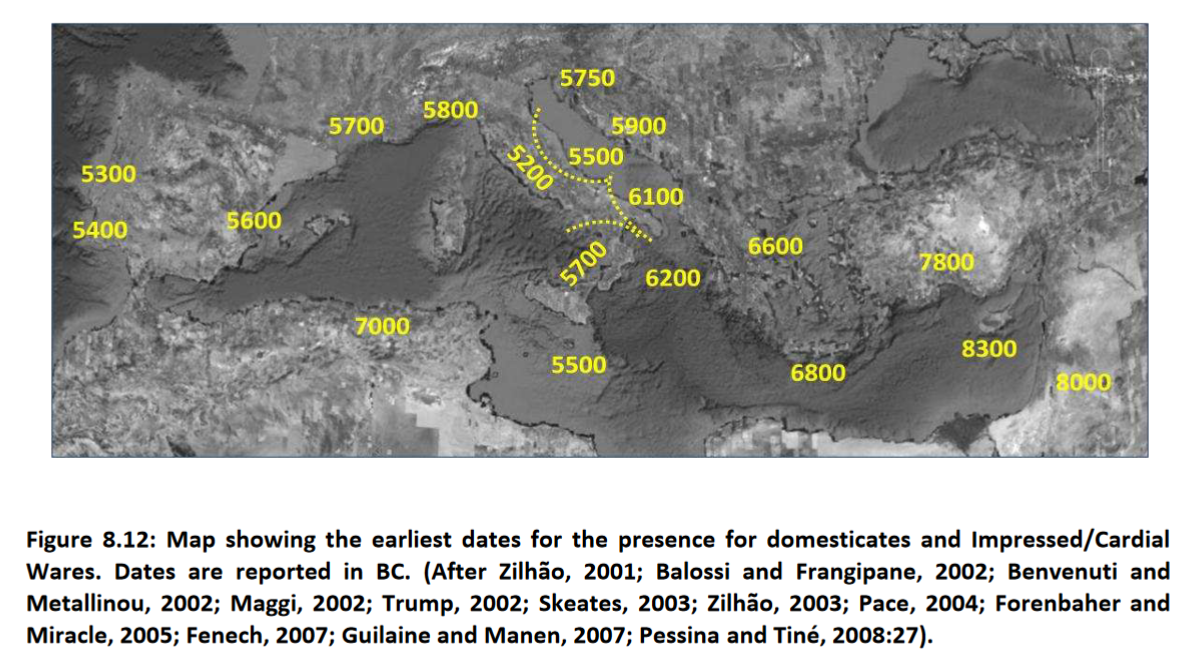
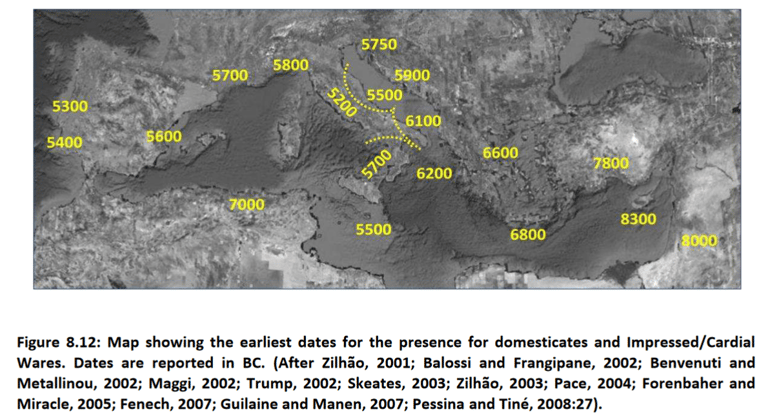
(January 25, 2026) Cardium pottery from Apulia Italy (6000-5500 BCE). Cardium pottery has patterns are made from impressions from fingers, fingernails, other small instruments and especially the edges of the Cerastoderma edule L.(Cardium) and Glycymeris insubricus Broc. shells. Cardium pottery seems to be a tradition of coastal Neolithic farmers because this style ranges from Phoenicia into the Iberian Peninsula only skipping Greece and Crete.
Photo from Spiteri (2012). Section A shows: Impressed decorative motifs from Balsignano (Apulia, Italy) (Muntoni, 2002a); B: Rocker decoration, created by the continuous zig-zag motion of a shell along a set trajectory, from Balsignano (Apulia) (Muntoni, 2002a)


(January 25, 2026) Cardium pottery from Iberia (5600 BCE)
Pottery from Cova del’Or (From Martí-Oliver, 2002:58 via Spiteri 2012)
(January 25, 2026) This chart shows the spread of Cardium pottery styles from east to west.


(May 26, 2024) The origins of the Megalithic material traditions in Europe remains controversial and incomplete because it seems to be a merger of the Mesolithic hunter/gatherers with both the northern and southern branches of the Neolithic farmer migration.
Megalithic structures include the stone circle, the dolmen (portal tomb), the passage grave, the gallery grave (aka wedge tomb), and standing stones (known as menhirs in France). Notice that the ealiest ones are in modern day Portugal and southern Spain.
The most famous megalith, Stonehenge, was built in several stages starting around 3000 BCE and continuing until about 2400 BCE. The Indo-European bell-beaker culture arrived in Britain around 2400 BCE.
At this time the remaining Mesolithic people were interbreeding with the Near Eastern farmers (for example, Otzi the iceman). DNA testing of remains from burials around Megalithic sites shows that paternal ancestry was overwhelmingly Mesolithic European, while maternal ancestry was predominantly East Mediterranean. Why this is the case is unknown.
Ancient DNA tests have shown that Atlantic Megalithic people had a variety of skin tones ranging from pale-intermediate to dark. Almost all had brown or black hair. The majority had brown eyes. They like the earlier Neolithic farmers were lactose intolerant.
More information at: https://www.eupedia.com/genetics/haplogroups_of_neolithic_farmers.shtml
Map showling the location of surviving European megaliths. Tombs having inner stone passages (dolmens) had an even greater distribution throughout Europe. Many were probably destroyed throughout history for their stone. The most famous megalith, Stonehenge, was built in several stages starting around 3000 BCE and continuing until about 2400 BCE. The Indo-European bell-beaker culture arrived in Britain around 2400 BCE.
A total of 17,409 megaliths have been recorded throughout Europe.
Reference
Johannes Müller, Clemens Krucken-berg, Ralph Großmann, Julia Luckner (2023) A map of European megaliths. JNA 25, 2023, 165 – 173. Online at https://doi.org/10.12766/jna.2023.6
The Southern and Northern Branches Merge In The West


(May 26, 2024) A Megalithic Tradition pot found near Stonehenge called the Windmill Pot from its location. Windmill hill was excavated between 1925 and 1929 and became one of the sites used by archaeologists to define the southern British Neolithic. It is dated to 4000 BCE
Pot on display at the Alexander Keiller Museum, Avebury, Great Britain. Image from: https://artsandculture.google.com/asset/pot-from-windmill-hill-causewayed-enclosure-avebury/hAFVqAjEzgMIbA
Examples of Megalithic pottery from what is now France (5250-4900 BCE).
Reference
Image from: Kirschneck, Erich (November 2021) The Phenomena La Hoguette and Limburg – Technological Aspects. Open Archeology volume 7 issue 1. Online at: https://doi.org/10.1515/opar-2020-0195


(May 26, 2024) The origins of the Megalithic material traditions in Europe remains controversial and incomplete because it seems to be a merger of the Mesolithic hunter/gatherers with both the northern and southern branches of the Neolithic farmer migration.
Megalithic structures include the stone circle, the dolmen (portal tomb), the passage grave, the gallery grave (aka wedge tomb), and standing stones (known as menhirs in France). Notice that the ealiest ones are in modern day Portugal and southern Spain.
The most famous megalith, Stonehenge, was built in several stages starting around 3000 BCE and continuing until about 2400 BCE. The Indo-European bell-beaker culture arrived in Britain around 2400 BCE.
At this time the remaining Mesolithic people were interbreeding with the Near Eastern farmers (for example, Otzi the iceman). DNA testing of remains from burials around Megalithic sites shows that paternal ancestry was overwhelmingly Mesolithic European, while maternal ancestry was predominantly East Mediterranean. Why this is the case is unknown.
Ancient DNA tests have shown that Atlantic Megalithic people had a variety of skin tones ranging from pale-intermediate to dark. Almost all had brown or black hair. The majority had brown eyes. They like the earlier Neolithic farmers were lactose intolerant. More information at:
https://www.eupedia.com/genetics/haplogroups_of_neolithic_farmers.shtml
(January 25, 2026) Skarpsalling Pot from Northern Denmark (3200 BC) is an example of the most developed pottery style from the Neolithic farmers prior to the Indo-European invasion. It has a glaze making it waterproof and substantial decorative elements.
It is now at the Danish National Museum at Kobenhaven (Nationalmuseet i København). Online at: https://en.natmus.dk/historical-knowledge/denmark/prehistoric-period-until-1050-ad/the-neolithic-period/the-skarpsalling-pot/
The Time Just Prior To The Indo-European Invasion
© 2022-2026. By David D. Olmsted. All pages licensed under a Creative Commons Attribution-NonCommercial-ShareAlike 4.0 International Copyright. https://creativecommons.org/licenses/by-nc-sa/4.0/