Ancient History of the Pentacle
It is a symbol of magical fate-shifting
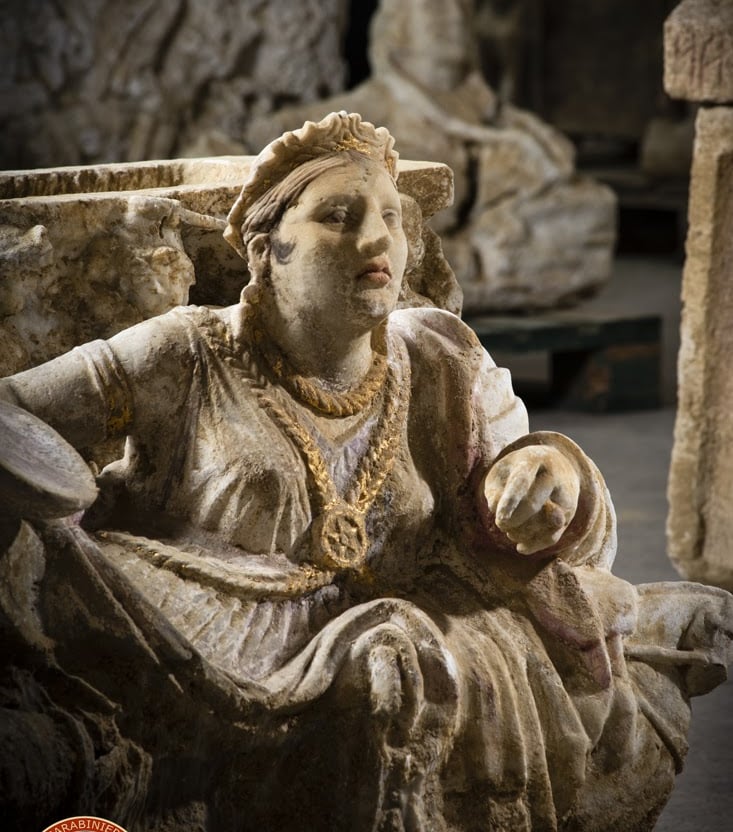
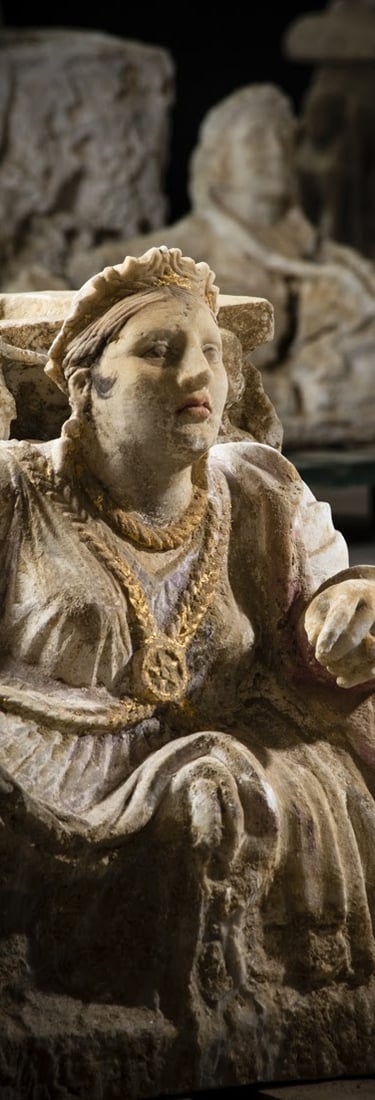
(December 4, 2025) The above is an Etruscan priestess shown with a pentacle necklace dating to about 500 BCE. This was part of an exceptional group of Etruscan art illegally excavated and seized by the Italian police before they could be laundered into the international markets. These were taken from archaeologically unexcavated sections at the Pulfina hypogeum (underground tomb complex) discovered in Città della Pieve in Umbria, Italy in 2015.
Reference
Italian Ministry of Culture (November 19, 2024) Archeologia, TPC: recuperati due sarcofagi e otto urne etruschi provenienti da uno scavo clandestino a Città della Pieve. Online at: https://cultura.gov.it/comunicato/27006
Photo by Emanuele Antonio Minerva with the Italian Minister of Culture (used under fair use provision). Online at: https://cultura.gov.it/comunicato/27006
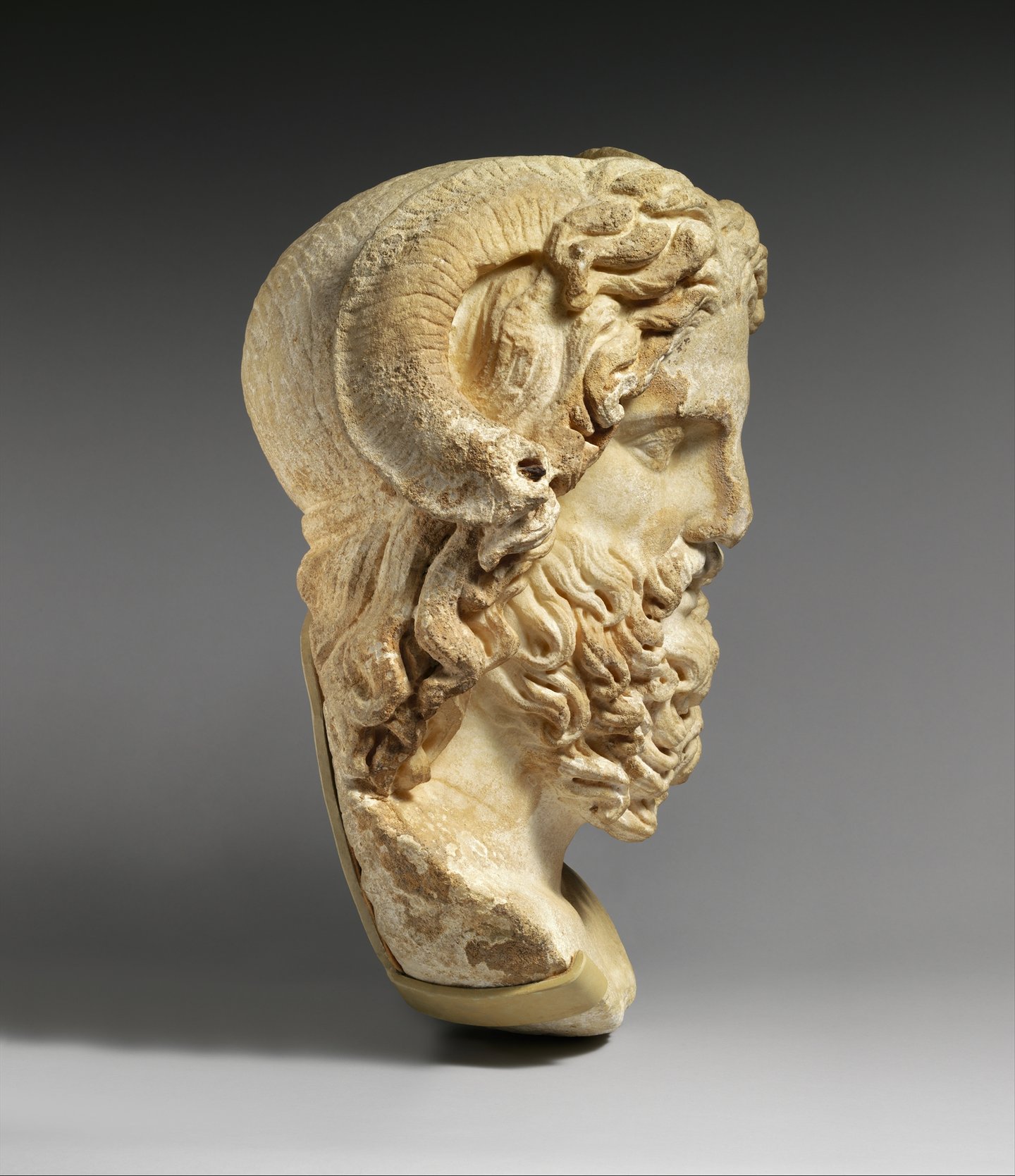
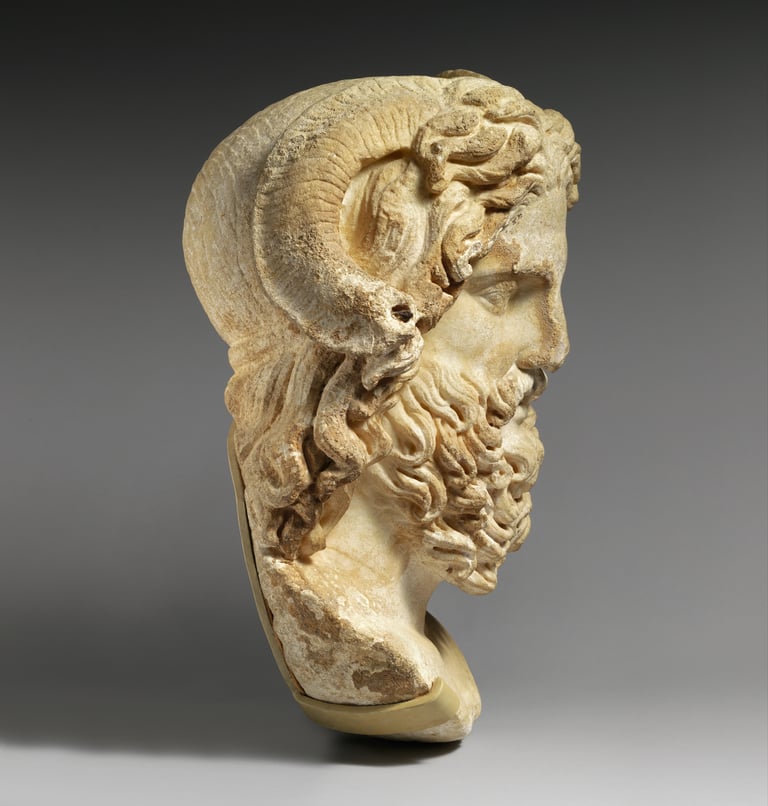
(January 23, 2026) What does this have to do with a pentacle? Read on. This ram horn god is called Zeus Amon and it became a representation of the fate shifting power of Alexander the Great who changed the course of history. Zeus-Amon's sanctuary was at the Oasis of Siwa in the Libyan desert. It was already famous as a site which combined the Greek kingly powers of Zeus with the fate powers of Egyptian Amon when Alexander the Great made his pilgrimage there in 331 B.C. Legend has it that its Oracle proclaimed him son of Zeus Amon and answered Alexander’s questions favorably (surprise, surprise).
This statue combines the classical representation of a bearded Zeus as king of the gods with the ram horns of the Egyptian dark new moon god Amon who was called the "hidden one." Amon was equivalent to the god Sin or Su'en in Mesopotamian Akkadian and Su in Druid Akkadian. By 2000 BCE Amon was associate with the sun god Re or Ra to become the national god of Egypt as Amon-Re. Amon's main temple was at Thebes in southern Egypt while Re/Ra's main temple was in the Nile Delta in the northern Egypt. So Amon-Re represented a unified Egypt as well as all 24 hours of the day.
In the Druid rune texts the type of magic which shifts fate is translated into English as astrology-magic.
Photo from: https://www.metmuseum.org/art/collection/search/257864
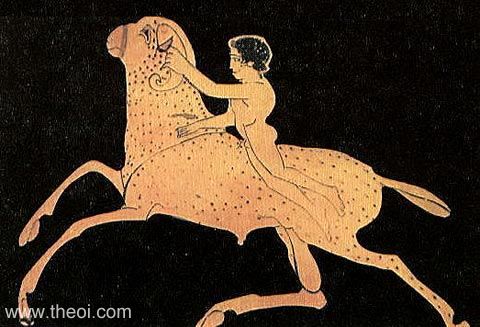


(January 23, 2026) Rams represent the powers of the dark new moon Su who shifts fate. This image is KRIOS KHRYSOMALLOS (Crius Chrysomallus) who was a flying, golden-fleeced ram. Krios means "ram." in Greek while khrusos means "gold" and mallos means "wool." This image is on a pot now at the National Archaeological Museum of Athens.
According to Greek mythology, it was sent by the cloud-nymphe Nephele to rescue her children Phrixos (Phrixus) and Helle when they were about to be sacrificed to the gods. The ram carried Phrixos all the way to Kolkhis (Colchis) at the far end the Black Sea and then instructed the boy to sacrifice him to the gods and lay his fleece in the grove of Aries (Greek god of war). Khrysomallos was afterwards placed amongst the stars as the constellation Aries and his shining fleece became the goal of the quest of Iason (Jason) and the Argonauts.
Because rams were sacred to the Druid dark new moon god Su, it had always been the preferred ultimate sacrifice in astrology magic for shifting fate onto itself (the sacrificial lamb idea). Yet later when humans began personifying their deities human sacrifice started to replace it as the ultimate sacrifice. During this time with the growth of empires, their distant rulers came to be seen to be just as powerful and capricious as nature powers. This resulted in the deities becoming personified and living in a royal court instead of being labels for clusters of spiritual powers (as was the case in ancient Druidry and is the case in modern witchcraft).
Photo and info from: https://www.theoi.com/Ther/KriosKhrysomallos.html
(Januaray 23, 2026) Rams tempt fate by jumping around on high mountain ledges. This would seem to be why they became associated with the spiritual power to shift fate. The Greek word for "ram" is "krios."
According to Greek mythology, Krios (Crius) was one of the elder Titans being the son of Ouranos (Uranus, Sky) and Gaia (Gaea, Earth). "Krios" seems to derive from Druid Akkadian as the phrase K.RY meaning "involving the shepherd-priests" where shepherd priests, according to the Druid rune texts, were the priestly-class involved with astrology magic and the dark new moon god Su. Shepherds, of course, are involved with sheep and the use of this name for a priestly class suggests they were involved with rams as sacrificial animals from the very beginning.
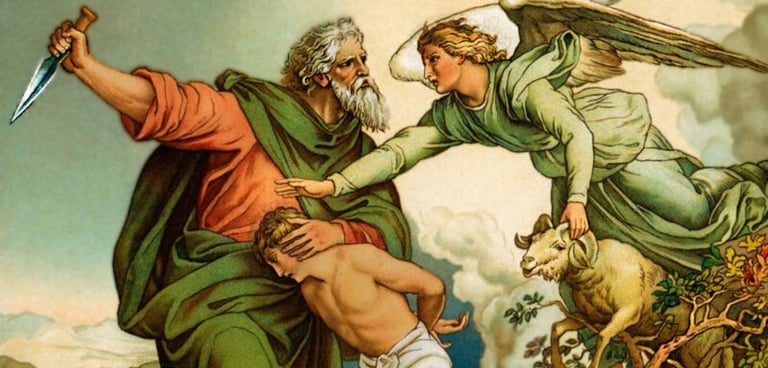
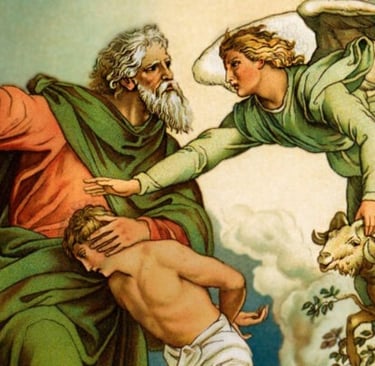
Chapter 22 in the book of Genesis in the Bible has a similar story to the Greek myth about replacing a human sacrifice with a ram. Abraham was told by God to sacrifice his son Isaac. As he was about to lower the knife an angel appeared telling him to instead use the ram caught in a nearby bush instead. Abraham had proven his devotion and that was all that was really needed.
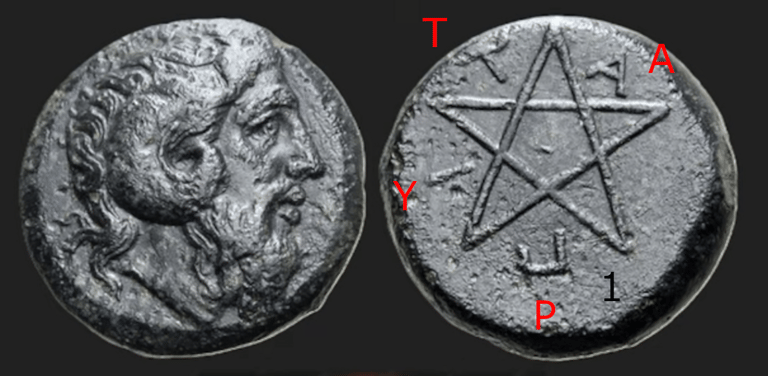
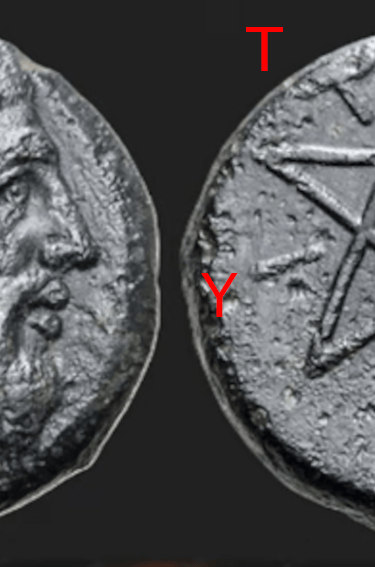

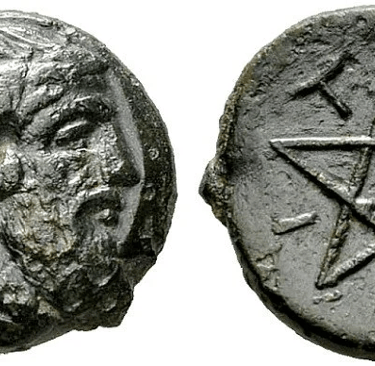
(September 27, 2024, update January 23, 2026) A pentacle coin From Pitane, Anatolia dated to 200s BCE. The face is Amon-Zeus representing the fate shifting power of Alexander the Great who changed history. The pentacle must also represent the fate shifting power, specifically, the fate shifting power of astrology-magic. It weighs 4.21 grams. This coin has the Druid Akkadian Runes of the Aegean style.
Translation in Druid Akkadian (Med Text 123)
(read clockwise from bottom. Capital letters on object. Small letters are inferred Inner vowels. Vowels are italic bold, Dual use letters are E/H, I/Y, U/W, and '/A in which vowel appears at beginning of words except for Yahu which is keeping its traditional Hebrew transliteration)
Runic letter style is Aegean Island from letter chart: Aegean Letter Lineage
Dictionary used: Latest Runic Akkadian dictionary
Pu ITu A
In English
Open his omens (literally "Open the omens of his")
Photo from: https://www.numisbids.com/n.php?p=lot&sid=526&lot=211
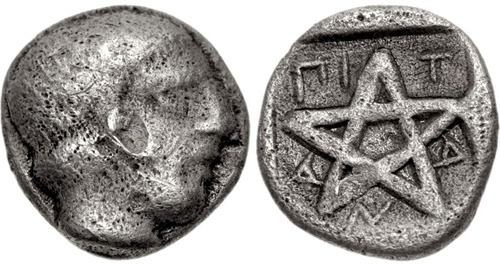
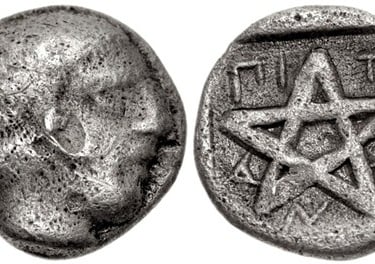
A different stamping with a similar head style and possibly different lettering which is too rubbed out to read in this photo.
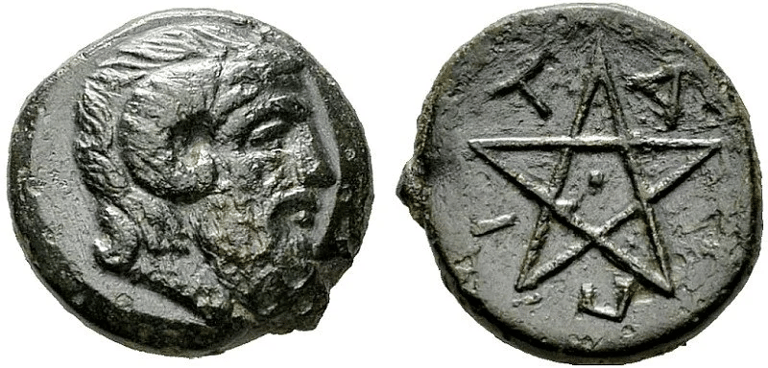
A different stamping with a similar head style and the same lettering. Notice how the hair streaking is different in the hair and how the pentacle has its arms weaving over and under in a proper pentacle fashion. Such weaving would represent the weaving of fate.
Photo from: https://www.numisbids.com/n.php?p=lot&sid=526&lot=211
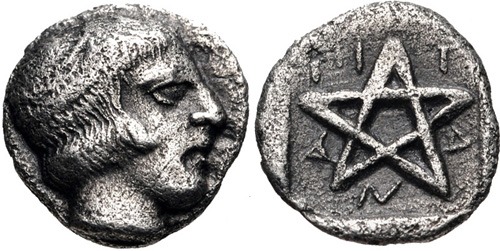
(September 27, 2024, updated January 23, 2026) The face is beardless with a short hair style which indicates this deity does not belong to any gender.
Translation in Druid Akkadian (Med Text 122)
(read clockwise from top. Capital letters on object. Small letters are inferred Inner vowels. Vowels are italic bold, Dual use letters are E/H, I/Y, U/W, and '/A in which vowel appears at beginning of words except for Yahu which is keeping its traditional Hebrew transliteration)
Runic Letter style is Aegean Island from the Aegean Letter Chart
Dictionary used: Latest Runic Akkadian dictionary
Tu ANu A PaYu
In English
Astrology-magic's considerations can affect its divine-birds (owls)
Comment: Considerations are focused emotions used in emotion magic. Astrology magic uses emotion magic but directs it to curse someone or something else and in that way the curse is shifted. Hence its use was always controversial in the later era Druid runic texts. It likely became involved in human sacrifices after deities were personified tending to replace ram sacrifices during extreme conditions. The magical divine birds were owls which were harbingers of a change of fate.
Online auction at: https://cngcoins.com/Coin.aspx?CoinID=162237
(September 27, 2024) The coin auction site claims this is from the 4th century BCE. (7mm, 0.39 grams, 5h). Excavations in the necropolis of Pitane revealed ceramic finds from the Mycenaean, protogeometric, geometric, orientalizing, and the Archaic Greek periods. In the fifth century BCE, Pitane was a member of the Delian League and is recorded as paying a tribute of 1,000 drachmas.
Thu is the Druid deity associated with emotion magic and as such it did not have an active gender (like a child) or it was both genders (hermaphrodite). The Druid pantheon was divided into two spiritual power classes. One was the life powers which caused life to grow and the other was the motion powers which caused things to move. The motion powers were the magical powers with their sources being the heavenly bodies and inner emotions.
Online auction at: https://cngcoins.com/Coin.aspx?CoinID=218527
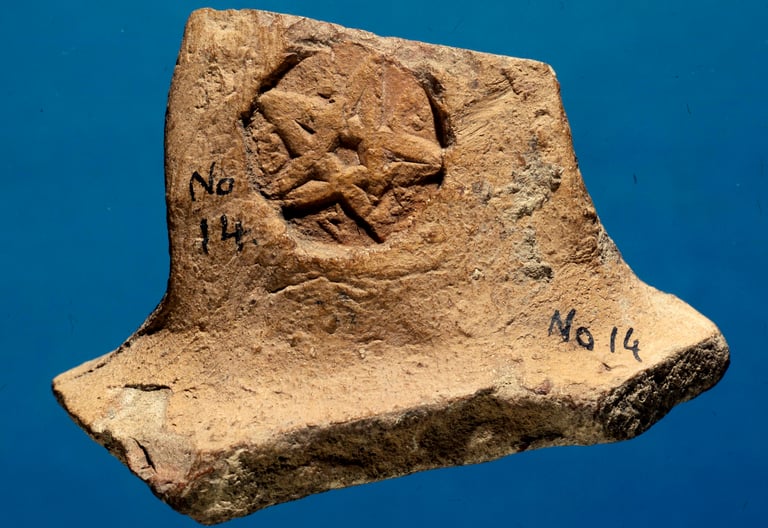
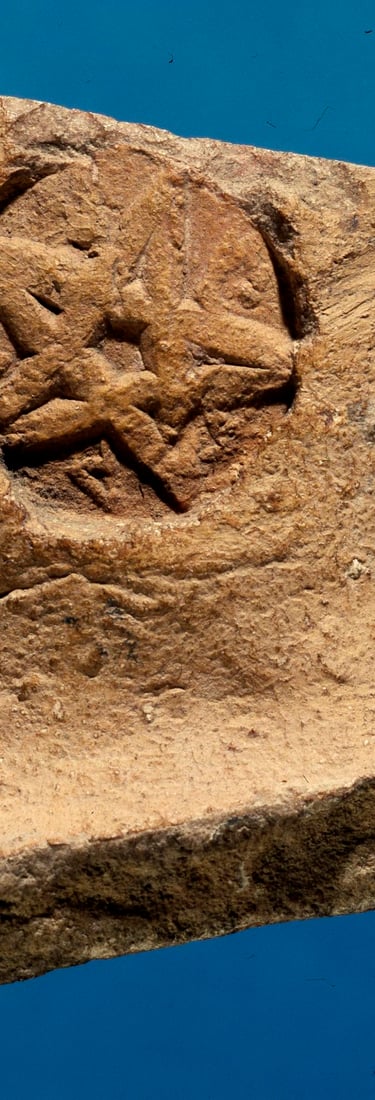
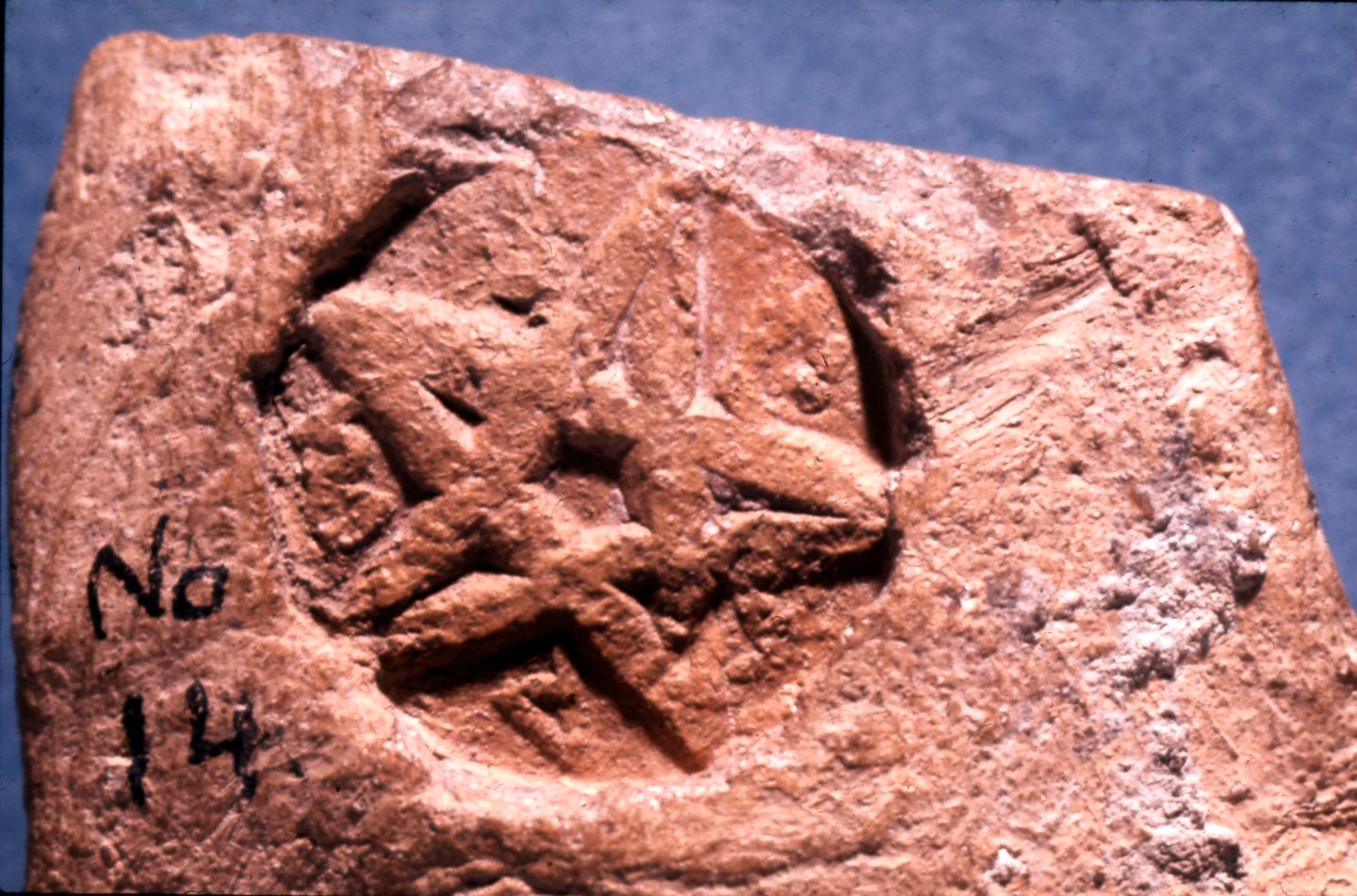

(May 21, 2024) This pottery jug handle was found by a collector sometime prior to 1927 when it was purchased by the British Museum. The collector claimed it came from the Ophel in Jerusalem. The Ophel is the side of the hill leading up to the temple mount. Whether it was really found on the Ophel is something we will never know but the letter style appears to be Judahite (southern Israelite) with a Phoenician bias suggesting it was made before the destruction of Jerusalem by the Babylonians around 587 BCE.
The British Museum Registration number is 1927,0530.83.
https://www.britishmuseum.org/collection/object/W_1927-0530-83
Close-Up of the same jug handle pentacle 600 BCE. The lettering is too rubbed out to read.
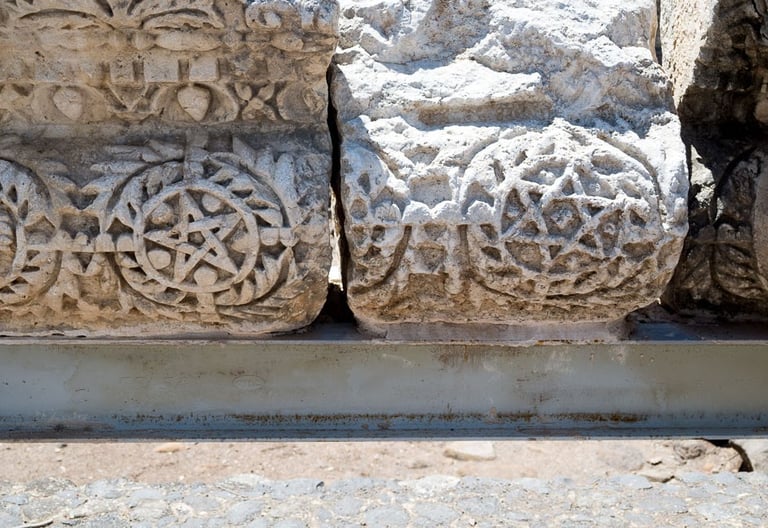
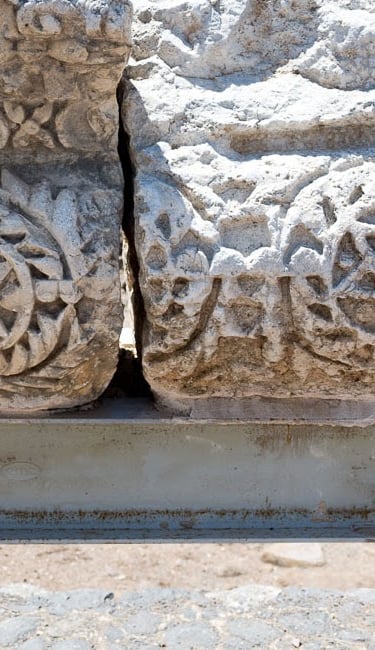

A Jewish pentacle is shown on the left surrounded by the 5 known planets (Mercury, Venus, Mar, Jupiter, Saturn). It was on a lintel in a synagogue in Capernaum in Galilee dating to 375 CE (Loffreda 1985). Galilee became the center of mystic Judaism at this time because it was on the magic trail trade route between Egypt and Mesopotamia (below).
Notice that this pentacle is woven showing each arm of the star going under or over the other arm.
References
Loffreda, Stanislao (1985) Recovering Capharnaum . Edizioni Custodia Terra Santa, Gerusalemme (Jerusalem)
Photo by David Olmsted
(July 3, 2022) Capernaum was located along the Magic Trail (figure 5). This was a Roman era trade route established by Herod the Great (reigned 37–4 BCE) with his building of the port city of Caesarea Maritima for connecting Egypt with Mesopotamia. This is how Herod acquired most of his wealth for his building projects including the Jerusalem Temple. This trade route opened during the time when Jesus lived in Capernaum so he was exposed to all sorts of ideas.
© 2022-2026. By David D. Olmsted. All pages licensed under a Creative Commons Attribution-NonCommercial-ShareAlike 4.0 International Copyright. https://creativecommons.org/licenses/by-nc-sa/4.0/