
Old Cornwall Runestones About Astrology Magic & Fate Shifting
Tawna Runestone 459 - Parish of Cardynham, Cornwall
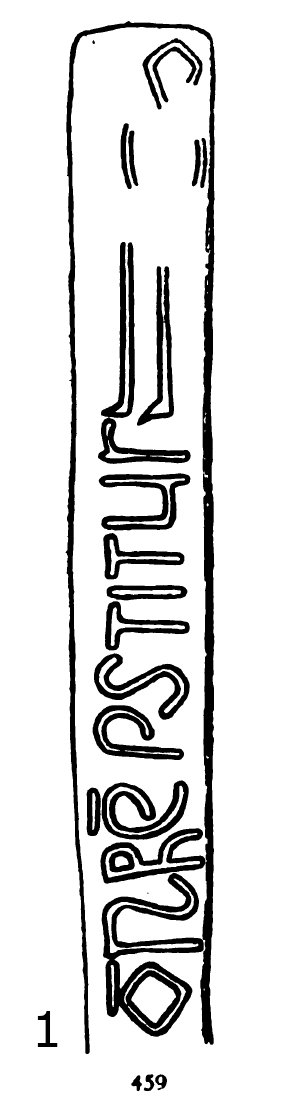
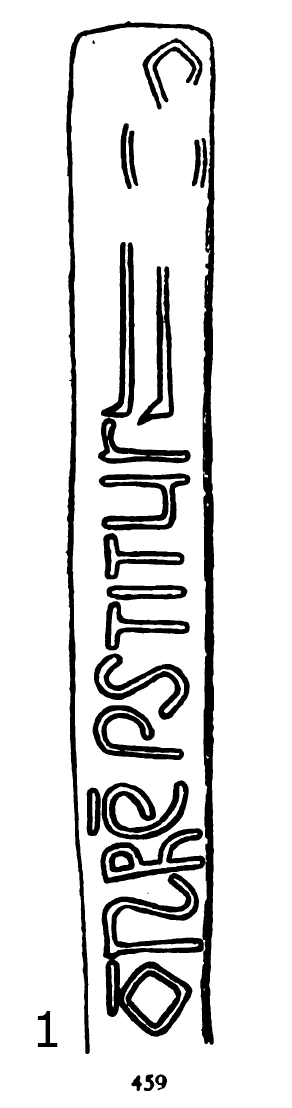
Translation in Druid Akkadian (Northern Text 154)
(read left to right. Capital letters on object. Small letters are inferred Inner vowels. Vowels are italic bold, Dual use letters are E/H, I/Y, U/W, and '/A in which vowel appears at beginning of words except for Yahu which is keeping its traditional Hebrew transliteration)
Runic letter style is Welsh from letter chart: North European Runic Lineage
Dictionary used: Latest Runic Akkadian dictionary
ANu RaKu Pu Su. Tu ITu UGu
In English
Considerations (emotion magic) can comb the openings of Su. Astrology-magic's omens are fearful.
Comment: Considerations are focused emotions used in emotion-magic. This text is stating that emotion magic can control the motion-powers (fate) coming from the dark new moon god Su. The astrology magic, usually associated with Su, does not need to be used.
Previously Attempted Translation
ORate Pro EPiscopus TITUS
This text was assumed to consist of Latin abbreviations composing a Christian official's name.
Background
(November 25, 2025) Macalister reports that this stone was being used as a post for the third gate on the left-hand side on the road to Bodmin from Venn Cross Roads.
A human figure seems to have been drawn at the top although that is not really complete enough to draw any conclusions.
This stone is a granite pillar being 4′ 7″ × 1′ 0″ × 0′ 9″
References
Macalister, R A Stewart. 1945. Corpus Inscriptionum Insularum Celticarum Volume 1, page 437. Online at: https://www.google.com/books/edition/Corpus_Inscriptionum_Insularum_Celticaru/4jgaAAAAYAAJ?hl=en
Gulval Runestone 463 - Parish of Gulval
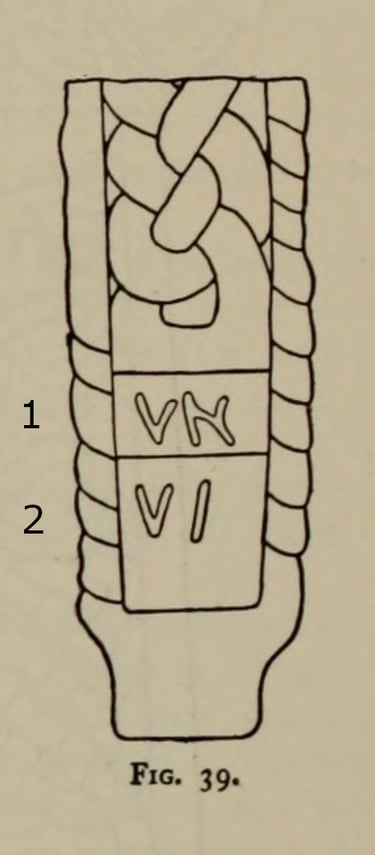
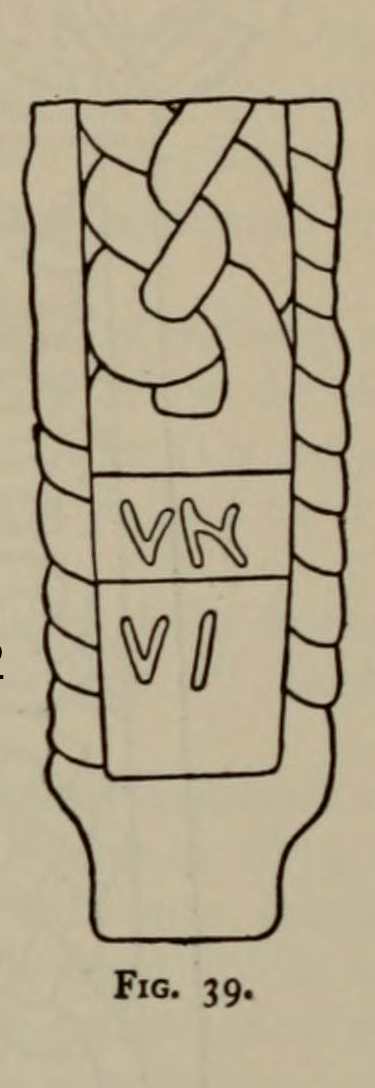
Translation in Druid Akkadian (Northern Text 158)
(read left to right. Capital letters on object. Small letters are inferred Inner vowels. Vowels are italic bold, Dual use letters are E/H, I/Y, U/W, and '/A in which vowel appears at beginning of words except for Yahu which is keeping its traditional Hebrew transliteration)
Runic letter style is Welsh from letter chart: North European Runic Lineage
Dictionary used: Latest Runic Akkadian dictionary
WaNu
UYu
In English
Resist
the fate-curses
Comment: This is a simple command to resist the fate curses with any sort of ritual. Fate and the curses from fate are defined by the celestial light goddess of Selu/Selene who represents the stars and planets.
Previously Attempted Translation
VRIVI
This text was assumed to consist of Latin abbreviations composing a Christian official's name.
Background
(November 25, 2025) Macalister reports that this stone was found in 1885 in the chancel wall of the church. It stands upside down, outside the church, beside the west end of the south aisle.
It is made of granite being 4′ 5″ × 1′ 5 1/2″ × 1′ 1/2"
References
Macalister, R A Stewart. 1945. Corpus Inscriptionum Insularum Celticarum Volume 1, page 438. Online at: https://www.google.com/books/edition/Corpus_Inscriptionum_Insularum_Celticaru/4jgaAAAAYAAJ?hl=en
Phillack Runestone 471 - Parish of Phillack


Translation in Druid Akkadian (Northern Text 162)
(read left to right. Capital letters on object. Small letters are inferred Inner vowels. Vowels are italic bold, Dual use letters are E/H, I/Y, U/W, and '/A in which vowel appears at beginning of words except for Yahu which is keeping its traditional Hebrew transliteration)
Runic letter style is Welsh from letter chart: North European Runic Lineage
Dictionary used: Latest Runic Akkadian dictionary
... Ma'u UḪu. ATu Tu ...
... Se'u Tu. Wa A LeYu
In English
... can push away exhalations (of fate from Selu/Selene). Monitor astrology-magic. ...
... can inhibit astrology-magic. Curses will affect those fate-powers.
Comment: This text seems to be about the interaction between astrology magic and the powers of fate.
Previously Attempted Translation
CLOTUALI FIL MOBRATTI
No English translation is given
Background
(November 25, 2025) Macalister reports that this stone was found standing south of the church against a shed. The church of Phillack was rebuilt in 1856 and the stone was discovered in the foundation of the old building.
It is a granite pillar being 5′ 3″ × 1' 6" x 1' 0" having highly weathered runes.
References
Macalister, R A Stewart. 1945. Corpus Inscriptionum Insularum Celticarum Volume 1, page 444. Online at: https://www.google.com/books/edition/Corpus_Inscriptionum_Insularum_Celticaru/4jgaAAAAYAAJ?hl=en
Color photo from: Photo from: Standing Stones of the Land's End Peninsula (2002/2007) by Ian McNeil Cooke: Online at: https://www.ancientpenwith.org/menhirs/men-scryfa.html

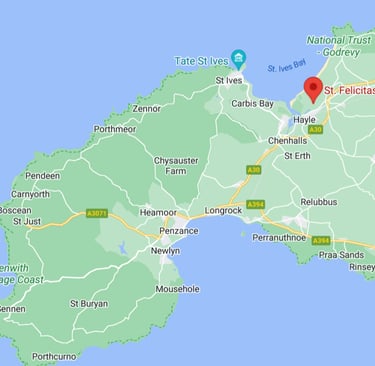
Location of Phillack runestone
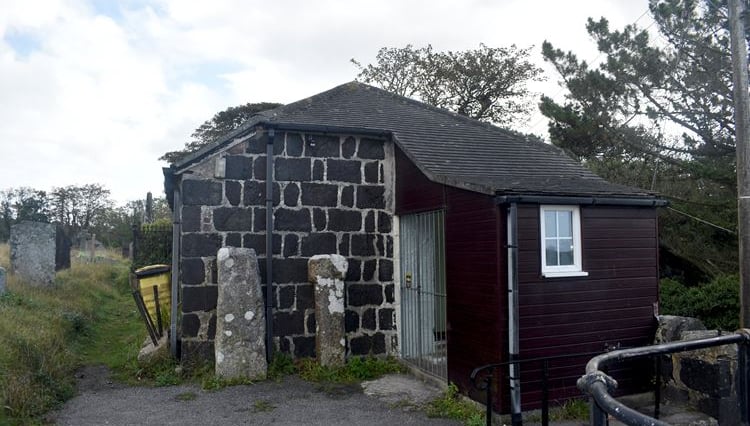


Runestone as it Appeared in 2021 Outside Old Church Vestry at Phillack in Cornwall, Britian
(Feb 20, 2023) This old vestry (church storage and changing room) is 35 meters east of the church of St. Phillack (St. Felicitas) which is southwest of St. Ives. The stele is in front by the corner. This building and stele and was registered with English Heritage in 1988 as a class 2 site number 1365625. It was used as a foundation stone in the first St. Phillack church which was torn down and replaced in 1856. Many more Celtic runestone with text likely exist as underground foundation stones of old churches.
References
Photo by Emma Trevarthen and found at:
https://historicengland.org.uk/listing/the-list/list-entry/1365625
Richard Edmonds (1857-58) The Celtic and Other Antiquities of the Land's End District of Cornwall. Archaeologica Cambrensis 3:3-4, pages 275-295, 350-368, 66-76, 173-183, 274-283
(The above articles were combined into an 1862 book)
Richard Edmonds (1862) The Land's End district: its antiquities, natural history, natural phenomena and scenery. Published by J. R. Smith
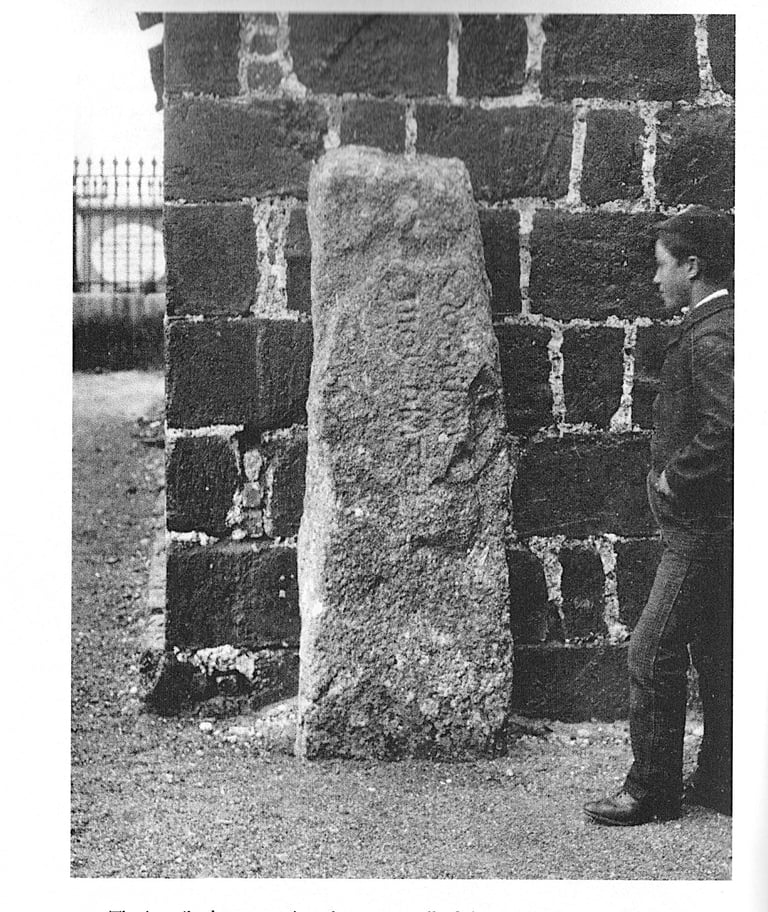
Phillack Stele as it Appeared in 1890
The mentioned Richard Edmonds in the above caption said the following in his book published in 1862 on page 63:
"An inscribed stone, as old perhaps as the last, formed one of the foundation stones of the late church at Phillack. It is 7 3/4 feet long, and now stands outside the wall of the vestry, in the southeastern corner of the courtyard but the inscription appears to be illegible."
References
Photo found in Chris Bond (2023) Antiquarian Notes on the Prehistory of Cornwall. Cornovia Press, Sheffield
Nanscowe Runestone 472 - Parish of Saint Breoc


Translation in Druid Akkadian (Northern Text 166)
(read left to right. Capital letters on object. Small letters are inferred Inner vowels. Vowels are italic bold, Dual use letters are E/H, I/Y, U/W, and '/A in which vowel appears at beginning of words except for Yahu which is keeping its traditional Hebrew transliteration)
Runic letter style is Welsh from letter chart: North European Runic Lineage
Dictionary used: Latest Runic Akkadian dictionary
Su EWu ERu -
Wa LaKu AQu. Nu IṢu I ....
In English
Su is shifting-attention to the harbor -
Fate-curses are indifferent to hope. The fate-revelations are making scarce the ....
Comment: The harbor is the rain making sky-shell. The text is stating the dark new moon god Su is beginning to get involved with it. Su is associated with astrology-magic which seeks to shift fate. The 2nd line is all about how fate is negatively affecting earth.
Previously Attempted Translation
VLCAGNI FILI
SEVERI
No English translation provided although this "translation" with its added letters at the end is in Latin and is supposed to read "Ulcangni daughter of Severi."
Background
(November 25, 2025) Macalister reports that this stone was at one time used as a gatepost on the farm of Nanscowe. Most recently it was standing in a small coppice on the left side of the garden road leading to the farmhouse.
The stone is made of granite being 4′ 0″ × 1′ 2″ × 0′ 10″
References
Macalister, R A Stewart. 1945. Corpus Inscriptionum Insularum Celticarum Volume 1, page 450. Online at: https://www.google.com/books/edition/Corpus_Inscriptionum_Insularum_Celticaru/4jgaAAAAYAAJ?hl=en
Saint Columb Major Runestone 475 - Parish of Saint Columb Major
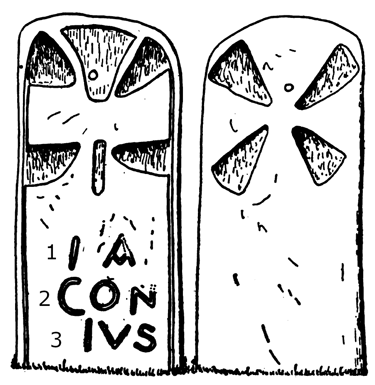
Translation in Druid Akkadian (Northern Text 168)
(read left to right. Capital letters on object. Small letters are inferred Inner vowels. Vowels are italic bold, Dual use letters are E/H, I/Y, U/W, and '/A in which vowel appears at beginning of words except for Yahu which is keeping its traditional Hebrew transliteration)
Runic letter style is Welsh from letter chart: North European Runic Lineage
Dictionary used: Latest Runic Akkadian dictionary
Yu A
Ka'u Nu
IWu Su
In English
Is not this
prodding revealing
the directing by Su?
Comment: "This" is referring to astrology-magic which the Druid cross represents. Astrology-magic is used to redirect fate represented by the celestial light goddess Selu/Selene. Astrology-magic gains its power from her masculine complement, the dark new moon god Su.
Previously Attempted Translation
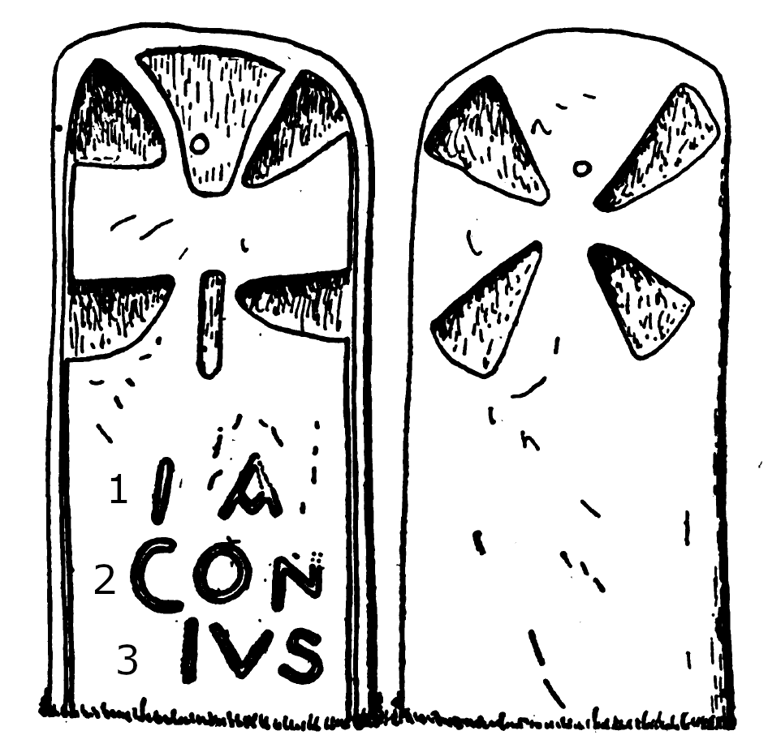
IACONIVS
No English translation provided
Background
(November 29, 2025) Macalister reports that this stone now stands in the churchyard just E. of the church porch. It was outside the churchyard in 1872 (according to Blight, page 10) , having been taken from a hedge in the neighborhood where it had served as a support for a railing. Holes were drilled through it for the purpose.
It is made of granite being 4′ 31″ × 2′ 1″ × 0' 10".
The image is that of an equilateral Druid Cross meaning "astrology-magic." This is also supported by the text.
References
Macalister, R A Stewart. 1945. Corpus Inscriptionum Insularum Celticarum Volume 1, page 453. Online at: https://www.google.com/books/edition/Corpus_Inscriptionum_Insularum_Celticaru/4jgaAAAAYAAJ?hl=en
Saint Hilary Runestone 481 - Parish of Saint Hilary
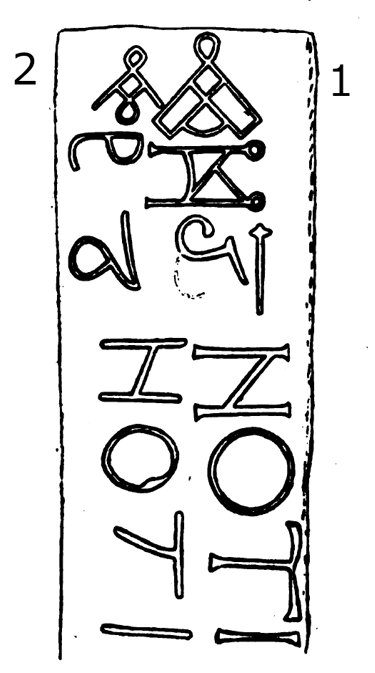
Translation in Druid Akkadian (Northern Text 173)
(read left to right. Capital letters on object. Small letters are inferred Inner vowels. Vowels are italic bold, Dual use letters are E/H, I/Y, U/W, and '/A in which vowel appears at beginning of words except for Yahu which is keeping its traditional Hebrew transliteration)
Runic letter style is Welsh from letter chart: North European Runic Lineage
Dictionary used: Latest Runic Akkadian dictionary
ANu Ṭu Ne'u Tu Ya
APu Ṭu Ne'u Tu Ya
In English
Considering Thu's emotional-effects is not astrology-magic
Veiling Thu's emotional-effects is not astrology-magic
Comment: Considerations are the focused emotions of emotion magic. This text is distinguishing between the practices of pure emotion magic involving the powers associated with the genderless deity Thu with the emotion magic involved with shitfing fate with astrology magic.
Previously Attempted Translation
NOTI
No English translation provided
Background
(January 11, 2026) Macalister reports that this stone was discovered in the burnt ruins of the old church of St. Hilary which was destroyed by fire in 1853. Also found in the ruins was a Roman miliary inscription from the time of Constantine. This stone was acting as a foundation stone in the chancel of the old church and is now set up just inside the churchyard gate to the E. of the entrance.
It is made of granite having dimensions of 6′ 6″ × 1' 8" x 0' 10". The top 2 letters of line 1 (A and N) and top letter of line 2 (A) have been decorated in a way seen in the illustrated Book of Kells dating to the 800's. This book consists of the 4 Biblical gospels written in Latin.
References
Macalister, R A Stewart. 1945. Corpus Inscriptionum Insularum Celticarum Volume 1, page 460. Online at: https://www.google.com/books/edition/Corpus_Inscriptionum_Insularum_Celticaru/4jgaAAAAYAAJ?hl=en
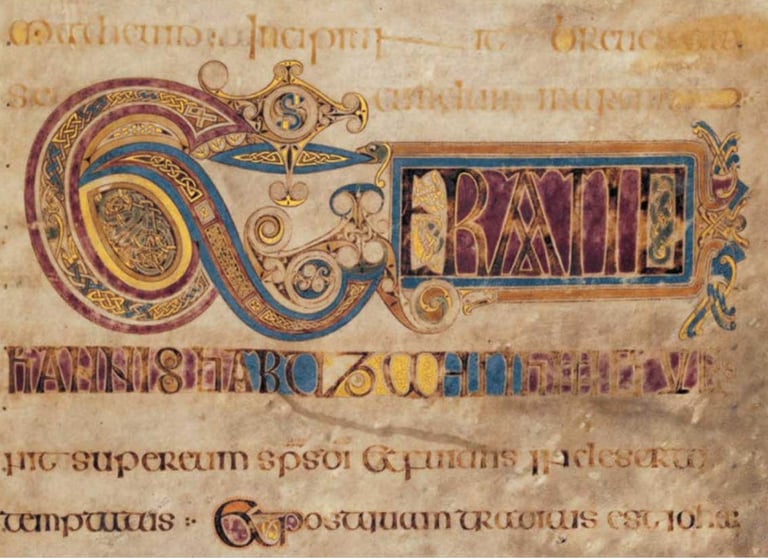
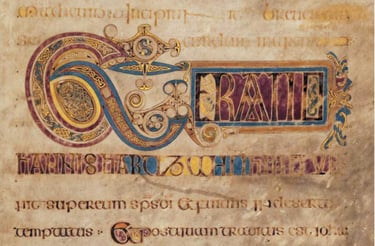
A page from the Irish Book of Kells (800 CE) showing the letter "A" in the style similar to that seen in the runestone above. Photo from https://stpatricksguild.com/book-of-kells/?srsltid=AfmBOorXXqBDrg2UP0pWyPV3DfXYmIshbo0_xr-2av2XxSyHeAmodHpX
Saint Just Runestone 483 - Parish of Saint Hilary
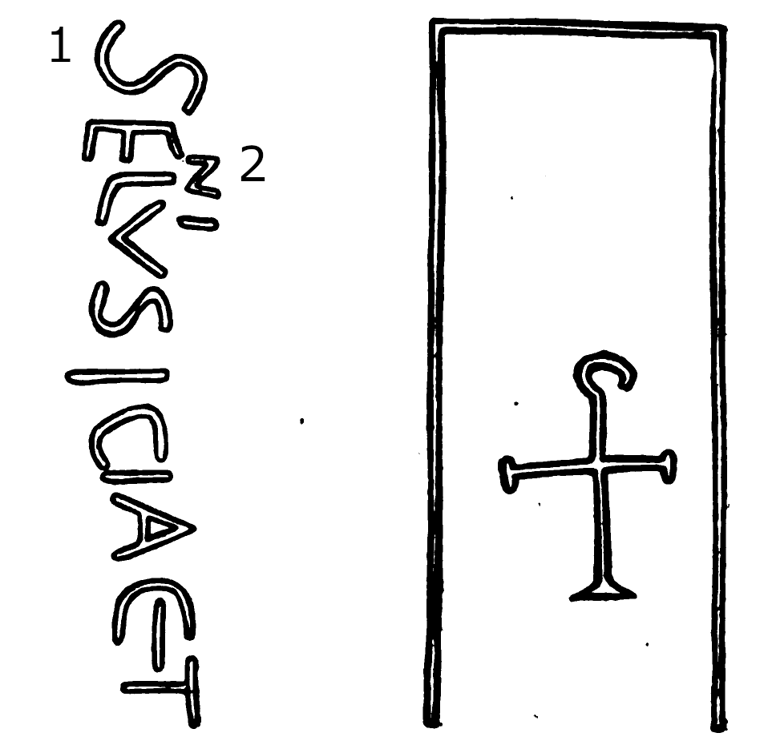

Translation in Druid Akkadian (Northern Text 174)
(read left to right. Capital letters on object. Small letters are inferred Inner vowels. Vowels are italic bold, Dual use letters are E/H, I/Y, U/W, and '/A in which vowel appears at beginning of words except for Yahu which is keeping its traditional Hebrew transliteration)
Runic letter style is Welsh from letter chart: North European Runic Lineage
Dictionary used: Latest Runic Akkadian dictionary
Su ELu Wa. Su IKu Ya AKu - Tu
Nu Ya
In English
Su's high-powers have been restricted (2. Not revealed). Su is not irrigating the emotion-owls - for astrology-magic.
Comment: The "Not revealed" phrase is a gloss for the first sentence to clarify that "restricted" means that Su's powers are not being revealed. Su is the dark new moon god associated with astrology magic which is used to shift fate.
Previously Attempted Translation
SELNIVS IC IAC - T
No English translation provided
Background
(January 12, 2026) Macalister reports that this stone was discovered in the parish church in the year 1834. It is now preserved in the north aisle just inside the N. door. One of its sides has the equilateral cross representing "astrology magic." This was the runic letter "T" in older runic texts.
It is a block of granite being 3′ 5″ × 1′ 2″ × 0' 10".
References
Macalister, R A Stewart. 1945. Corpus Inscriptionum Insularum Celticarum Volume 1, page 462. Online at: https://www.google.com/books/edition/Corpus_Inscriptionum_Insularum_Celticaru/4jgaAAAAYAAJ?hl=en
Buckland Monachorum Ogham/Rune Stone 488 Near Tavistock, County Devon
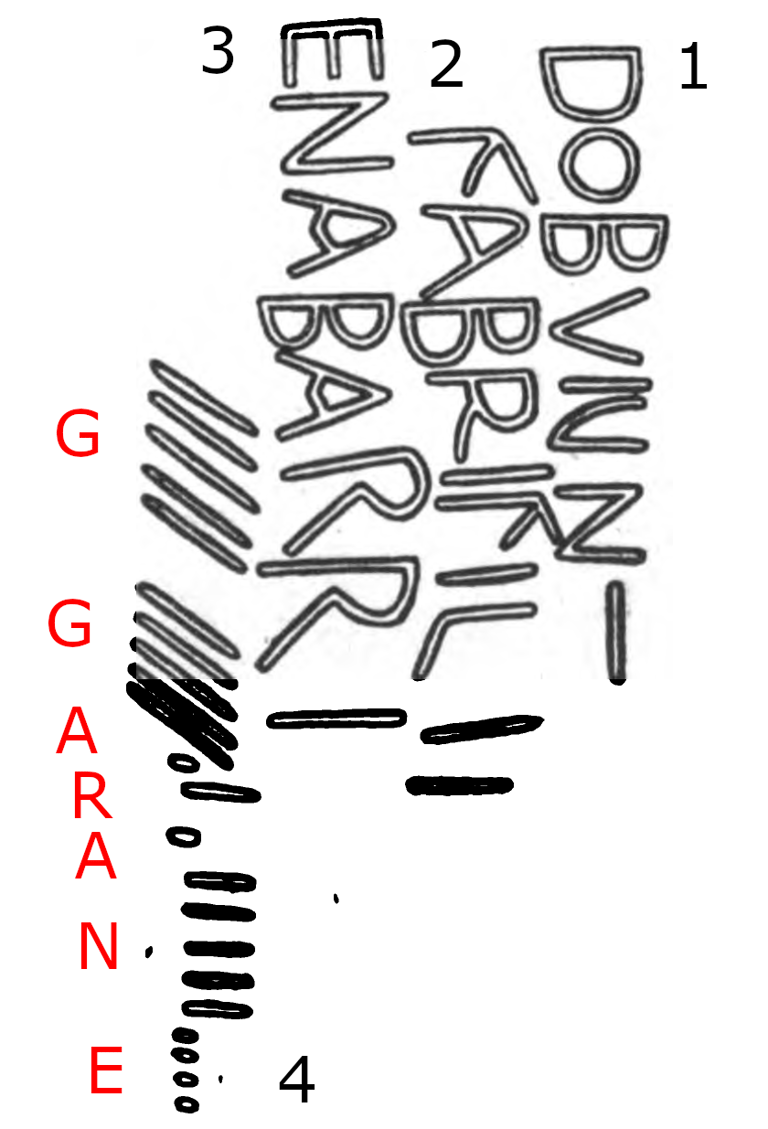
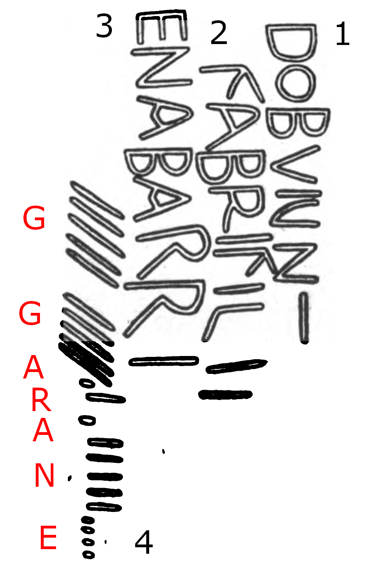
Translation in Druid Akkadian (Northern Text 178)
(read left to right. Capital letters on object. Small letters are inferred Inner vowels. Vowels are italic bold, Dual use letters are E/H, I/Y, U/W, and '/A in which vowel appears at beginning of words except for Yahu which is keeping its traditional Hebrew transliteration)
Runic letter style is Welsh from letter chart: North European Runic Lineage
Ogham from Ogham Letter Chart
Dictionary used: Latest Runic Akkadian dictionary
Di'u Bu U IWu Nu -
Ṣu A BaRu IṢu ILu
ENu A Bu ARu Ru
[ogham] ENu ARu A GaGi
In English
Divine-emotion-powers (from Su) can nourish and redirect the fate-revelations.
The activity of its Seers (who do astrology magic) will make scarce the high-motion-powers (causing fate).
Reassignments of those nourishments will control the griffons.
[ogham] Reassignments by the Controllers (owls) can affect the underworld.
Comment: Shepherd-priests are magic crafters who seek to shift fate using astrology-magic (Tu). This text is about how they can use emotion powers to redirect fate. The griffons edit the divine irrigation network which direct life powers to earth. If the life power flow is reduced then this text assumed they will cut that network channel/thread. The last sentence in ogham states that such shifts of fate can affect the fate powers of Kate/Hekate in the underworld.
Previously Attempted Translation
DOBVNN
FABRI FILII
ENABARRI
ENABARR
No English translation provided
Background
(January 13, 2026) Macalister reports that this stone was found being used as a gatepost. Two iron staples still remain on the left side from that function. It is now in the vicarage garden at Tavistock, apparently moved there by Rev. E. A. Bray, sometime vicar of that parish.
It is a pillar of grit 4′ 8″ × 1′ 5″ × 0' 11"
References
Macalister, R A Stewart. 1945. Corpus Inscriptionum Insularum Celticarum Volume 1, page 468. Online at: https://www.google.com/books/edition/Corpus_Inscriptionum_Insularum_Celticaru/4jgaAAAAYAAJ?hl=en
The ending lines in sentences 2 and 3 do not seem to be part of the text but are instead scratches.
Yealmpton Runestone 494, County Devon
Translation in Druid Akkadian (Northern Text 185)
(read left to right. Capital letters on object. Small letters are inferred Inner vowels. Vowels are italic bold, Dual use letters are E/H, I/Y, U/W, and '/A in which vowel appears at beginning of words except for Yahu which is keeping its traditional Hebrew transliteration)
Runic letter style is Welsh from letter chart: North European Runic Lineage
Dictionary used: Latest Runic Akkadian dictionary
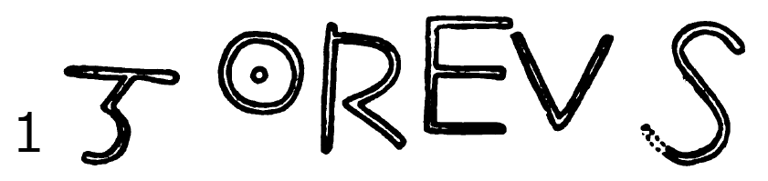
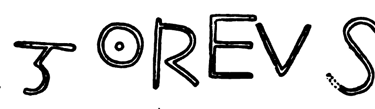
Ta'u Ru EWu Su
In English
The pasture's griffons are shifting-attention to Su.
Comment: The pasture is the starry night sky which defines fate. Normally its divine birds are owls, not griffons/eagle-vultures which edit and cut the life threads/channels of the divine irrigation network which direct life powers to earth. This text seems to have confused the 2. Su is the dark new moon god associated with shifting fate so the whole point of this text is that the divine birds normally revealing fate are having their fate shifted by Su.
Previously Attempted Translation
NEPRANI
FILI CONBEVI
No English translation provided
Background
(March 4, 2026) Macalister reports that this stone was a granite pillar, standing at the west end of the parish church , opposite the tower doorway
Its dimensions are: 5′ 11″ × 1′ 4″ × 0′ 9″.
References
Macalister, R A Stewart. 1945. Corpus Inscriptionum Insularum Celticarum Volume 1, page 472. Online at: https://www.google.com/books/edition/Corpus_Inscriptionum_Insularum_Celticaru/4jgaAAAAYAAJ?hl=en
Silchester 496, County Hampshire

Translation in Druid Akkadian (Northern Text 186)
(read left to right. Capital letters on object. Small letters are inferred Inner vowels. Vowels are italic bold, Dual use letters are E/H, I/Y, U/W, and '/A in which vowel appears at beginning of words except for Yahu which is keeping its traditional Hebrew transliteration)
Runic letter style is Welsh from letter chart: North European Runic Lineage
Dictionary used: Latest Runic Akkadian dictionary
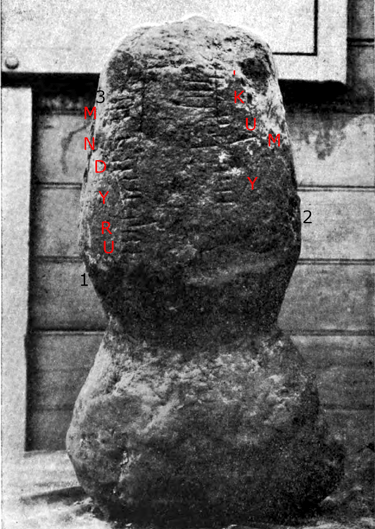
Wa ReYu Du
IMu Wa Ka'u
[Runes] Mu Nu
In English
Restrict the shepherd-priest's manifestations.
Emotions can restrict the prodding.
[Runes] Fertility-fluids will be revealed.
Comment: Shepherd-priests do astrology magic which shift fate. That is their "manifestations." Doing this fixes the future which negates the effects of conventinal emotion magic which seeks to push and prod the fertility fluids through the divine irrigation network
Previously Attempted Translation
EBICATO [S MAQ]
I MUCO[ ....
No English translation provided
Background
(March 4, 2026) This stone was found during an 1893 excavation of a Roman town called Calleva Atrebatum in Silchester, Hampshire. Thus far it remains the only one of its kind found in England, and the only ogham inscription in England east of Cornwall and Devon.
It now measures 1 ' 11 " in height and consists of a plinth , originally about 0' 4" x 1′ 2″ x 1' 2" , with a circular base above it , having a cyma and a torus molding. Above is the pillar, which is of a cone shape, widening upwards from o' 8" to 0' 10" diameter, and then narrowing to the top. The top is broken off with the diameter at the fracture being 0' 7".
The pillar stone was found upside down some five to six feet beneath the surface, apparently at the bottom of a former well. A white metal or pewter vessel "of peculiar form" lay underneath, crushed by it.
The pewter vessel turned out to be a simple, biconical flagon similar to a few other examples found in southern Britain which can be dated broadly to the 300s CE.
References
Macalister, R A Stewart. 1945. Corpus Inscriptionum Insularum Celticarum Volume 1, page 474. Online at: https://www.google.com/books/edition/Corpus_Inscriptionum_Insularum_Celticaru/4jgaAAAAYAAJ?hl=en
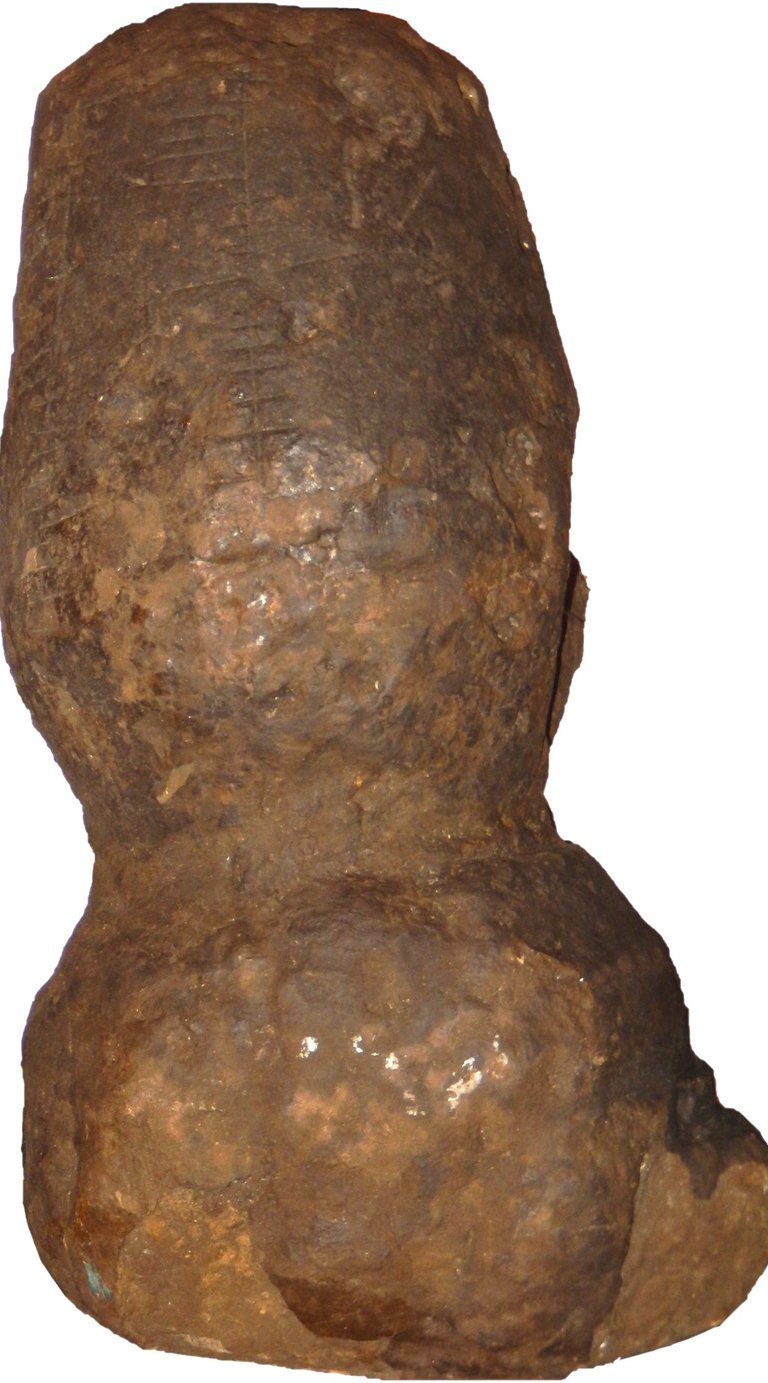
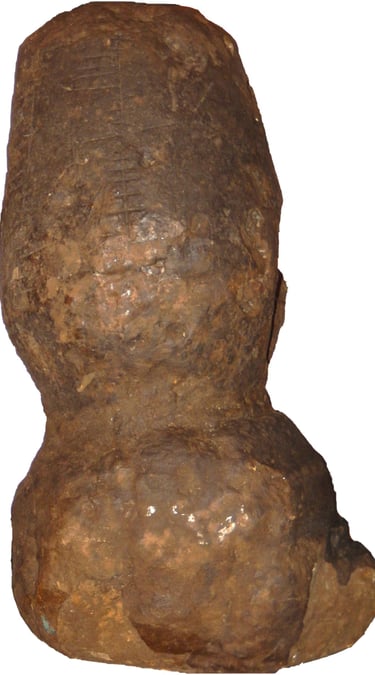
The Silchester Ogham stone in storage at the Reading Museum storage facility, Reading, Berkshire in 2016. From Wikimedia Commons at: https://commons.wikimedia.org/wiki/File:Silchester_Ogham_Stone.jpg

© 2022-2026. By David D. Olmsted. All pages licensed under a Creative Commons Attribution-NonCommercial-ShareAlike 4.0 International Copyright. https://creativecommons.org/licenses/by-nc-sa/4.0/