Evolution of Celtic Crosses From Witchcraft Symbols
Two rune styles are found in Britain and Ireland. First is the Celtic style appearing around 100 BC deriving from Rhone river trade, Second is the Rhine River style appearing around 450 CE. Ogham originated as a neutral way for both groups to communicate.
Header Reference
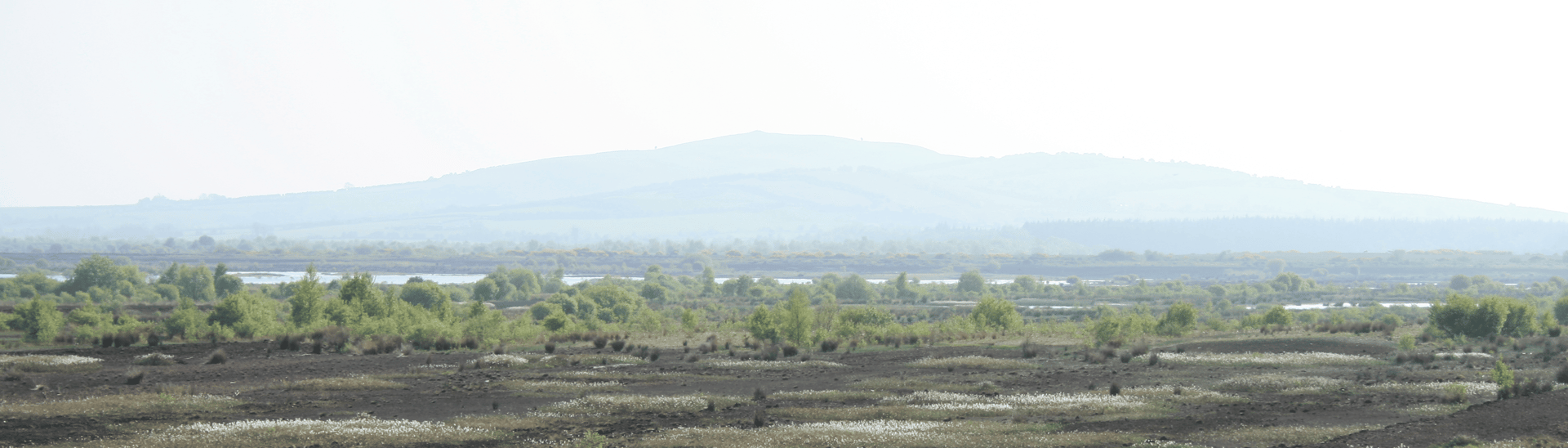
The image of the header shows the large Bog of Allen with the extinct volcano called Croghan Hill in the distance. The Bog of Allan is one of the largest bogs in Ireland being 958 square kilometres (370 square miles) stretching into counties Offaly, Meath, Kildare, Laois, and Westmeath. It is located in the center of Ireland between the rivers Liffey and Shannon. It is one of the bogs which supported the large Druid site of Clonmacnois. I would have been even larger during the iron age.
https://en.wikipedia.org/wiki/Bog_of_Allen
National Museum of Ireland at https://www.museum.ie/en-ie/collections-research/irish-antiquities-division-collections/collections-list-(1)/iron-age
Celtic Doydon Runestone 478 - Parish Of Saint Endellion, Cornwall (~100 BC)


Background
(January 10, 2026) Macalister reports that this stone formerly stood on the cross-road midway between St. Endellion and Port Quin on a base, which still remains in its original position. It then went by the name of "Long Cross." It has now been moved to a very weather exposed place in front of a castellated summer-house, on Doydon Headland; and in consequence it is suffering severely from the weather.\
The small ogham inscription is too disintegrated for certainty. A mortice has been cut in the top, 3/4" deep, and 3" x 4" across.
The squarish runes show this rune style is not too far from the Aegean style it derives from. The use of a more flowing sign for astrology magic in the La Tene style also dates it early. A good date for this would be around 100 BE.
The stone is granite being 4' 6" x 0' 11" x 0' 8"
La Tene Material Culture
La Tène iron age material culture items in Britain are are generally dated to between 400 BCE and 43 CE when the Romans conquered Gaul. They are characterized by ever more curvilinear and abstract designs replacing the more realistic art styles. The Romans kept the more realistic art styles following Greek realism.
The style appeared in Ireland around 200 BCE and became a permanent part of Irish culture.
References
Macalister, R A Stewart. 1945. Corpus Inscriptionum Insularum Celticarum Volume 1, page 456. Online at: https://www.google.com/books/edition/Corpus_Inscriptionum_Insularum_Celticaru/4jgaAAAAYAAJ?hl=en
Translation in Druid Akkadian (Northern Text 171)
(read left to right. Capital letters on object. Small letters are inferred Inner vowels. Vowels are italic bold, Dual use letters are E/H, I/Y, U/W, and '/A in which vowel appears at beginning of words except for Yahu which is keeping its traditional Hebrew transliteration)
Runic letter style is Celtic from letter chart: North European Runic Lineage
Ogham signs too uncertain to read
Dictionary used: Latest Runic Akkadian dictionary
Bu Pa'u Ku A Qu. Nu YaYa Ḫu. KaYu A'u Tu
Gi A Di'u Tu
Tu IKu Ya IWu Su
In English
Nourishing the divine-bird's (griffon's) involvement will affect their life-threads. Fate-revelations will pain Hu. Prod the emotion-powers (awen) with astrology-magic.
Emotion-energy can affect those divine-powers with astrology-magic.
Astrology-magic (witchcraft) will not irrigate redirecting by Su.
Comment: This text is saying that because fate pains the sun and storm god Hu that emotion magic should be used to shift fate using astrology magic. Astrology-magic shifts fate by weakening the flow of life powers to the fated objects (that is, cursing it) and amplifying the flow of life powers to other objects in its place. The text ends by stating that astrology magic does not just amplify the life power flow already being done by the dark new moon god Su.
Previously Attempted Translation
BROCAGNI IHC LACIT NADOTTI FILIVS
No English translation provided
The symbol at the top is the Druid PT symbol meaning "Open Astrology-magic" from the letters P and T respectively. It is not a Christian Chi-Ro symbol. It is showing some of the curvilinear style of the La Tene material culture which dates this to anytime after 300 BCE.
Celtic Whithorn Runestone 519 - County of Wigtown, Scotland (~300 CE)
Background
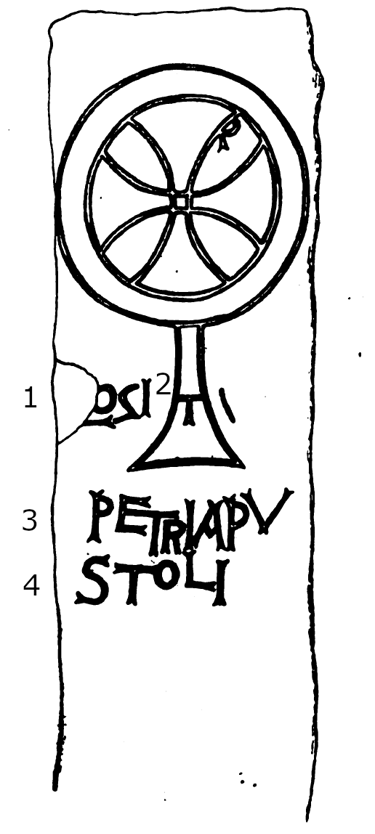
Macalister does not provide any geographic information about this stone. Whithorn was a coastal town on the southwest coast of Scotland across from Ireland.
The town was the location of the first recorded Christian church in Scotland, Candida Casa "White/Shining House", built by Saint Ninian about 397 CE. Since Christians liked to take over Druid sacred sites when permitted by the local ruler, this indicates that a Druid site was here.
This stone has dimensions 3′ 8″ × 1′ 1″ × 0′ 9 1/2 ″
References
Macalister, R A Stewart. 1945. Corpus Inscriptionum Insularum Celticarum Volume 1, page 497. Online at: https://www.google.com/books/edition/Corpus_Inscriptionum_Insularum_Celticaru/4jgaAAAAYAAJ?hl=en
Translation in Druid Akkadian (Northern Text 206)
(May 3, 2026)
(read left to right. Capital letters on object. Small letters are inferred Inner vowels. Vowels are italic bold, Dual use letters are E/H, I/Y, U/W, and '/A in which vowel appears at beginning of words except for Yahu which is keeping its traditional Hebrew transliteration)
Runic letter style is Celtic from letter chart: North European Runic Lineage
Dictionary used: Latest Runic Akkadian dictionary
Le'u Ku Ya
Tu
Pu ETu ReYu APu Wu
Su Ta'u LeYu
In English
Fate will not involve
astrology-magic (witchcraft).
Opening the boundary with shepherd-priests (witches) will veil the restrictions (of fate)
Su can pasture fate.
Comment: This text is saying that witchcraft does not cause the deaths resulting from fate but instead seeks to restrain and control (pasture) fate. Su is the dark new moon god associated with astrology magic which shifts fate. Shepherd-priests are the priestly class which do astrology magic. The boundary is the sky-shell holding the life network which directs the life powers to earth.
Previously Attempted Translation
LOGI
T
PETRI APV
STOLI
This was incorrectly claimed to a Latin phrase which translates into English as:
Lodging of Peter the apostle
The problem is that the word "logi" is the Latin root for "logic." "Logi" could be Old French "Loge" (hut, lodging) which dates to after 1100 and only arrived in Britain with the Normans. Then the "T" has to be ignored. Also Latin texts never split words (although they will use abbreviations if space is limited).
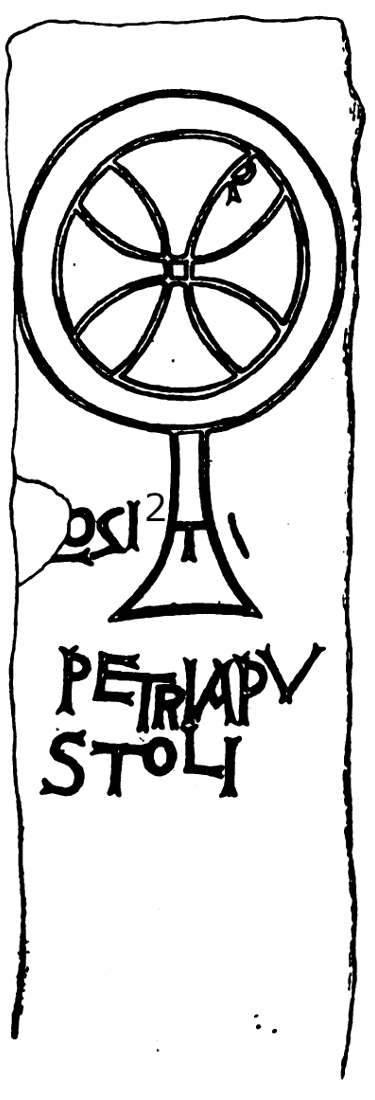
Based on the text, the sign at the top is the Druid astrology-magic (witchcraft) symbol deriving from the Etruscan letter "T." While it could be interpreted as a Christian Chi-Ro symbol if the narrow arms are considered to be a part of the sign instead of the wide arms, the text does not support that interpretation.
The hollow circle represents the dark new moon and eye pupil god Su who powers astrology-magic (witchcraft). The added lower arm represents the flow of its power from the divine realm to earth. In this image that arm is clearly separate from the witchcraft symbol.
Celtic Saint Clement Ogham/Rune Stone 473 - Parish of Saint Clement/Truro, Cornwall (~550 CE)


Background
Macalister reports that this stone was first noticed in 1754 serving as a gatepost at the entrance to the Vicarage of St. Clement's. It now stands, and has stood for some considerable time, inside the entrance gate.
It made from granite being 9' 0" x 1' 4" x 1' 2"
Originally, this stone had ogham on either side of the runic text but most of the ogham was chipped away giving a wavy shape to the stone.
The top of this stone shows an equilateral Druid cross representing astrology magic. This derives from an earlier form of the "T" letter representing the Druid Akkadian word Tu meaning "astrology magic."
Yet this stone mixes Druidry with Christianity using the 2 Druid deities who are also Christian deities (Yahu/Yahweh translated as Lord in the English King James Bible and Alu translated as "God" in the same Bible. The earliest date for this stone would then be around 330 CE when the Roman emperor Constantine (ruled 306 to 337 CE) started promoting public Christianity.
References
Macalister, R A Stewart. 1945. Corpus Inscriptionum Insularum Celticarum Volume 1, page 451. Online at: https://www.google.com/books/edition/Corpus_Inscriptionum_Insularum_Celticaru/4jgaAAAAYAAJ?hl=en
Translation in Druid Akkadian (Northern Text 167)
(May 3, 2026)
(read left to right. Capital letters on object. Small letters are inferred Inner vowels. Vowels are italic bold, Dual use letters are E/H, I/Y, U/W, and '/A in which vowel appears at beginning of words except for Yahu which is keeping its traditional Hebrew transliteration)
Runic letter style is Celtic from letter chart: North European Runic Lineage
Dictionary used: Latest Runic Akkadian dictionary
IQu Nu Ya'u Ku
Wa ITu ALu - Ṣu ILu Ya Ta'u Pu. ReYu Ku Ya
In English
The flock (owls) will reveal Yahu's involvement.
Restrictions will foreshadow Alu (God). - Activations (from emotion magic) cannot elevate the pasture's (night sky) openings. The shepherd-priests (witches) are involved.
Comment: Druidry shares 2 gods with Christianity, Yahu/Yahweh and Alu/Alohim Yahweh (power of Yahu) is translated as "Lord" in the King James Bible while Alohim/'elohim (powers of Alu) is translated as "God." This false translation gives the illusion of monotheism when the Old Testament, when properly translated, shows that concept in transition. Both are life powers with Alu being the source god while Yahu manifests life on earth upon command of the higher powers. Drought or plague which restricts new life involves Yahu. The 2nd line goes on to say that emotion magic cannot overcome these fate caused restrictions. Only astrology-magic (witchcraft) which seeks to shift fate has any hope of correcting such restrictions. This text shows that the author was aware of Christianity but considered it just another denomination of Druidry (similar to the Druid groups promoting emotion magic or astrology-magic.)
Previously Attempted Translation
IGNIOC
VITALI FILI TORRICI
No English translation provided
This is one of the earliest runestones to mix Christianity with Druidry. A Druid cross representing astrology magic is shown at the top. Notice the art style is realistic instead of La Tene indicating it belongs to the Roman artistic tradition.
Bog Iron Brought Eastern Roman Goods Into Ireland Via Rhine River Ships with their Trader's Runic Literacy.
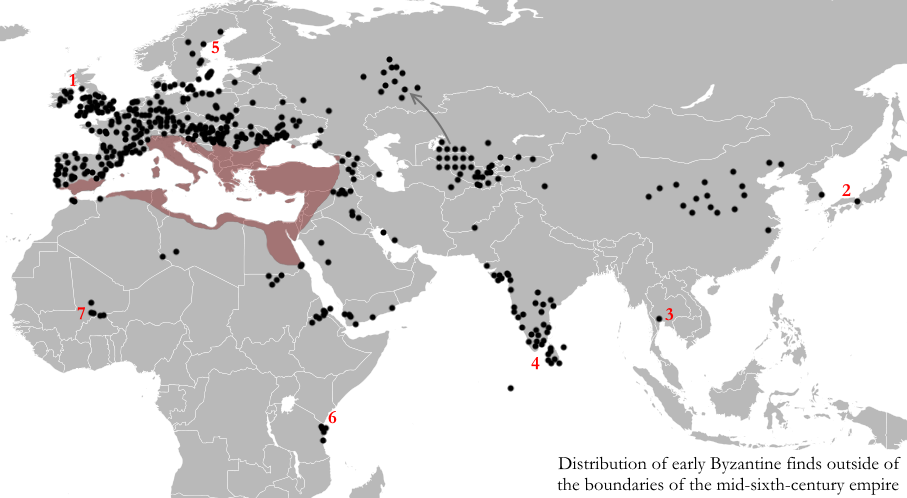
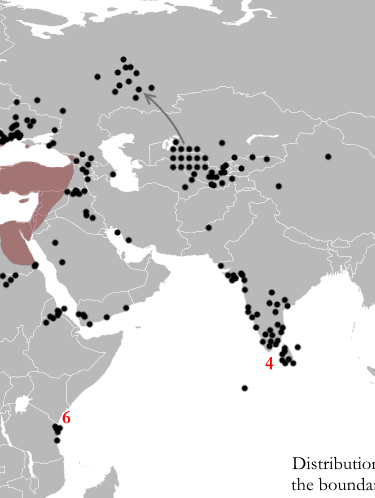
The Christianized Roman empire ruling from Byzantium had a resurgence between 450 and 550 CE until the Plague of Justinian ended it. It traded with Europe along newly cleared river trade routes, especially the Danube-Rhine trade route which had opened up to trade again after it had ceased to be a violent frontier between Rome and various Germanic tribes. The Roman empire traded luxury goods for Celtic bog iron. Map from Green (2017). In 407, the usurper Constantine III removed the remaining field army to fight in Gaul which removed the last Roman power from northern Europe.
References
Green, Caitlin (March 2017) Blog post entitled "A very long way from home: early Byzantine finds at the far ends of the world." Online at: https://www.caitlingreen.org/2017/03/a-very-long-way-from-home.html
Nea Paphos Temple Token Text From Cyprus Starts The Rhine River Letter Style Seen In Ireland (Before 390 CE)
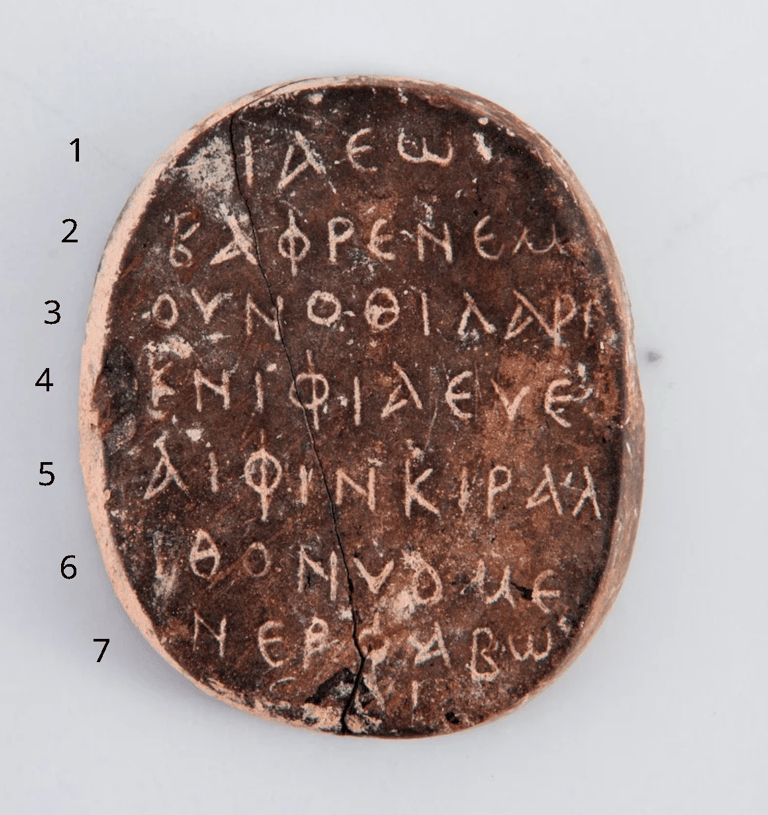
Background
The letter style of this token shows a letter style developing into the Rhine river style which would later be found in Britain, Ireland, France (Carolingian), and Belgium/Netherlands (Anglo-Saxon) after 450 CE. Its theme is Druid and not Christian.
This token was discovered in the summer of 2011 (3rd July – 6th August 2011) by archaeologists at the Paphos Agora Project during the first excavation campaign (Śliwa, J. 2013). It was discovered in trench II, area 2 (room 5), in the center of the Agora. Its find layer was identified as late Eastern Roman dated to the 500's CE partially due to the presence of ceramic objects of the Cypriot Red Slip Ware type.
Nea Paphos (New Paphos) was founded around 400 BC as an important harbor along the sea trade route from the Black Sea and Greece to Egypt. Shortly after 200 CE Nea Paphos became the capital of Cyprus. It replaced Old Paphos near the Sanctuary of Aphrodite (originally temple of the Druid goddess Ayu based on found figurines) which developed after the Great Drought of 1350 BC. Its remains have been located by British archaeologists in the area of the modern town of Kouklia.
After 22 BC Cyprus became a province of the Roman Senate governed by a proconsul. An earthquake around 15 BC which destroyed Paphos. The reconstruction was initiated by Emperor Augustus. Paphos then came to be called Augusta (Sebaste), and the nickname Flawia was added by Emperor Titus, who personally visited the local sanctuary of Aphrodite. As Strabo writes, Sebaste had beautiful buildings and temples. They were mainly inhabited by local Greeks, as well as Romans, Jews and the early Christian diaspora. The residents had the right to mint their own coin with the representation of the temple of the goddess Aphrodite on the reverse side.
Earthquakes struck Paphos 3 more times during Roman Period in 77/76, 126, and twice during the 300's. This destruction caused it to lose it importance although it continued to be occupied. These earthquakes and the anti-Pagan decrees of Emperor Theodosius I around 390 BCE would have closed the temple of Aphrodite.
Consequently, the date assigned to it by the archaeologists must be wrong. It Paphos Agora projec's website even admits the earthquakes have made interpreting the archaeological layers problematic. It says:
"The numerous destruction and reconstruction of the city with the frequent re-use of the same building materials resulted in a very complex arrangement of cultural layers discovered by archaeologists today."
References
Paphos Agora Project. https://paphos-agora.archeo.uj.edu.pl/en_GB/nea-pafos
Śliwa, J. (2013) Magical amulet from Paphos with the iaew - palindrome, Studies in Ancient Art and Civilization 17, 293-301. Online at: https://www.academia.edu/14185465/Magical_Amulet_from_Paphos_with_the_%CE%B9%CE%B1%CE%B5%CF%89_palindrome_2013_
Translation in Druid Akkadian (Med Text 74)
(February 19, 2025, updated May 2, 2026)
(read left to right. Capital letters on object. Small letters are inferred Inner vowels. Vowels are italic bold, Dual use letters are E/H, I/Y, U/W, and '/A in which vowel appears at beginning of words except for Yahu which is keeping its traditional Hebrew transliteration)
Runic letter style is a mix between Aegean, Celtic, and Rhine River (representing both ends of the Rhine-Danube river) from letter chart: North European Runic Lineage
Dictionary used: Latest Runic Akkadian dictionary
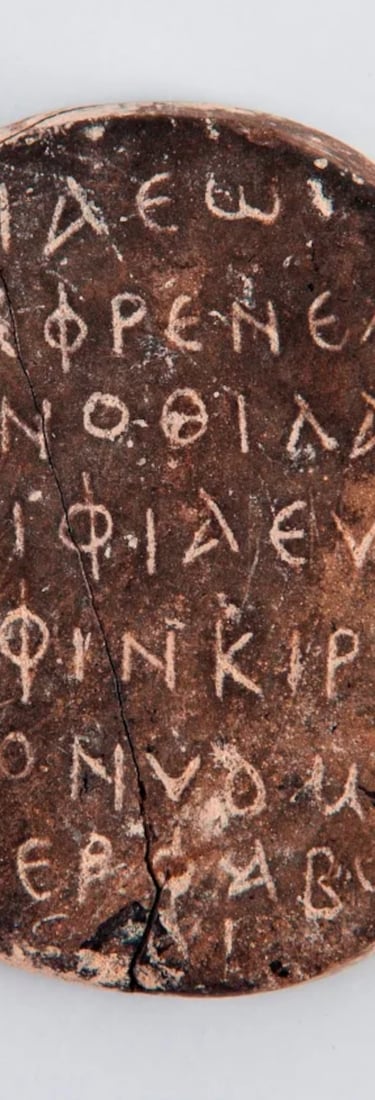
[A]Yu A EṢu
Bu A ṬaRu E Nu EMu
AWu Ne'u Qu ILu ARu Gi
Ku Nu IṬu Ya A. EWu E
A IṬu INu Ku IRu A Lu
Qi'u Nu U'a M E
Nu E ReṬu ABu Ṣu
In English
[A[Yu can affect this shedding (of fate).
Nourishments (life powers) can affect the impressions making-ineffective the fate-revelations of the Supervisor (Su)
Emotion-powers (Awen) can emotionally-affect the threading of the high-powers. Control the emotional-energies.
Involving fate-revelations does not make-sticky those-powers. Shifting attention (with astrology-magic) is ineffective.
Affecting the stickiness with the Moon-eye (Su) will involve the astrological-fate-powers affecting the lack.
Envy has revealed the curses causing the fertility-fluids disablement.
Fate-revelations have disabled the streams of the priest-parent's activities.
Comment: A drought is being blamed on fate triggered by too much envy in the population. Priest-parents are the Druid priestly class involved with life-powers.
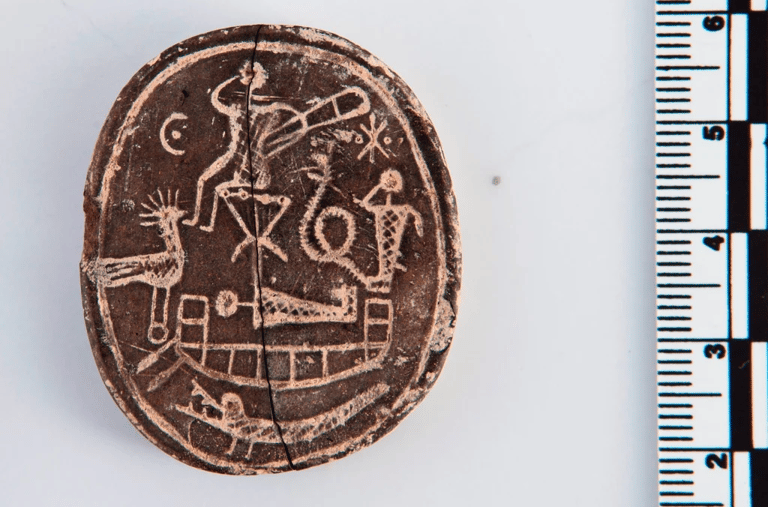
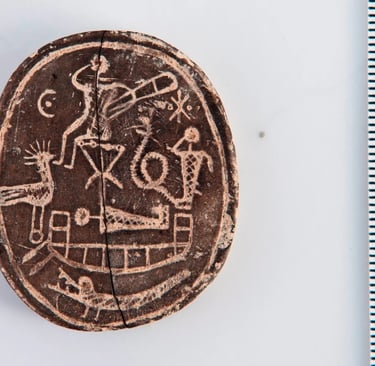
Front and back sides of the Nea Paphos token. The back side is a mix of Druid, Egyptian and Greek themes. It shows Herakles with his club among the heavens (star and snake representing fate, crescent moon representing the Druid goddess Ayu who controls the editing of the divine irrigation network streaming the fertility-fluids mentioned in the text). Below that is an Egyptian funeral boat ferrying a body. At the very bottom is the Egyptian crocodile protective god Sobek.
The Bog Land Context of Clonmacnois
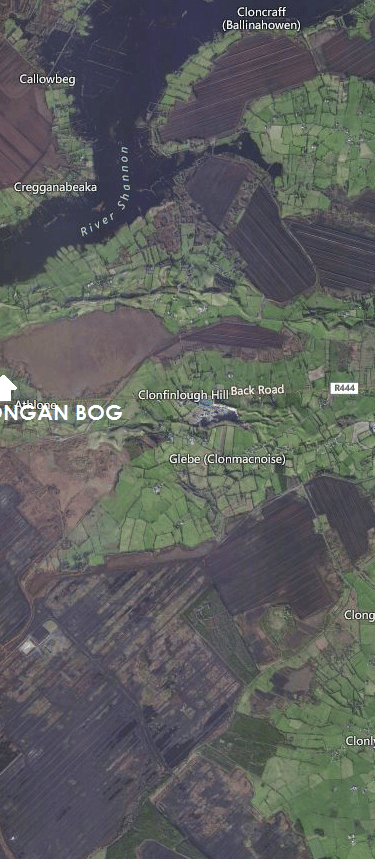
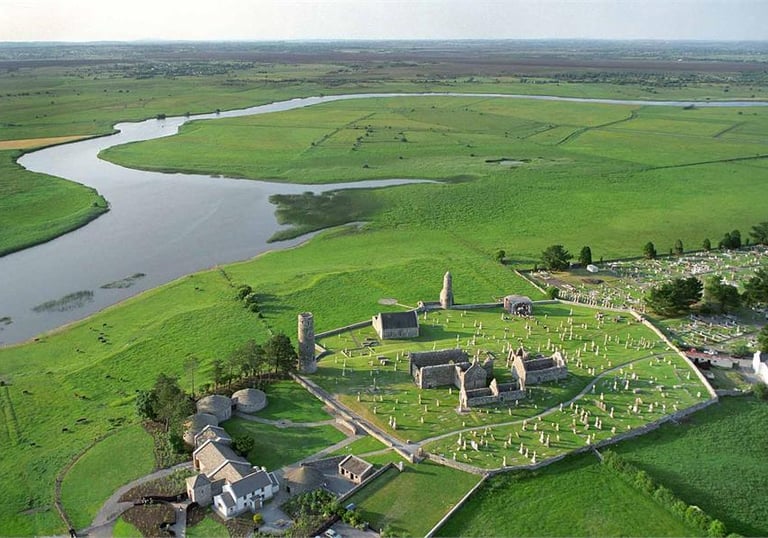
(April 1, 2026) This is the raised embankment called an esker which was left by a glacier and used to access Clonmacnois.
Ireland's move from a monastic framework to a diocesan one in the 1100's during the imposition of Norman control greatly diminished it wealth but not before a small Cathedral had been built. Still it contained a large amount more ancient stone architecture including 2 round Towers, 3 high crosses, 9 Churches and over 700 early Christian grave slabs and Anglo-Saxon Druid runestones.
These runestones were likely somewhat preserved because either they were used in the construction of one of the many monastic buildings or because the Druid astrology-magic crosses were mistaken for Christian crosses.
References
(April 1, 2026) Arial view of the center of Clonmacnois. Christian records indicate this monestary was founded around 550 CE by St Ciarán. Ciarán was the son of a craftsman. After completing his education, Ciarán became the founder of a small monastery on Hare Island in Lough Ree, before choosing the site of Clonmacnoise to establish another monastery.
A rivalry existed between the monasteries founded by the Celts represented by St. Patrick and those founded by the Anglo-Saxons such as Clonmacnois. A conflict occured in the year AD 764 between the communities of Clonmacnoise and the nearby Columban monastery of Durrow with over 200 men being killed. This was also echoed by writers such as Tírechán, who in around the year 700 CE complained that the community of Clonmacnoise forcibly held many churches that he claimed were founded by St Patrick.
Reference
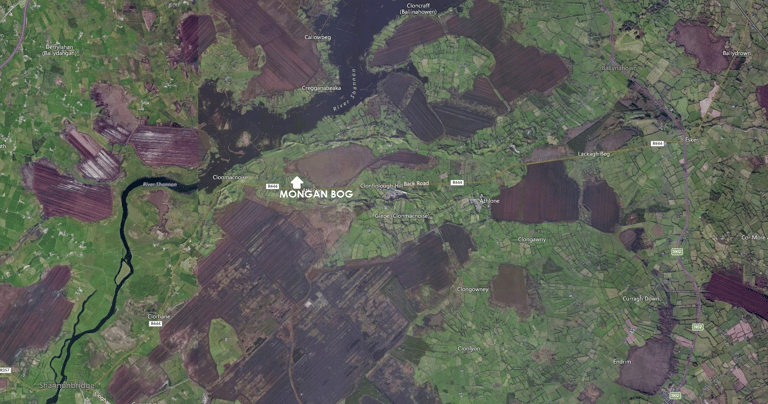
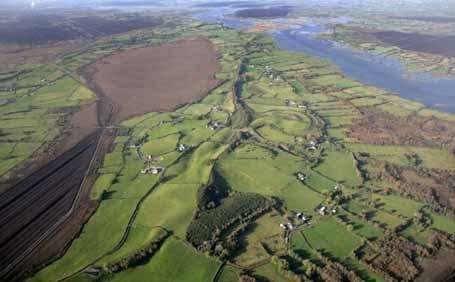
(April 1, 2026) Clonmacnois is located to the left of the Mongan bog in this arial view. Clonmacnois used to be surrounded by bogs, most of which today have been mined for peat. This leads to the ironic consequence that the few remaining natural Irish bogs have a higher elevation then the drained mined bogs.
The word "Clonmacnois" seems to be the Druid phrase K.L'.N.M.AK meaning the people "involved with fate-plans by revealing fertility-fluids with fate-owls." Fertility-fluids are the life powers which need to be distributed to the right places on earth for life to flourish. The runic texts below all fit this description.
A good number of stones have gone missing since they were first recorded during the 1800's. Macalister reports that this was due to theft by visitors and others, partly to the practice of burying a slab with its inherent sanctity in newly-made graves. Also a local reports he broke up many of the slabs for building materials. A number of stone fragments have been found by Mr. Molloy (of Clonmacnois National School) or his son, in the field walls in the neighborhood.
Reference
https://www.raisedbogs.ie/about-mongan-bog/
Macalister, R A Stewart. 1949. Corpus Inscriptionum Insularum Celticarum Volume 2. Online at: https://www.google.com/books/edition/Corpus_Inscriptionum_Insularum_Celticaru/4jgaAAAAYAAJ?hl=en
Rhine Style Clonmacnois Runestone 628 - Barony of Garrycastle, County of Offally, Ireland (~400 CE)
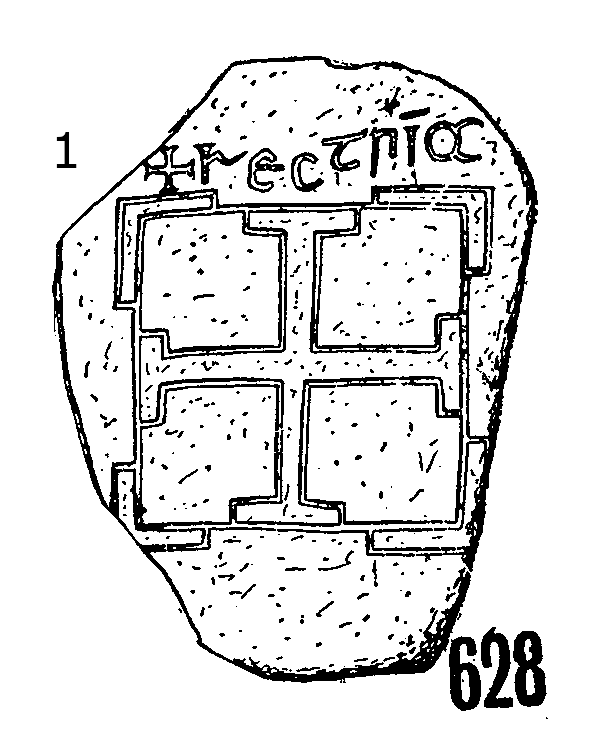
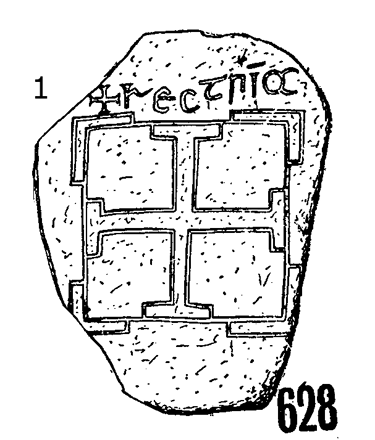
Background
Macalister reports that this stone was one of hundreds of fragments left behind after the 1552 destruction of this monastery by English soldiers garrisoned at Athlone during English King Henry VIII's war against Catholic monasteries after he split with Rome.
It measures 22 x 15 1/2 x 2 3/4 inches
Previously Attempted Translation
RECTNlA
No English translation provided
References
Macalister, R A Stewart. 1949. Corpus Inscriptionum Insularum Celticarum Volume 2, pages 43 and 46 with plate in the appendix. Online at: https://www.google.com/books/edition/Corpus_Inscriptionum_Insularum_Celticaru/4jgaAAAAYAAJ?hl=en
Translation in Druid Akkadian (Northern Text 210)
(March 30, 2026)
(read left to right. Capital letters on object. Small letters are inferred Inner vowels. Vowels are italic bold, Dual use letters are E/H, I/Y, U/W, and '/A in which vowel appears at beginning of words except for Yahu which is keeping its traditional Hebrew transliteration)
Runic letter style is Rhine-river from letter chart: North European Runic Lineage
Dictionary used: Latest Runic Akkadian dictionary
Tu Gu EKu. Tu Nu ISu
In English
Astrology-magic will energize starvation. Astrology-magic will reveal the Goddess
Comment: This text is against the use of astrology-magic (witchcraft). Because of this it would have been for using emotion magic to overcome drought and plague.
The Goddess represents 3 Druid goddesses: Ayu, Selu/Selene, and Kate/Hekate. Ayu was the crescent moon goddess who edited the connections of the life network which distributed life powers to earth. Selu was the celestial light goddess representing the heavenly bodies and define fate. Kate was the goddess of the underworld where souls where stored after death and before birth in the process of reincarnation.
The symbol is the archaic Druid runic letter "T" meaning "astrology-magic." This rune style for "T" is found in most of the Aegean rune styles. Notice how this same text transitions to its style of "T" in the rune 5th from the left.
Clonmacnois Runestone 651 - Barony of Garrycastle, County of Offally, Ireland (~400 CE)
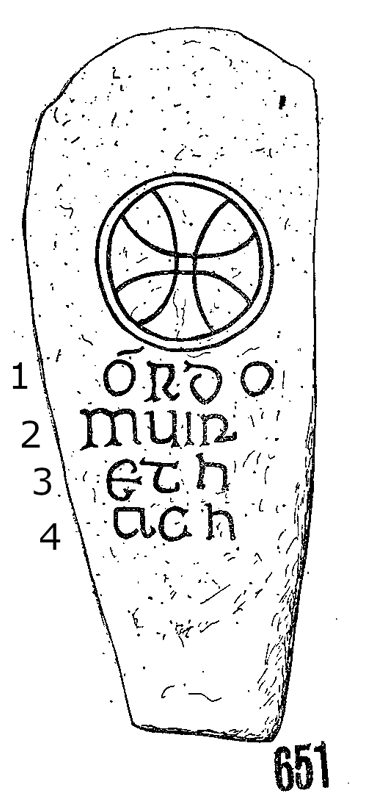
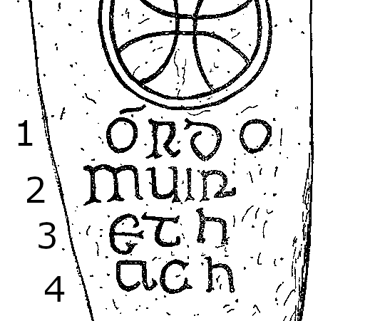
Background
Macalister reports that this stone was one of hundreds of fragments left behind after the 1552 destruction of this monastery by English soldiers garrisoned at Athlone during English King Henry VIII's war against Catholic monasteries after he split with Rome.
It measures 42 1/2" x 18' x 3 3/4"
Previously Attempted Translation
OR DO MUIRETHACH
No English translation provided
References
Macalister, R A Stewart. 1949. Corpus Inscriptionum Insularum Celticarum Volume 2, pages 43 and 48 with plate in the appendix. Online at: https://www.google.com/books/edition/Corpus_Inscriptionum_Insularum_Celticaru/4jgaAAAAYAAJ?hl=en
Translation in Druid Akkadian (Northern Text 285)
(April 23, 2026)
(read left to right. Capital letters on object. Small letters are inferred Inner vowels. Vowels are italic bold, Dual use letters are E/H, I/Y, U/W, and '/A in which vowel appears at beginning of words except for Yahu which is keeping its traditional Hebrew transliteration)
Runic letter style is Rhine-river from letter chart: North European Runic Lineage
Dictionary used: Latest Runic Akkadian dictionary
ARu Di'u
Mu Wa IRu
E Tu Nu
AKu Nu
In English
Control the divine-motion-powers
Fertility-fluids can restrict the astrological-fate-powers
Disable astrology-magic's revelations
The fate-owls have been revealed.
Comment: This text is promoting the life powers and it against the motion powers which are behind all magic (emotion magic and astrology-magic.). The Druid gods gods which are also Christian gods (Alu/Alohim and Yahu/Yahweh) are life powers.
The symbol is the archaic Druid letter "T" meaning "astrology-magic." The cross is the same style as that found in Celtic stone 519 above.
Clonmacnois Runestone 658 - Barony of Garrycastle, County of Offally, Ireland (500 CE)
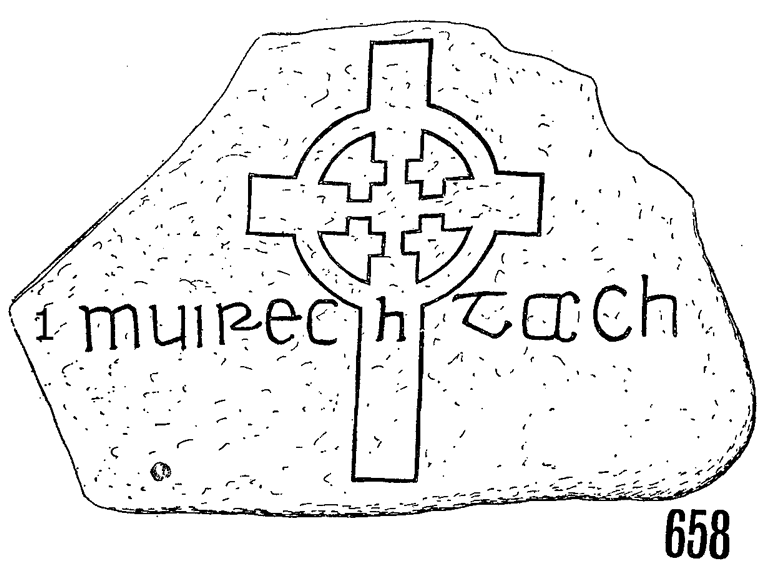
Background
(April 2, 2026) Macalister reports that this stone was one of hundreds of fragments left behind after the 1552 destruction of this monastery by English soldiers garrisoned at Athlone during English King Henry VIII's war against Catholic monasteries after he split with Rome.
It measures 25 x 33 x 4 1/2 inches
Previously Attempted Translation
MUIRECHTACH
No English translation provided
References
Macalister, R A Stewart. 1949. Corpus Inscriptionum Insularum Celticarum Volume 2, pages 43 and 49 with plate in the appendix. Online at: https://www.google.com/books/edition/Corpus_Inscriptionum_Insularum_Celticaru/4jgaAAAAYAAJ?hl=en
Translation in Druid Akkadian (Northern Text 233)
(April 2, 2026)
(read left to right. Capital letters on object. Small letters are inferred Inner vowels. Vowels are italic bold, Dual use letters are E/H, I/Y, U/W, and '/A in which vowel appears at beginning of words except for Yahu which is keeping its traditional Hebrew transliteration)
Runic letter style is Rhine-river from letter chart: North European Runic Lineage
Dictionary used: Latest Runic Akkadian dictionary
Mu Wa IRu EKu Ḫu. Tu Su Ku Ḫu
In English
Fertility-fluids can restrict the astrological-fate-powers from starving Hu. The astrology-magic of Su can involve Hu.
Comment: Hu is the life power god of sun and storm who also represents the divine irrigation network which distributes the life powers to earth. Su is the dark new moon god who powers the fate shifting of astrology magic. This text is saying fate shifting can affect Hu.
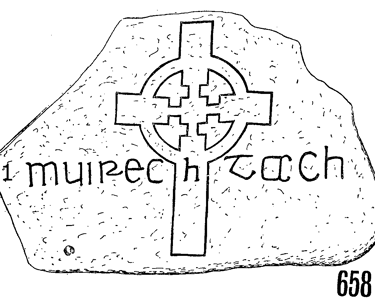
This is the classic Celtic cross. It represents the mixing of Druidry and Christianity, specifically the mix of astrology-magic (witchcraft), a motion power, with the life powers promoted by Christianity.
Clonmacnois Runestone 717 - Barony of Garrycastle, County of Offally, Ireland (500 CE)
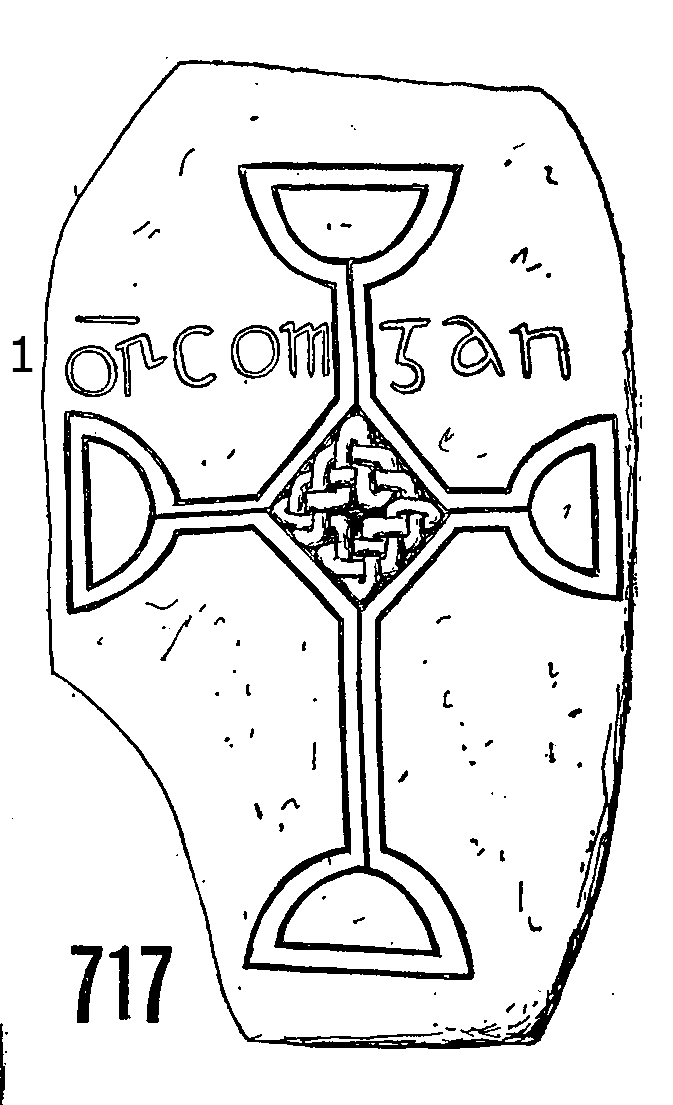
Background
(May 3, 2026) Macalister reports that this stone was one of hundreds of fragments left behind after the 1552 destruction of this monastery by English soldiers garrisoned at Athlone during English King Henry VIII's war against Catholic monasteries after he split with Rome.
Its dimensions are 39 x 21 x 4 1/2 inches
Previously Attempted Translation
OR COMGAN
English translation
(none provided)
References
Macalister, R A Stewart. 1949. Corpus Inscriptionum Insularum Celticarum Volume 2, pages 43 and 55 with plate in the appendix. Online at: https://www.google.com/books/edition/Corpus_Inscriptionum_Insularum_Celticaru/4jgaAAAAYAAJ?hl=en
Translation in Druid Akkadian (Northern Text 305)
(read left to right. Capital letters on object. Small letters are inferred Inner vowels. Vowels are italic bold, Dual use letters are E/H, I/Y, U/W, and '/A in which vowel appears at beginning of words except for Yahu which is keeping its traditional Hebrew transliteration)
Runic letter style is Rhine-river from letter chart: North European Runic Lineage
Dictionary used: Latest Runic Akkadian dictionary
ARu Ka'u Mu Ṭu ANu
In English
Control the prodding of the fertility-fluids with Thu's considerations (focused emotions also used in emotion magic).
Comment: This text is promoting emotion magic to influence the movement of the fertility-fluids. Thu is the genderless deity associated with emotion magic. Considerations are the focused emotion used in emotion magic. Druidry always had groups promoting emotion magic over astrology-magic. This emotion magic groups would eventually win out over the astrology-magic (witchcraft) group in early Christianity before it was itself persecuted.
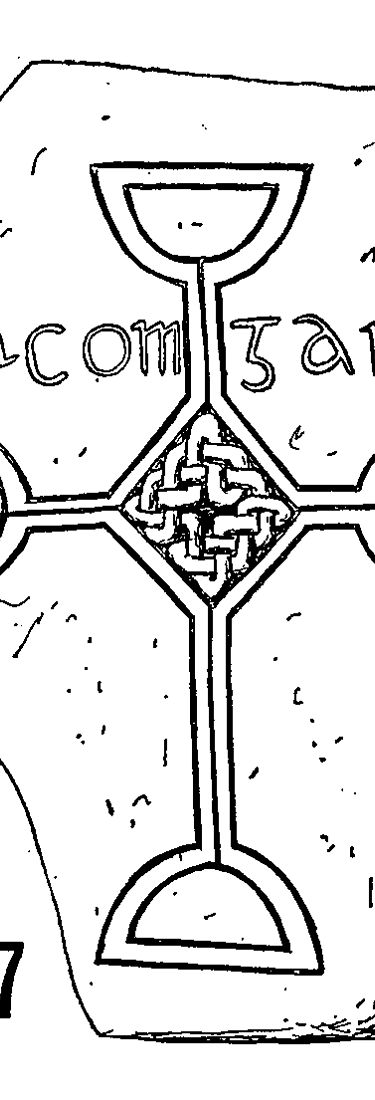
This Celtic cross shows an image of the divine irrigation network in its center. This network distributes fertility-fluids (life powers) to earth which in turn trigger Yahu to manifest life forms. This network will eventually be represented more abstractly as the curvilinear La Tene material tradition permeates Ireland.
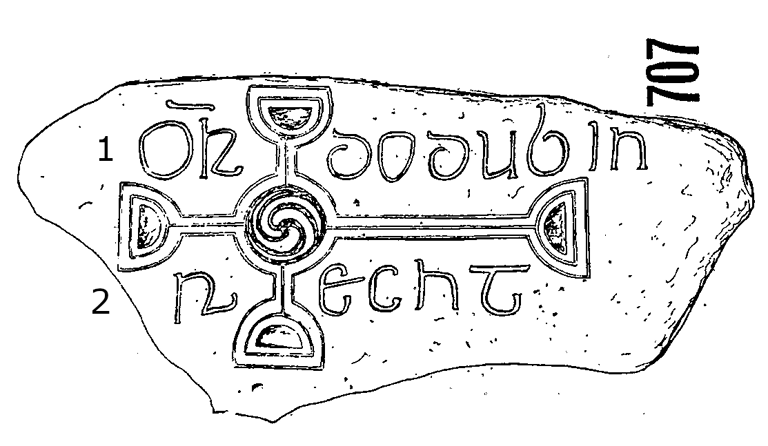
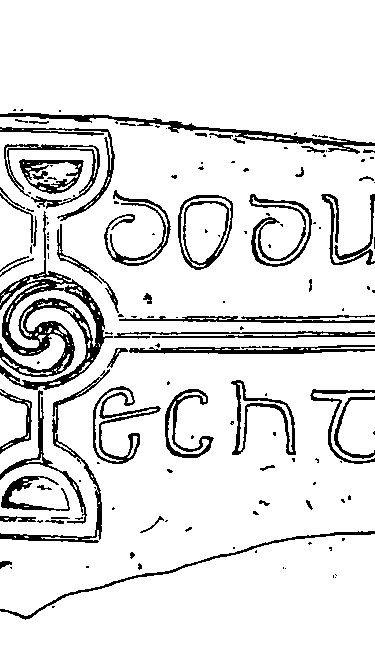
Clonmacnois Runestone 707 - Barony of Garrycastle, County of Offally, Ireland (500 CE)
Background
Macalister reports that this stone was one of hundreds of fragments left behind after the 1552 destruction of this monastery by English soldiers garrisoned at Athlone during English King Henry VIII's war against Catholic monasteries after he split with Rome.
Its dimensions are 36 x 20 1/2 x 4 inches
Previously Attempted Translation
OR DO DUBINRECHT
English translation
(none provided)
References
Macalister, R A Stewart. 1949. Corpus Inscriptionum Insularum Celticarum Volume 2, pages 43 and 54 with plate in the appendix. Online at: https://www.google.com/books/edition/Corpus_Inscriptionum_Insularum_Celticaru/4jgaAAAAYAAJ?hl=en
Translation in Druid Akkadian (Northern Text 300)
(May 3, 2026)
(read left to right. Capital letters on object. Small letters are inferred Inner vowels. Vowels are italic bold, Dual use letters are E/H, I/Y, U/W, and '/A in which vowel appears at beginning of words except for Yahu which is keeping its traditional Hebrew transliteration)
Runic letter style is Rhine-river from letter chart: North European Runic Lineage
Dictionary used: Latest Runic Akkadian dictionary
ARu Di'u Du Wa Bu INu
Ru EKu Nu Tu
In English
Controlling the divine-motion-powers will restrict nourishing the Moon-eye (Su)
Griffons can starve the revelations of astrology-magic.
Comment: This text is against using astrology magic (witchcraft) which is powered by the dark new moon god Su. Griffons are a life power which edit the divine irrigation network under the control of emotion magic or the crescent moon goddess Ayu (a life powers).
This cross has the emotion power spiral instead of the network in its center. Its text is promoting both emotion magic and the life powers and is against astrology-magic.
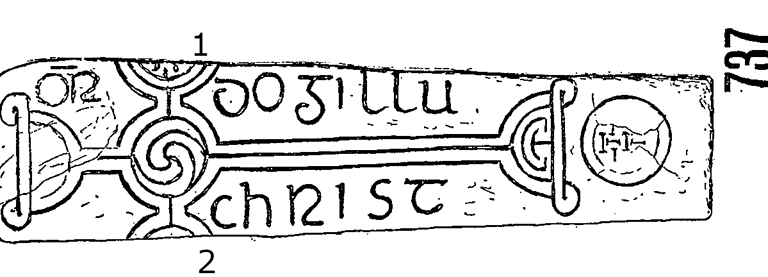
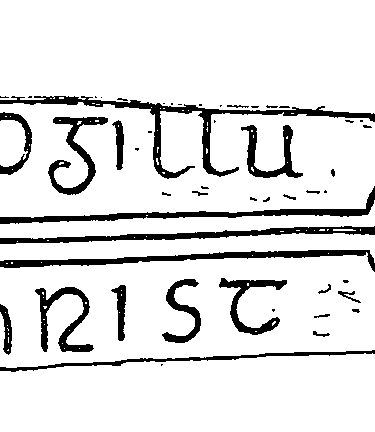
The Christ Runestone 737 at Clonmacnois - Barony of Garrycastle, County of Offally, Ireland
Background
(April 25, 2026) Macalister reports that this stone was one of hundreds of fragments left behind after the 1552 destruction of this monastery by English soldiers garrisoned at Athlone during English King Henry VIII's war against Catholic monasteries after he split with Rome.
This important stone is now found built into a niche in the surrounding wall at the Eastern end of the cemetery.
Its dimensions are 40 x 15 inches
Previously Attempted Translation
[OR] DO GILLU-CHRIST.
English translation
(none provided)
References
Macalister, R A Stewart. 1949. Corpus Inscriptionum Insularum Celticarum Volume 2, pages 43 and 57 with plate in the appendix. Online at: https://www.google.com/books/edition/Corpus_Inscriptionum_Insularum_Celticaru/4jgaAAAAYAAJ?hl=en
Translation in Druid Akkadian (Northern Text 309)
(read left to right. Capital letters on object. Small letters are inferred Inner vowels. Vowels are italic bold, Dual use letters are E/H, I/Y, U/W, and '/A in which vowel appears at beginning of words except for Yahu which is keeping its traditional Hebrew transliteration)
Runic letter style is Rhine-river from letter chart: North European Runic Lineage
Dictionary used: Latest Runic Akkadian dictionary
Di'u Ṭu ILu LiWu ("OR" in the drawing is a guess)
[Latin letters] Christ
In English
The Divine-motion-powers of Thu can elevate the love of
Christ
Comment: Line 1 is Druid Akkadian while line 2 is Latin. Thu is the genderless god associated with the powers of emotions so it would be associated with love just like the Christian Christ.
This important stone shows the transition to Christianity. Its text has Druid emotion magic supporting the "love of Christ."
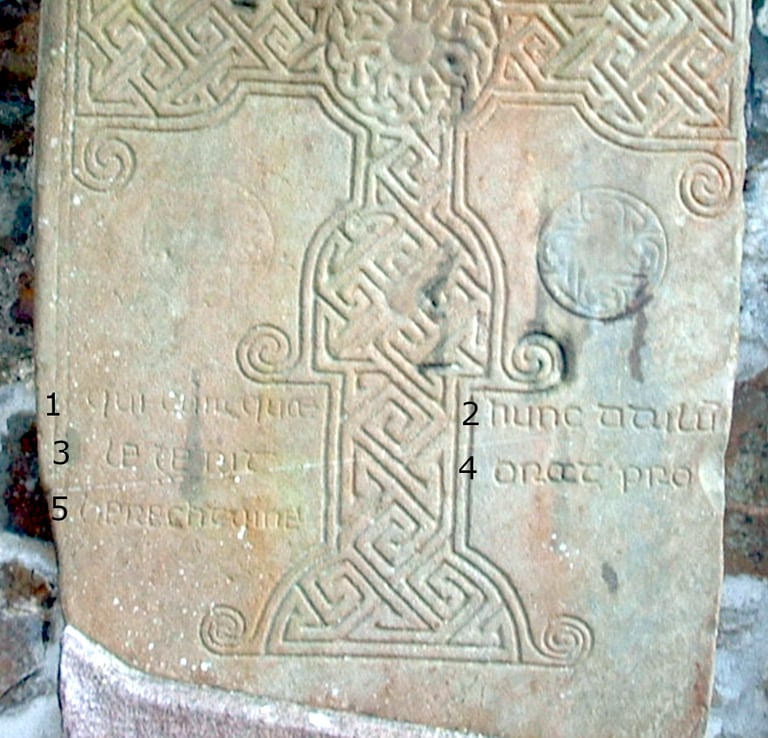
Tulleylease Runestone 908 - Barony of Duhallow, County Cork, Ireland
Background
(April 28, 2026) Macalister reports that this stone is now in the national museum.
The stone is 3' x 2'
Previously Attempted Translation
QUICUMQUAE HUNC TITULUm LEGERIT ORAT PRO
BERECHTUINE
English translation
(none provided)
References
Macalister, R A Stewart. 1949. Corpus Inscriptionum Insularum Celticarum Volume 2, pages 92. Online at: https://www.google.com/books/edition/Corpus_Inscriptionum_Insularum_Celticaru/4jgaAAAAYAAJ?hl=en
Translation in Druid Akkadian (Northern Text 331)
(read left to right. Capital letters on object. Small letters are inferred Inner vowels. Vowels are italic bold, Dual use letters are E/H, I/Y, U/W, and '/A in which vowel appears at beginning of words except for Yahu which is keeping its traditional Hebrew transliteration)
Runic letter style is Rhine-river from letter chart: North European Runic Lineage
Dictionary used: Latest Runic Akkadian dictionary
Wa UYa. Ku UMu Wa USu E.
Nu WaNu Ku. DiDu IKu Wa
Lu E. Tu ERu ITu
ARu Su Tu Pu Re'u
ARu Ru EKu Nu. Tu Wa Ya N E
In English
Restrict the fate-curses. Involving the storm powers (a life power) will restrict the traditional disablements.
Fate-revelations can be stubborn about the involvement (of life based storm powers). Prostituting the divine-irrigation network should be resisted.
The lack (of fate revelations) is from disablements. Astrology-magic (witchcraft) can harbor the omens.
The control of Su's astrology-magic can be opened by shepherd-priests (witches).
Controlling the griffons (life power) can starve the fate-revelations. Astrology-magic cannot restrict the fate-revelation's disablement.
Comment: This text is promoting astrology-magic (witchcraft) to control fate instead of the rituals involving the life powers, specifically the rituals involved in bringing rain (storm powers). Astrology-magic shifts fate by cursing some sort of scapegoat.
The stone as it existed in 2021.
Photo by Fiona Edmonds from https://impactmap.cam.ac.uk/increasing-awareness-of-linguistic-and-cultural-heritage-in-britain-and-ireland/
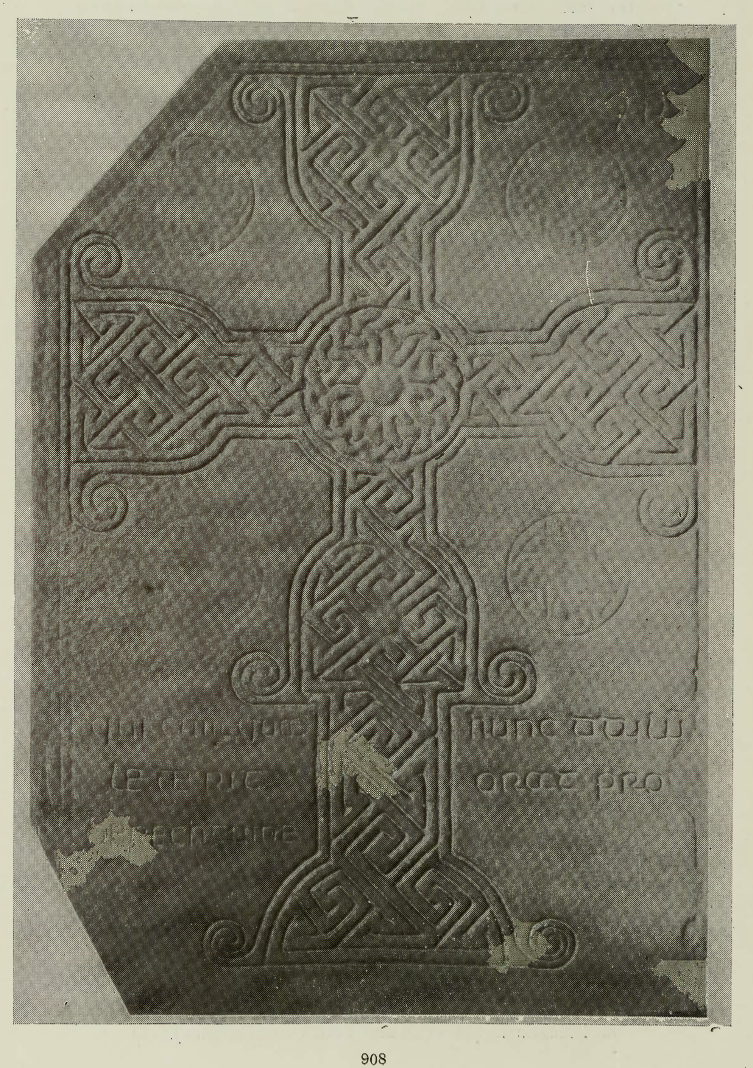
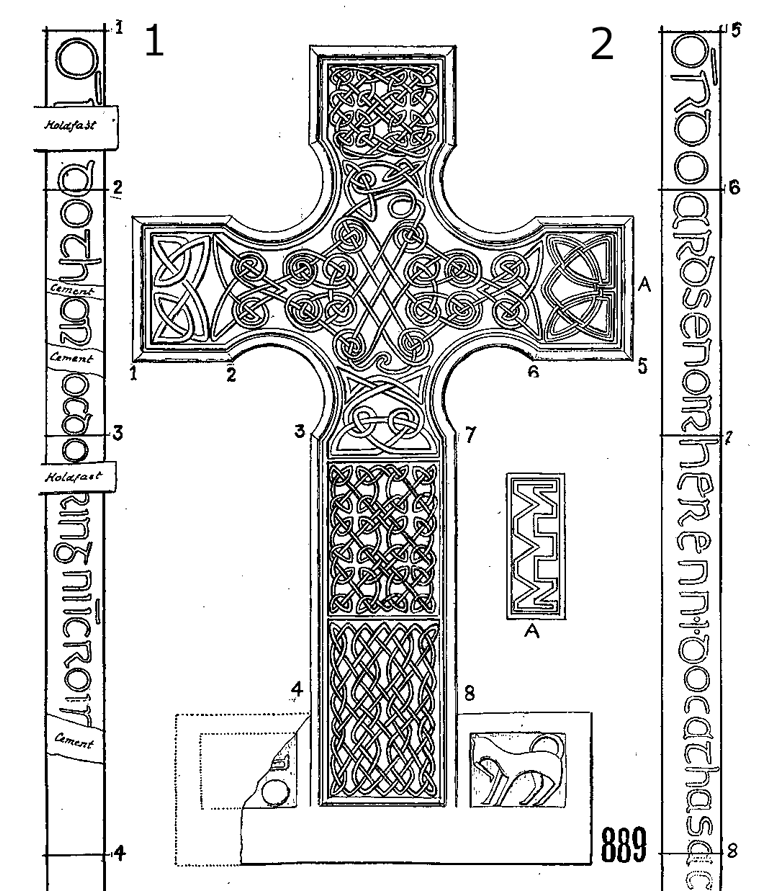
The stone from Macalister (1949) shows a decorative form of the divine irrigation network filling up the cross. Notice the many Druid spirals representing clusters of motion powers (spiritual powers) which push the fertility-fluids (life powers) through the network. This decorative style would become characteristic of early Christian codices produced by the monistaries.
Iniscealtra Runestone 889 - Barony of Tulla Upper, County Clare, Ireland
Background
(April 27, 2026) Macalister reports that this stone is located on a small island in the river Shannon. Specifically Inis Cealtra lies in Scariff Bay, an inlet of Loch Derg on the Shannon.
Christian records indicate that around 520 a monastery was founded on the island by St. Colum (d. 548). A 2nd monastery, which became noted for its learning, was founded by St. Caimin (d. 653), who was Bishop-Abbot of Inis Cealtra. Vikings first raided the island in 836 led by Turgesius which led to the death of many monks.
The Viking raid caused a tall round tower to be built but it was never finished. This led to the legend that a beautiful witch distracted the stonemason.
The cross is 5' 1 1/2" high, 3' 1" wide, and 3" thick.
Previously Attempted Translation
OR DO AEDSENOIR ERENN .i. DO CATHASACH
OR DO THOR[N]OC DO RINGNI In CROIS
English translation
A prayer for the Chief Elder of Ireland
A prayer for Tornoc who made the cross
References
Macalister, R A Stewart. 1949. Corpus Inscriptionum Insularum Celticarum Volume 2, pages 89 with plate in the appendix. Online at: https://www.google.com/books/edition/Corpus_Inscriptionum_Insularum_Celticaru/4jgaAAAAYAAJ?hl=en
Translation in Druid Akkadian (Northern Text 319)
(read left to right. Capital letters on object. Small letters are inferred Inner vowels. Vowels are italic bold, Dual use letters are E/H, I/Y, U/W, and '/A in which vowel appears at beginning of words except for Yahu which is keeping its traditional Hebrew transliteration)
Runic letter style is Rhine-river from letter chart: North European Runic Lineage
Dictionary used: Latest Runic Akkadian dictionary
A[R]u Di'u. Tu Ne'u Re'u. Ku Du Ru. INu ṬeNu Ya IKu. Re'u IŠu
ARu Di'u. SeRu Du Zu E Ne'u. IRu Nu ERu. ENu Nu Ya. Di'u Ku Su. Tu Nu Ku [1]
In English
Control the divine-motion-powers. Astrology-magic (witchcraft) can emotionally-affect the shepherd-priests (witches). Involvement will manifest the griffons. The Moon-eye (Su) will not grind-down the divine-irrigation-network. The shepherd-priests are confused.
Control the divine-motion-powers. Death-warnings can manifest the emanation's disablement of emotional-effects. Astrological-fate-powers will reveal the divine-harbor. Reassignments are not being revealed. The divine-motion-powers will involve Su. Astrology-magic will reveal the involvement of [word].
Comment: Line 1 of this text is reminding the readers that the emotion magic used by the shepherd-priests (witches) to shift fate curses will circle around and affect them as well. This is the "law of return" or "law of attraction." The emanations of line 2 refer to the fate powers coming from the heavenly bodies. This text is claiming this will disable the emotions of emotion magic and not reveal the state of the high life powers (the divine harbor).
This cross shows 3 layers of the divine irrigation network on its front face representing the life power source (Alu), connective network (Hu and Ayu), and manifestations (Yahu). One side of the base shows a cat which in this context would be associated with witches.
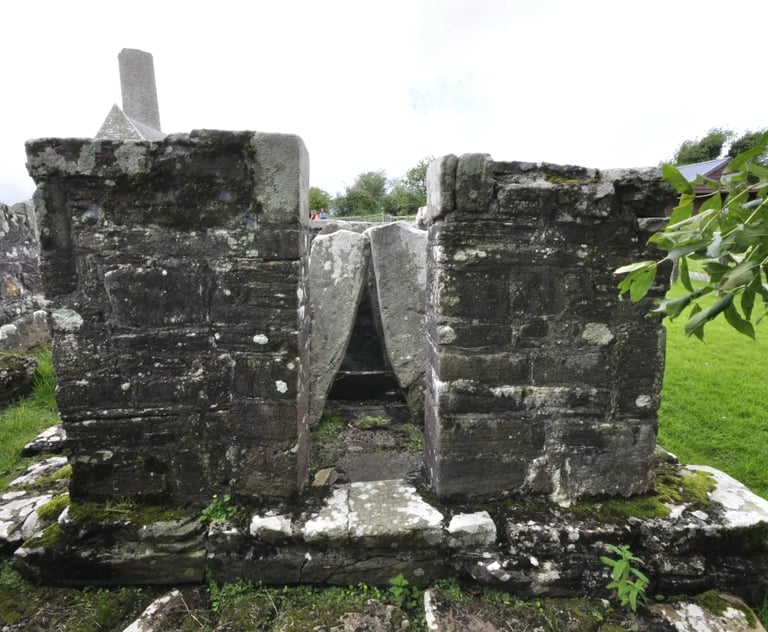
Inis Cealtra was a Druid holy site before being taken over by the Christians. This is the remains of an earlier monolith building now called "The Confessional." Notice the large leaning stone slabs behind the towers. The towers themselves are made of large stones of various sizes, much larger and more varied than what is found on early Christian buildings.
Also surviving on the site is a Druid altar now called "The Bargaining Stone" and the remains of a sacred well now called simply the "Holy Well."
Inis Cealtra today. Photo from https://rotharroutes.com/2020/08/02/inis-cealtra-holy-island/
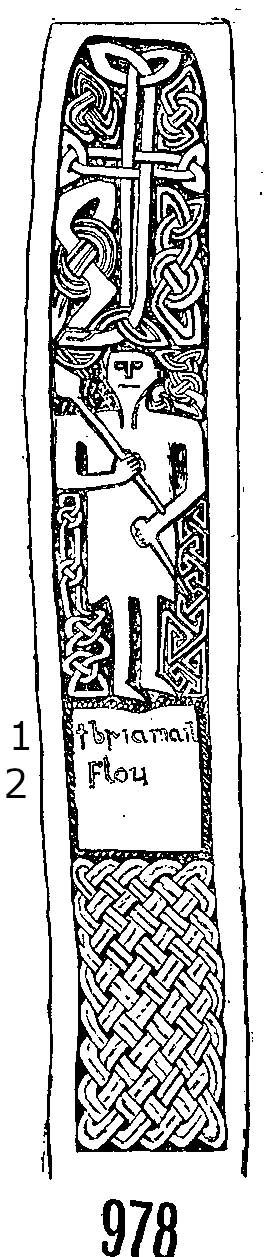
Llandefaelog Fach Runestone 978 - County Brecan, Wales
Background
(April 7, 2026) Macalister reports that this stone is now standing against the Penoyre vault in the churchyard.
Its dimensions are: 7' 7 1/2" x 1' 3 1/2" x 0' 4".
The Druid cross here represents the flow of the life powers to earth as guided by fate. It is not a Christian cross.
References
Macalister, R A Stewart. 1945. Corpus Inscriptionum Insularum Celticarum Volume 2, page 133 with plate in the appendix. Online at: https://www.google.com/books/edition/Corpus_Inscriptionum_Insularum_Celticaru/4jgaAAAAYAAJ?hl=en
Translation in Druid Akkadian (Northern Text 248)
(read left to right. Capital letters on object. Small letters are inferred Inner vowels. Vowels are italic bold, Dual use letters are E/H, I/Y, U/W, and '/A in which vowel appears at beginning of words except for Yahu which is keeping its traditional Hebrew transliteration)
Runic letter style is Rhine-river from letter chart: North European Runic Lineage
Dictionary used: Latest Runic Akkadian dictionary
Bu PaYu. AMu AYu Lu
Ṣu Le'u Wa
In English
Nourish the network-birds. The Reed-boat Ayu is lacking.
Activating fate will cause restrictions.
Comment: The divine irrigation network which distributes the life powers to earth is edited by the griffons/eagle-vultures under the control of either emotion magic or by the crescent moon goddess Ayu. The text is saying to intervene with the life powers instead of with the motion powers of fate as generated by the heavenly bodies.
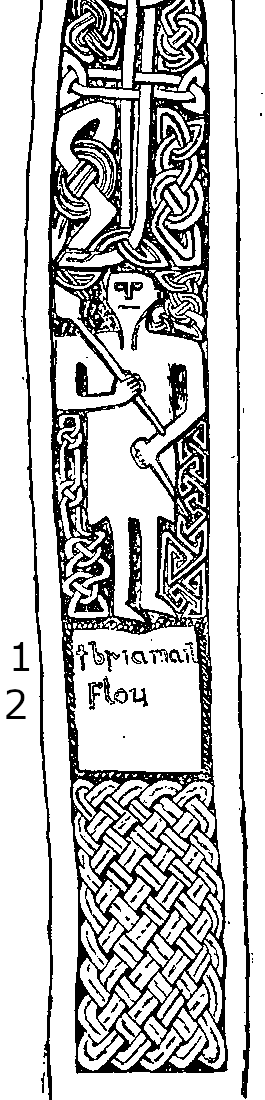
The warrior on the stone seems to represent the warning not to do astrology-magic. The cross is integrated in with the divine irrigation network.
Previously Attempted Translation
+ BRIAMAIL FLOU
No English translation provided.
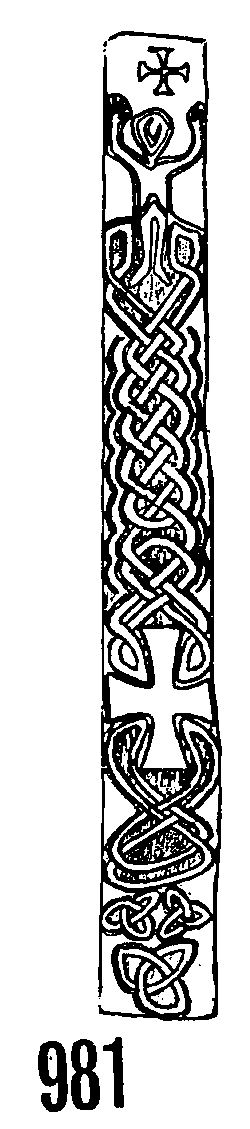
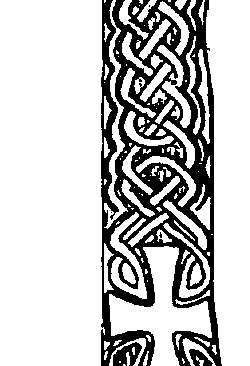
The Llanfyrnach stone is similar although it does not have runes. It does have 2 Druid astrology-magic (witchcraft) signs.
Macalister, R A Stewart. 1945. Corpus Inscriptionum Insularum Celticarum Volume 2, page 135 with plate in the appendix. Online at: https://www.google.com/books/edition/Corpus_Inscriptionum_Insularum_Celticaru/4jgaAAAAYAAJ?hl=en
© 2022-2026. By David D. Olmsted. All pages licensed under a Creative Commons Attribution-NonCommercial-ShareAlike 4.0 International Copyright. https://creativecommons.org/licenses/by-nc-sa/4.0/